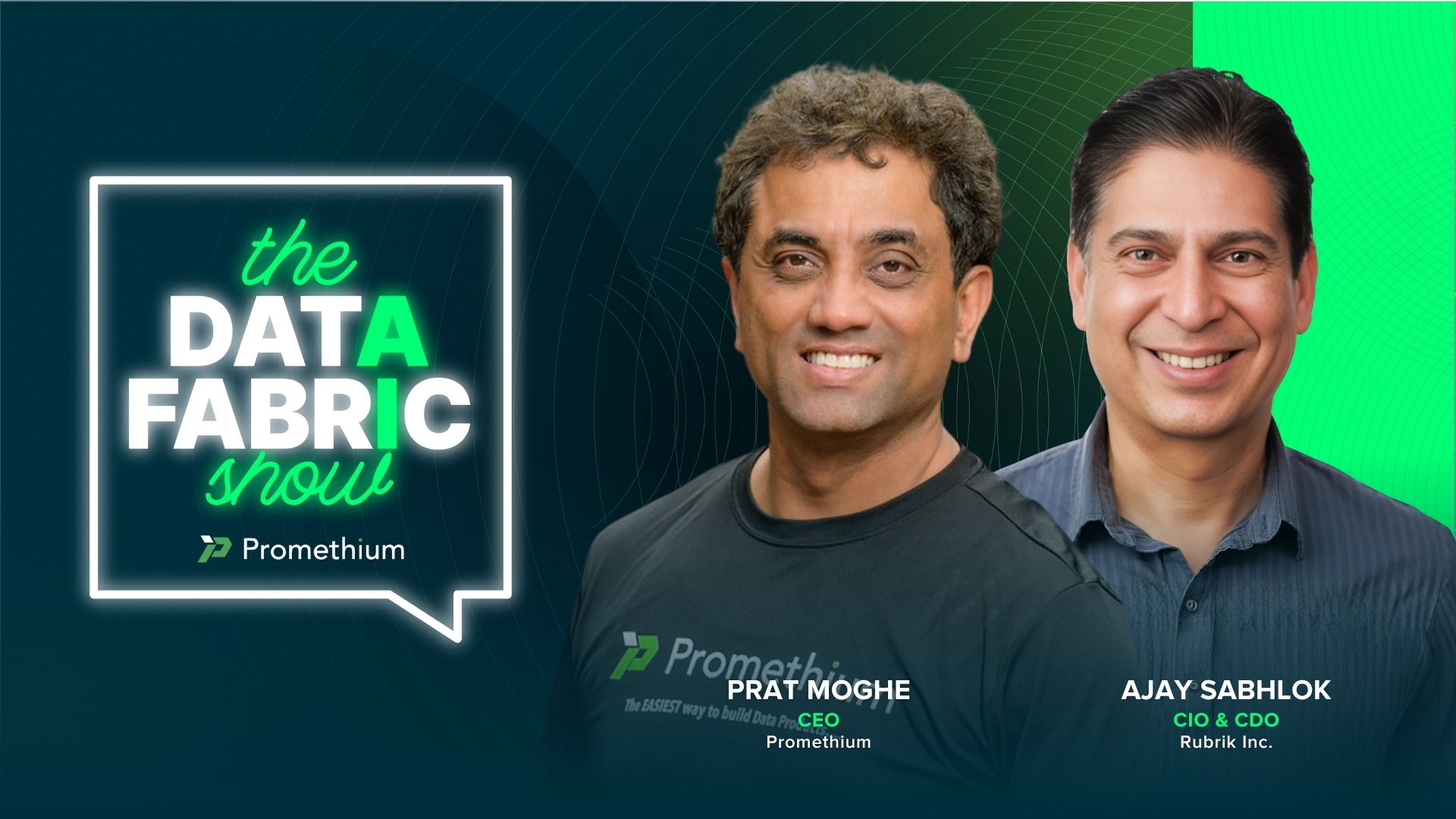
The latest episode of the AI Data Fabric Show is now live, featuring Ajay Sabhlok, CIO and CDO at Rubrik. Ajay’s journey from consultant to CXO across companies like VMware and Rubrik offers a masterclass in leadership and execution.
In this episode, he shares how:
Leading with architecture creates the foundation for scale and resilience.
Engaging the full C-suite turns buy-in into genuine championship for key initiatives.
Practicing servant leadership empowers teams and drives lasting impact.
Listen to the full conversation with Ajay Sabhlok on The AI Data Fabric Show (or click here to listen on Spotify or Apple Podcast). The full transcript of the episode is available below.
Full Transcript of the Episode
The AI Data Fabric Show
Guest: Ajay Sabhlok, CIO & CDO at Rubrik
Host: Prat Moghe, CEO of Promethium
Prat:
Welcome everyone to another episode of The AI Data Fabric Show. I’m your host, Prat Moghe from Promethium, and I’m thrilled to have with me today Ajay Sabhlok — CIO and CISO at the fast-growing company Rubrik. Ajay, welcome to the show!
Ajay:
Thank you, Prat. Excited to be here and looking forward to the conversation.
Prat:
Fantastic. I’m joining from Boston and Ajay’s in the Bay Area. When I looked at your background, Ajay, I was really impressed by the range of experiences you’ve had — from hands-on data work and consulting to IT leadership through multiple waves of transformation.
You’ve built data warehouses, led Siebel and Salesforce transformations, and now scaled Rubrik through its IPO. Can you take us through your journey — where you grew up, some of your early influences, and the key milestones that shaped your career?
Early Career: From Mumbai Engineer to Building Data Warehouses
Ajay:
Sure. I grew up in Mumbai, which was the only city I knew for most of my early life until I left for engineering college. After graduating, I joined Tata in Mumbai, and my first overseas project was with a retailer in California.
That was my first exposure to building applications from the ground up — back in the days before SaaS or even mature on-prem apps. You had to assemble every component yourself — networking, interfaces, hardware, software — everything.
I loved coding. I wrote device drivers, voice card software, all kinds of systems-level code. That hands-on experience later led me to Oracle Engineering, and then into the world of pre-built enterprise applications like Siebel.
Transition to Siebel and Solution Architecture
Ajay:
What fascinated me about Siebel was the concept of pre-built applications — software you could take out of the box and then tailor for your needs instead of building from scratch.
That approach of leveraging and customizing rather than reinventing really appealed to me. It saved time and enabled consistency. But I also learned that success depended heavily on discovery and execution discipline — understanding what users really needed, defining blueprints clearly, and then executing with a strong, collaborative team.
The tools and methodologies evolved — from waterfall to agile — but the fundamentals of success remained the same: clear goals, communication, collaboration, and accountability.
Stepping into IT Leadership at Mercury Interactive
Prat:
That’s a big shift — from consulting to IT leadership. What motivated that move?
Ajay:
While consulting for Mercury Interactive, I helped them achieve CRM excellence using Siebel. During that process, the company offered me the opportunity to lead CRM internally — to run it end-to-end, not just advise.
That was a turning point. As a consultant, you influence a piece of the puzzle. As a leader, you own the entire lifecycle — design, build, production, and support — across global operations. It was an incredible learning experience in managing scale, stakeholders, and outcomes.
Lessons from Failure and Managing Change
Prat:
You’ve shown unusual longevity in your roles — that’s rare, especially in high-growth environments. Was there an early challenge or failure that shaped how you lead through change?
Ajay:
Absolutely. Every role brought challenges. When I joined Logitech in 2007, the team expected me to continue with Siebel. Instead, I proposed moving to Salesforce.
Even though I came from an on-prem background, I saw the potential of true multi-tenant SaaS. Siebel’s hosted model was still single-tenant, requiring constant maintenance. Salesforce’s model — one scalable architecture serving all customers — was revolutionary.
We implemented Salesforce at Logitech and achieved in two to three months what used to take a year. It was a revelation: cloud-native applications could deliver agility, performance, and reduced overhead at scale.
Leading with Architecture at VMware
Ajay:
When I joined VMware, the first challenge was rolling out a global customer support system. VMware wanted to move from Siebel to Salesforce Service Cloud — but Salesforce had never hosted an enterprise customer of that size.
So, we did something unusual — we performance-tested Salesforce. Vendors said, “Nobody performance-tests SaaS systems.” I said, “We’re VMware — we have to.”
We ran large-scale performance and resilience tests, discovered telecom-related bottlenecks, worked with Salesforce to address gaps, and built a custom portal on top. The result was a highly successful rollout that our support engineers loved.
That experience reinforced my belief in comprehensive thinking — anticipating how things can fail, testing assumptions, and leading with architecture.
Embedding Architecture as the Foundation at Rubrik
Prat:
You’ve mentioned that you lead with architecture. How did that shape your approach at Rubrik?
Ajay:
When I joined Rubrik, I had a blank slate. One of the first things I did was embed architecture as the foundation — not as a complementary function.
At VMware, architecture was often treated as an add-on. At Rubrik, I made it the gatekeeper for every decision — tools, processes, data flow, and resilience.
We question everything: the tech, the integrations, the data exchange, and especially resilience. As a cybersecurity company, resilience isn’t optional — it’s core to who we are.
Building IT Teams from 2 People to IPO Scale
Prat:
When you joined Rubrik, it was about 700 employees. How did you scale IT to support a public company?
Ajay:
It was a journey. Early on, IT was fragmented — different teams buying tools independently, solving point problems. We centralized everything, applied architecture discipline, and built around key pillars: applications, data, and security.
We declared a cloud-only architecture — no on-prem business apps — and adopted Snowflake early to become a data-driven company. That decision paid off.
With Snowflake, we gained scalability, real-time analytics, and near-instant KPI visibility. Our CEO championed this top-down, which made adoption across teams much faster. When executives embrace data-driven decision-making, it becomes part of the company culture.
The Project Review Board: Centralizing IT Decisions
Prat:
You’ve mentioned a Project Review Board. How does that work?
Ajay:
We introduced the Project Review Board (PRB) early on — a concept I brought from VMware. It’s a quarterly forum where all enterprise software and IT investments are reviewed and approved.
The board includes the CFO, CRO, Head of Engineering, Chief Customer Officer, and co-founder. Every proposal goes through ROI and security review.
This structure eliminates shadow IT and tool sprawl. It also strengthens accountability. All software budgets roll up through me, ensuring consistency, security, and architectural integrity.
A great example: our sales team wanted to implement territory management three years before we were ready. The CRO held off until we reached operational maturity — then greenlit it this year when scale justified the investment. That discipline comes from the PRB model.
Lessons for CIOs: Servant Leadership and Change
Prat:
You’ve led major transformations. What advice would you give other CIOs and COOs?
Ajay:
We’re in an era of rapid change — AI, data resilience, multi-cloud — so adaptability is key.
My advice:
Stay engaged and connected with your teams.
Build passionate, collaborative talent.
Lead with servant leadership — be accessible, supportive, and empowering.
Your teams often hold the answers — you just have to unlock their potential. That’s how you create a resilient, innovative organization.
Mentors Who Shaped Ajay’s Leadership
Prat:
Are there any mentors or leaders who influenced your approach?
Ajay:
Yes, several.
Avon Puri, Rubrik’s first CIO and now Chief Data & Digital Officer at Sequoia, taught me a lot about scaling technology and keeping a learning mindset.
Mark Egan, CIO at VMware, was instrumental in shaping my leadership foundation.
Bill Hui, another VMware leader, influenced my thinking on execution excellence and collaboration.
Their mentorship helped me develop the mindset I still apply today — leading with architecture, clarity, and empathy.
Prat:
That’s fantastic, Ajay. Thank you for sharing your journey and insights. It’s been great having you on The AI Data Fabric Show, and we’re excited to see Rubrik continue to scale.
Ajay:
Thank you, Prat. It’s been a pleasure.
SHARE THIS: