Enterprise data strategy stands at a crossroads. As AI demands real-time access to trusted data and business users expect instant insights, traditional approaches are failing. Organizations are turning to data fabric architectures — but the choice between open and closed approaches will define your data strategy for years to come. The data integration market is experiencing explosive growth, projected to reach $18.71 billion by 2029 with a CAGR of 9.20%, underscoring the increasing reliance on data to drive decision-making and highlighting the critical importance of choosing the right platform architecture.
This comprehensive guide examines Microsoft Fabric alternatives through the lens of architectural philosophy, business impact, and strategic flexibility. Whether you’re evaluating initial platforms or considering migration, understanding these fundamental differences is critical for enterprise success in an AI-driven future. To get a comprehensive evaluation framework of Microsoft Fabric and its alternative, visit this guide.
For a deeper architectural lens, grab the companion brief — Open vs. Closed Data Fabric: A Strategic Guide for Enterprise Data Leaders. It explains how centralizing in OneLake vs. federating in place impacts migration time, lock-in, AI readiness, and multi-cloud flexibility.
The Strategic Decision: Open vs. Closed Data Architectures
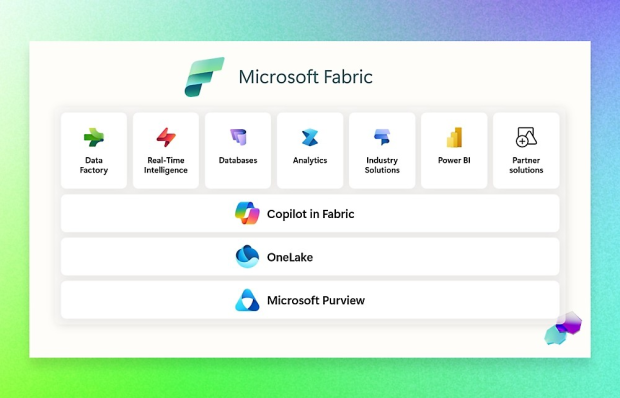
Microsoft Fabric represents the closed data fabric approach — centralized, integrated, and deeply tied to the Microsoft ecosystem. But this isn’t your only option. Two fundamentally different philosophies have emerged that will shape enterprise data strategies for the next decade:
Closed Data Fabric Architecture:
- Centralize data into one vendor’s platform through required migration
- Migrate data to OneLake before gaining access to advanced capabilities
- Standardize on integrated tools within the proprietary ecosystem
- Accept vendor dependency in exchange for tight integration and unified experience
Open Data Fabric Architecture:
- Federate access across existing infrastructure without disruption
- Query data in place without movement or duplication requirements
- Preserve tool choice and vendor independence across clouds
- Enhance current investments rather than replace them wholesale
Curious to learn more? Click here to download the strategic guide on open vs closed data fabrics
Why This Choice Matters in 2025
Three converging trends make this architectural decision more critical than ever before:
1. AI Acceleration
Models and agents need governed, real-time data access across all sources. Traditional batch processes and centralized approaches create bottlenecks that slow AI initiatives and prevent organizations from capitalizing on the AI revolution.
2. Data Complexity
Enterprises rely on dozens of platforms across clouds and regions. Multi-cloud strategies are now standard, making vendor-agnostic approaches increasingly valuable for maintaining flexibility and avoiding architectural constraints.
3. Speed Expectations
Waiting weeks for dashboards or months for migrations is no longer acceptable. Business demands instant access to insights across all data sources, and competitive advantages often depend on speed to insight rather than perfect integration.
The wrong choice creates migration debt, vendor lock-in, architectural rigidity, and hidden costs. The right choice enables instant value, strategic flexibility, faster AI adoption, and lower total cost of ownership.
Microsoft Fabric: Understanding the Closed Approach
Microsoft Fabric integrates Azure Synapse, Power BI, Data Factory, and Purview into a unified platform centered on OneLake. This OneLake-centric architecture defines everything about how Fabric operates — all data must be ingested before advanced capabilities become available.
What Microsoft Fabric Does Well
For organizations standardized on Microsoft technologies, Fabric streamlines many data lifecycle aspects. The single vendor relationship simplifies procurement, support, and strategic planning, while development teams benefit from consistent APIs, shared authentication, and unified monitoring across the entire stack. When everything runs within the Microsoft ecosystem, organizations can achieve faster initial development cycles and leverage deep integrations that would be difficult to replicate across multiple vendors.
Microsoft Fabric’s standout advantage lies in its capacity-based pricing model, where a single compute cost covers all workloads — whether working with Spark, SQL, or real-time data. This predictability is especially valuable in enterprise environments where cost management is crucial. The platform’s deep integration with Power BI, Microsoft 365, and Azure creates a cohesive user experience for organizations already invested in Microsoft technologies.
The enterprise support model represents another significant advantage. Comprehensive SLAs, roadmap alignment, and escalation paths through a single vendor reduce operational complexity. For teams already trained on Microsoft tools, the learning curve for additional Fabric capabilities remains relatively shallow.
Hidden Costs of Closed Architecture
However, this integration comes with substantial costs that often become apparent during implementation. The migration tax represents the most immediate challenge, with organizations typically facing 6-18 months of migration work before seeing full benefits. This timeline includes not just data movement, but also workflow reconstruction, team retraining, and integration rebuilding for any non-Microsoft systems.
Data movement costs extend beyond the initial migration. OneLake storage requirements create ongoing duplication expenses, particularly for organizations with large data volumes. The processing overhead of maintaining synchronized copies can become substantial, especially when real-time access patterns conflict with batch ingestion schedules.
Vendor dependency creates longer-term strategic risks. Once data resides in OneLake and workflows depend on Fabric-specific features, switching costs become prohibitive. This dependency reduces negotiating leverage with Microsoft and constrains future technology choices. Organizations find themselves bound to Microsoft’s roadmap and pricing decisions, with limited ability to adopt innovative tools from other vendors.
Leading Microsoft Fabric Alternatives
For more data fabric vendors, please see our comparison guide.
Open Data Fabric Solutions
Promethium Open Data Fabric
Promethium represents the open data fabric approach — federating access across existing infrastructure without requiring data movement or vendor lock-in. Rather than centralizing data into a proprietary format, Promethium brings computational intelligence to data where it already lives, preserving existing investments while adding new capabilities. The platform’s agentic architecture is purpose-built for the AI era, enabling both human users and autonomous agents to collaborate seamlessly across distributed data sources. This approach delivers instant value through zero-migration deployment while maintaining strategic flexibility for evolving technology landscapes. Rather than centralizing data into a proprietary format, Promethium brings computational intelligence to data where it already lives, preserving existing investments while adding new capabilities. (Learn more here)
Core Architecture:
The foundation rests on a three-layer approach designed for maximum flexibility and minimum disruption. The Instant Data Fabric layer provides zero-copy federation across a variety of data sources, connecting platforms without requiring custom integration development. Whether data resides in Snowflake, Oracle, Databricks, SAP, or legacy systems, Promethium establishes secure, governed connections that respect existing access controls.
Above this foundation, the 360° Context Engine automatically discovers and applies metadata, lineage, and business context across all connected sources. Unlike traditional approaches requiring manual semantic modeling, this layer continuously learns and adapts, building comprehensive understanding of data relationships and business relevance.
At the top, Mantra™ Data Answer Agent provides AI-native orchestration for both humans and systems. Rather than just a chatbot interface, it’s a sophisticated system of specialized agents that can plan complex queries, resolve ambiguity, and deliver explainable results with complete lineage and context.
Key Differentiators:
- Universal Access: Query data where it lives across any cloud, on-premises, or SaaS environment without migration requirements
- Complete Context: Automated metadata discovery and business context application ensuring accurate, explainable results
- AI-Native Design: Purpose-built for human-AI collaboration with support for any LLM or agent framework
- Zero Migration: Deploy in weeks with immediate access to federated data sources while preserving existing investments
Strengths:
- Zero-copy federation across all data sources without migration requirements
- AI-native architecture supporting any LLM or agent framework through open APIs
- 360° Context Engine for automated metadata discovery and business context
- Weeks to deployment vs. months of complex integration
- Preserves existing technology investments while adding intelligence
Considerations:
- Newer platform compared to established data warehouses
- Requires embracing federated architecture over centralized control
- Best suited for organizations with distributed data landscapes
Best For: Organizations with distributed data across multiple clouds, existing technology investments to preserve, immediate AI initiatives requiring real-time data access, or regulatory requirements preventing data centralization.
Download the executive brief (no form fill required)
Starburst Data
Built on Trino (formerly Presto) and Apache Iceberg, Starburst offers an open lakehouse platform designed to eliminate vendor lock-in while providing enterprise-grade capabilities. The platform’s “Icehouse” architecture combines Trino’s federated query performance with Iceberg’s reliability and ACID transaction support.
Starburst Data
Built on Trino (formerly Presto) and Apache Iceberg, Starburst offers an open lakehouse platform designed to eliminate vendor lock-in while providing enterprise-grade capabilities. The platform’s “Icehouse” architecture combines Trino’s federated query performance with Iceberg’s reliability and ACID transaction support. Starburst provides both self-managed and fully managed deployment options, with Galaxy offering cloud-native convenience while maintaining open standards. The platform’s focus on federation enables organizations to query data across multiple sources without movement, making it particularly valuable for distributed enterprise environments.
Strengths:
- Excellent federated query performance across multiple data sources
- Open architecture based on standard formats (Iceberg, Parquet) prevents vendor lock-in
- Strong governance and security features with fine-grained access controls
- Both self-managed and fully managed deployment options available
Considerations:
- Requires technical expertise for optimal deployment and performance tuning
- Limited native AI/agent integration compared to purpose-built platforms
- Smaller ecosystem compared to major cloud data warehouses
Cloud Data Warehouses
Snowflake
Snowflake remains the most prominent alternative to Microsoft Fabric, particularly for organizations requiring SQL-first analytics with multi-cloud flexibility. The platform’s unique architecture separates compute and storage, enabling elastic scaling and predictable performance for analytical workloads. The platform’s data sharing capabilities represent a significant competitive advantage, allowing organizations to securely share live data across business boundaries without replication. Recent developments include enhanced support for semi-structured data, machine learning capabilities through Snowpark, and improved integration with popular data science tools.
Strengths:
- Multi-cloud deployment flexibility with consistent performance across AWS, Azure, and GCP
- Excellent data sharing capabilities enabling secure collaboration without replication
- Simple pay-as-you-go pricing model with independent compute and storage scaling
- Strong SQL compatibility with low learning curve for traditional database users
- Robust security features and compliance certifications
Considerations:
- Data centralization still required, creating migration overhead
- Costs can escalate without proper optimization and monitoring
- Limited native AI/ML capabilities require integration with external tools
- Less suitable for real-time streaming analytics compared to specialized platforms
Strategic Positioning:
According to recent enterprise comparisons, Snowflake’s architecture is composed of three decoupled yet tightly integrated layers that provide flexibility but adopting Snowflake often means managing and paying for multiple tools, adding complexity and operational overhead.
Amazon Redshift
Amazon Redshift provides deep integration with the AWS ecosystem, offering both serverless and provisioned deployment options. When combined with AWS Lake Formation and other AWS services, it creates a comprehensive data platform with strong governance capabilities.
Ecosystem Integration and Evolution:
Redshift’s strength lies in its seamless integration with the broader AWS service ecosystem. Native connections to S3, Lambda, SageMaker, and other AWS services create powerful data pipelines with minimal custom development. The platform supports both traditional data warehousing workloads and modern analytics patterns through features like Redshift Spectrum for querying data in S3.
Recent enhancements include improved machine learning integration, support for streaming data, and enhanced security features. The serverless option eliminates infrastructure management while maintaining the performance characteristics that make Redshift popular for analytical workloads.
Redshift’s pricing model offers predictability through reserved instances or flexibility through on-demand pricing. For organizations already invested in AWS infrastructure, the platform provides compelling economics and operational simplicity.
Strategic Positioning:
The platform excels for organizations with significant AWS commitments and analytical workloads that benefit from tight ecosystem integration. However, organizations should consider potential AWS lock-in and evaluate whether the ecosystem benefits outweigh the flexibility constraints of single-cloud deployment.
Google BigQuery
Google BigQuery stands out for its serverless architecture and native integration with Google Cloud’s AI/ML services, providing a platform where organizations can process large-scale analytical workloads with minimal infrastructure management. The platform’s columnar storage and distributed processing architecture optimize performance for analytical queries while maintaining cost efficiency through automatic scaling. Integration with Google’s AI ecosystem provides unique capabilities for organizations pursuing advanced analytics, including native support for machine learning through BigQuery ML. The platform’s support for standard SQL and integration with popular BI tools ensures compatibility with existing workflows.
Strengths:
- True serverless architecture eliminates capacity planning and infrastructure management
- Excellent integration with Google Cloud AI/ML services including Vertex AI
- Automatic scaling handles workloads from gigabytes to petabytes seamlessly
- Competitive pricing with pay-per-query model and flat-rate options
- Strong performance for analytical workloads with columnar storage optimization
- Built-in machine learning capabilities through BigQuery ML
Considerations:
- Google Cloud ecosystem dependency limits multi-cloud flexibility
- Integration complexity with non-Google services and tools
- Data centralization still required for optimal performance
- Limited real-time capabilities compared to specialized streaming platforms
Lakehouse Platforms
Databricks
Databricks pioneered the lakehouse architecture, combining the best aspects of data lakes and data warehouses on a foundation of Apache Spark and Delta Lake. For organizations seeking a powerful, scalable platform with strong support for advanced analytics and machine learning, Databricks represents a top choice among Microsoft Fabric alternatives. The platform’s maturity, open-source backbone, and multi-cloud flexibility make it well-suited for enterprises with complex data needs and ambitious AI/ML goals. Its comprehensive feature set and Unity Catalog governance capabilities provide enterprise-grade security while enabling data democratization across organizations.
Strengths:
- Comprehensive MLOps capabilities through MLflow for complete machine learning lifecycle management
- Unity Catalog provides enterprise-grade governance with fine-grained access controls
- Open Delta Lake format prevents vendor lock-in while providing ACID transactions
- Multi-cloud flexibility across AWS, Azure, and GCP with consistent experience
- Strong support for multiple programming languages (Python, R, Scala, SQL)
Considerations:
- Requires significant technical expertise to optimize performance and manage deployments
- Consumption-based pricing can lead to unexpected costs without careful monitoring
- Complex for business users, primarily designed for technical data teams
- Learning curve can be steep for organizations new to Spark-based architectures
Performance and Pricing:
Recent analysis shows that Databricks offers exceptional performance for large-scale data processing thanks to its foundation on Apache Spark and improvements through their Photon execution engine, delivering up to 8x performance improvements over standard Spark.
Dremio
Dremio provides a forever-free lakehouse platform with strong query acceleration through its Apache Arrow-based Sonar engine. The platform focuses on self-service analytics and data virtualization, making enterprise data accessible to both technical and business users. Dremio’s core strength lies in query acceleration technology, which uses Apache Arrow and columnar caching to dramatically improve performance on analytical workloads without requiring data movement. The platform can accelerate queries against data lakes, warehouses, and operational databases while presenting a unified view to end users.
Strengths:
- Forever-free tier provides substantial capabilities for smaller organizations
- Excellent query acceleration through Apache Arrow-based Sonar engine
- Self-service approach enables business analysts to access data independently
- Support for open formats (Parquet, Delta Lake, Iceberg) prevents vendor lock-in
- Federation capabilities enable querying across multiple sources
- Reduces infrastructure requirements by eliminating separate ETL processes
Considerations:
- Limited enterprise features in free tier may require paid upgrades
- Smaller ecosystem compared to major data warehouse alternatives
- Less comprehensive governance features compared to enterprise platforms
- May require technical expertise for complex deployments
Enterprise Data Fabric Solutions
Informatica IDMC
Informatica’s Intelligent Data Management Cloud (IDMC) represents the most comprehensive enterprise data fabric solution, powered by CLAIRE AI and providing end-to-end data management capabilities including integration, quality, governance, and catalog services. The platform’s CLAIRE AI engine automates many aspects of data management, including data discovery, quality assessment, and integration mapping. IDMC’s strength lies in its mature governance capabilities and extensive connector ecosystem, with connections to hundreds of data sources and applications capable of handling the most complex enterprise data landscapes. The solution provides comprehensive security and compliance features, including data privacy controls, audit trails, and integration with enterprise identity management systems.
Strengths:
- Most comprehensive enterprise data management platform with end-to-end capabilities
- CLAIRE AI engine automates data discovery, quality assessment, and integration mapping
- Extensive connector ecosystem supporting hundreds of data sources and applications
- Mature governance capabilities with advanced data lineage and impact analysis
- Strong compliance features including data privacy controls and audit trails
- Hybrid and multi-cloud deployment support with consistent governance policies
Considerations:
- Complex implementations requiring significant investment in technology and specialized skills
- Higher total cost of ownership compared to simpler alternatives
- Comprehensive capabilities come with correspondingly complex configuration requirements
- May be overkill for organizations with simpler data management needs
Talend Data Fabric
Talend offers a unified platform for data integration, quality, and governance with strong support for both cloud and on-premises deployments. The platform provides low-code/no-code capabilities alongside traditional development approaches, combining data integration, quality, and governance in a single solution. Talend’s visual development environment enables both technical and business users to create data integration workflows through pre-built connectors and transformation components. The platform’s open-source heritage provides cost advantages and prevents vendor lock-in while enterprise features ensure scalability and support for mission-critical workloads.
Strengths:
- Unified platform combining data integration, quality, and governance capabilities
- Visual development environment accessible to both technical and business users
- Strong hybrid and multi-cloud deployment flexibility
- Pre-built connectors and transformation components accelerate development
- Open-source heritage provides cost advantages and prevents vendor lock-in
- Tight integration between data quality and integration workflows
Considerations:
- Requires significant customization for complex enterprise requirements
- Limited AI-native capabilities compared to modern alternatives
- Learning curve for users unfamiliar with ETL/ELT concepts
- May require additional tools for advanced analytics and machine learning workflows
Feature-by-Feature Comparison
Data Access and Federation
| Capability | Microsoft Fabric | Promethium | Snowflake | Databricks |
|---|---|---|---|---|
| Data Sources | Must ingest to OneLake | Query in place across 200+ sources | Requires data loading | Requires data ingestion |
| Real-time Access | Limited by batch ingestion | Live queries against sources | Near real-time with streams | Depends on ingestion frequency |
| Multi-cloud Support | Azure only | Native AWS, Azure, GCP | Multi-cloud supported | Multi-cloud supported |
| Data Movement | Required | Zero-copy access | Required | Required |
| Storage Costs | OneLake duplication required | Use existing storage investments | Snowflake storage required | Delta Lake storage required |
| Latency | Depends on ingestion frequency | Real-time, source-native performance | Near real-time with optimization | Optimized for batch and streaming |
AI and Agent Integration
| Capability | Microsoft Fabric | Promethium | Snowflake | Databricks |
|---|---|---|---|---|
| AI Integration | Copilot only, limited scope | Full agentic architecture supporting any LLM | Snowpark ML and Cortex | Comprehensive MLOps with MLflow |
| Agent Support | Not designed for autonomous agents | Native agent-to-agent orchestration via MCP | Basic AI features through Cortex | MLOps focused, limited agent support |
| Context Delivery | Manual modeling required | Automated context discovery | Limited semantic layer | Unity Catalog provides context |
| API Accessibility | Limited, Power BI focused | Full REST, SQL, JDBC, MCP support | Good SQL/API support | Strong programmatic access |
| Real-time AI | Constrained by data freshness | Live data for real-time decisions | Near real-time with streaming | Batch and streaming supported |
| Agent Memory | Not supported | Persistent context across sessions | Not supported | Limited through MLflow |
Governance and Security
| Capability | Microsoft Fabric | Promethium | Snowflake | Databricks |
|---|---|---|---|---|
| Policy Enforcement | Centralized in Purview | Distributed, source-aware governance | Role-based access control | Unity Catalog governance |
| Access Control | Azure AD dependent | Fine-grained, role-based access control | Robust RBAC system | Unity Catalog RBAC |
| Data Lineage | Within OneLake only | Cross-platform, complete lineage | Limited native lineage | Good with Unity Catalog |
| Compliance | Microsoft compliance model | Adaptable to any framework | Strong compliance features | Enterprise compliance supported |
| Audit Trail | Purview-based | Comprehensive, cross-system auditing | Detailed audit capabilities | Unity Catalog audit trails |
| Data Residency | OneLake requirements | Data stays in original locations | Multi-cloud data residency | Multi-cloud flexibility |
User Experience and Self-Service
| Capability | Microsoft Fabric | Promethium | Snowflake | Databricks |
|---|---|---|---|---|
| Self-Service Access | Power BI dashboards + Copilot | Natural language + any BI tool + agentic workflows | SQL-based with some BI integration | Notebook-based with BI integration |
| Business User Experience | Dashboard-centric | Conversational, iterative | SQL-focused | Technical, developer-oriented |
| Data Discovery | Purview catalog only | Automated across all sources | Basic catalog capabilities | Unity Catalog discovery |
| Query Interface | Limited natural language | Full conversational interface | SQL-based queries | SQL and notebook interfaces |
| Result Explanation | Basic lineage | Complete context and reasoning | Query performance insights | Technical debugging capabilities |
| Learning Capability | Static models | Adaptive, improves via agentic memory | Static optimization | Model versioning through MLflow |
Integration and Extensibility
| Capability | Microsoft Fabric | Promethium | Snowflake | Databricks |
|---|---|---|---|---|
| Data Catalog Integration | Purview only | Universal — Alation, Collibra, Atlan, Unity Catalog | Limited native catalog | Strong Unity Catalog integration |
| BI Tool Support | Power BI optimized, limited others | Universal — Tableau, Looker, Power BI, ThoughtSpot | Good BI tool ecosystem | Strong BI integration capabilities |
| Data Platform Support | Azure-centric, OneLake required | Native — Snowflake, Databricks, Oracle, SAP, cloud and on-prem | Multi-cloud warehouse | Multi-cloud lakehouse platform |
| Custom Applications | Limited Power Platform APIs | Full REST, SQL, JDBC, MCP API access | Strong API ecosystem | Comprehensive API support |
| Agent/AI Integration | Copilot only | Any LLM, agent framework via MCP or A2A | Snowpark ML integration | MLOps-focused AI integration |
| Multi-Cloud Deployment | Azure only | Native AWS, Azure, GCP, and hybrid support | Multi-cloud supported | Multi-cloud lakehouse deployment |
Use Cases: Where Architecture Makes the Difference
Multi-Cloud Enterprise Strategy
Challenge: Global financial services firm with data across Snowflake (analytics), Azure (productivity), and on-premises (core banking) needs unified access for risk management.
Closed Architecture (Fabric):
- Migration requirement: Move all data to OneLake
- Regulatory challenges: Data residency rules prevent cloud migration
- Integration complexity: Custom gateways for core banking systems
- Timeline: 18+ months for full migration
- Cost: $5M+ in migration and duplication
Open Architecture Approach:
- Federation: Query across all environments without movement
- Compliance: Data stays in regulated environments
- Integration: Direct connectivity to core systems
- Timeline: 4 weeks to production
Outcome: Open architecture enables immediate compliance while closed requires regulatory exceptions and massive investment.
Rapid AI Implementation
Challenge: Technology company needs autonomous AI agents accessing distributed enterprise data for complex analysis workflows.
Closed Architecture: Limited to Copilot functionality within Microsoft ecosystem, requiring custom development for multi-agent workflows.
Open Architecture: Native support for any LLM or agent framework with real-time access across all data sources, enabling immediate AI deployment.
Marketing Analytics Optimization
Challenge: Retailer with data across Redshift (customers), Snowflake (sales), and BigQuery (digital campaigns) needs rapid campaign optimization.
Closed Architecture: 4-6 weeks to migrate and integrate data before analysis possible, missing critical campaign windows.
Open Architecture: Instant federation enables real-time optimization across all platforms without migration delays.
Business Impact Analysis
Total Cost of Ownership
Microsoft Fabric:
- Migration costs: $2-5M+ for enterprise implementations
- Ongoing OneLake storage: Additional data duplication costs
- Vendor dependency: Reduced negotiating power over time
- Timeline: 6-18 months before full value realization
Open Alternatives:
- Faster implementation with lower upfront costs
- Zero migration requirements leverage existing storage investments
- Vendor independence maintains negotiating flexibility
- Timeline: 4-6 weeks to production value
Strategic Flexibility
Closed Architecture Risks:
- Platform lock-in constrains future technology choices
- Azure-only deployment limits multi-cloud strategies
- Switching costs become prohibitive over time
- Innovation tied to single vendor roadmap
Open Architecture Benefits:
- Technology choice preservation across clouds and tools
- Future-proof architecture adapts to changing needs
- Vendor independence maintains negotiating power
- Innovation adoption without platform constraints
Curious to learn more? Click here to download the strategic guide on open vs closed data fabrics
Decision Framework
Choose Microsoft Fabric When:
- Organization is 100% standardized on Microsoft ecosystem
- No multi-cloud requirements or constraints exist
- Migration timeline and costs are acceptable
- Deep Microsoft integration outweighs vendor dependency risks
Choose Open Data Fabric (Promethium) When:
- Multi-cloud or hybrid architectures are strategic requirements
- Existing technology investments must be preserved
- Rapid deployment and immediate value are priorities
- AI initiatives require real-time access across distributed data
- Vendor independence and future flexibility are important
Choose Cloud Data Warehouses When:
- Primary need is analytical workloads on structured data
- Single cloud provider alignment is acceptable
- Traditional SQL-based approach meets requirements
- Data consolidation approach is preferred
Choose Lakehouse Platforms When:
- ML/AI workloads are the primary driver
- Technical teams can manage complex platforms
- Open table formats and standards are priorities
- Both structured and unstructured data processing needed
Implementation Considerations
Evaluation Process
- Assess Current State: Document existing data sources, tools, and workflows
- Define Requirements: Establish criteria for speed, costs, flexibility, and AI readiness
- Proof of Concept: Test leading alternatives with real data and use cases
- Total Cost Analysis: Include migration, training, and ongoing operational costs
- Strategic Alignment: Evaluate long-term technology strategy and vendor relationships
Migration Planning
From Microsoft Fabric:
- Assess OneLake data and dependency mapping
- Plan federation approach for zero-disruption transition
- Preserve existing Microsoft tool investments where valuable
- Implement governance policies across distributed architecture
To Open Architecture:
- Connect existing sources without migration requirements
- Implement federated governance across all platforms
- Train teams on conversational data interfaces
- Gradually expand self-service capabilities
Future-Proofing Your Data Strategy
The data landscape continues evolving rapidly. Consider these trends when making architectural decisions:
AI-First Data Architectures
Future platforms must be built for AI consumption from day one. Real-time, contextual access becomes more critical than centralized storage.
Agent-to-Agent Collaboration
Multi-agent workflows require open APIs and flexible orchestration — capabilities limited in closed platforms.
Regulatory Evolution
Data sovereignty and privacy regulations increasingly favor in-place processing over centralized storage models.
Technology Innovation
Open architectures enable adoption of innovative tools and techniques without platform migration requirements.
Conclusion
The Microsoft Fabric alternatives landscape in 2025 offers unprecedented choice and capability, but success depends on understanding the fundamental architectural decisions that will shape your data strategy for years to come. The choice between open and closed data fabric architectures represents more than a technology decision — it’s a strategic commitment that affects everything from deployment speed and costs to AI readiness and vendor independence.
Organizations choosing open data fabric approaches like Promethium achieve faster deployment, preserve existing technology investments, and maintain the flexibility needed for rapidly evolving AI requirements. Cloud data warehouses like Snowflake and Databricks provide proven capabilities but require data centralization and careful cost management. Enterprise data fabric solutions from Informatica and Talend offer comprehensive features but demand significant implementation investment.
The evidence is clear: as AI becomes the primary consumer of enterprise data and multi-cloud architectures become standard, the ability to federate access without migration constraints becomes a competitive advantage. The architectural choice made today will determine whether your organization can adapt quickly to new technologies or remains constrained by vendor dependencies and technical debt.
Choose wisely — your data strategy decision will define your organization’s agility in an AI-driven future. If you want to learn more about Promethium’s Open Data Fabric alternative, reach out to our team to schedule a strategy session or download the comprehensive guide.
Share This Article
SHARE THIS:



Share This Article
SHARE THIS: