Every enterprise wants the same thing from AI: fast, accurate answers grounded in their data and business context. But getting there isn’t easy. Data is scattered, systems are complex, and most organizations have already made significant investments in their stack.
Today, two distinct paradigms are emerging to make AI work on enterprise data. One focuses on consolidating everything into an integrated ecosystem, while the other takes a platform-agnostic approach that works with existing infrastructure. Understanding the tradeoffs between them is crucial for building a sustainable AI strategy.
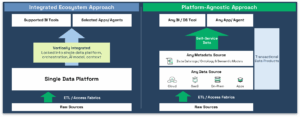
Paradigm 1: The Integrated Ecosystem Approach
Major cloud and platform vendors offer a compelling value proposition: “Consolidate your data into our platform, and AI capabilities come built-in.”
This approach has clear advantages:
- Simplified operations: Everything works together out of the box with minimal integration overhead
- Unified experience: Consistent interfaces and workflows across tools
- Vendor support: Single point of contact for issues and a clear upgrade path
However, this model also comes with tradeoffs:
- Data centralization requirements: Success depends on migrating data into the vendor’s preferred format and storage layer
- Tool ecosystem constraints: While these platforms offer extensive capabilities, they may not support every specialized tool your teams rely on
- Context limitations: Some platforms require you to bring your own semantic models and business context — they excel at computation but may need help with domain-specific knowledge
For organizations already committed to a single vendor’s ecosystem, this can be an efficient path forward.
Paradigm 2: The Platform-Agnostic Approach
The alternative paradigm prioritizes flexibility and works with existing infrastructure:
- Data stays in place: AI connects to your current data sources — whether that’s Snowflake, Databricks, Oracle, Salesforce, or on-premises systems — without requiring migration
- Tool flexibility: Integrates with your existing BI tools, notebooks, and applications rather than replacing them
- Comprehensive context: Pulls in metadata, business definitions, and usage patterns from wherever they currently exist in your organization
This approach offers several advantages:
- Lower migration risk: Builds on existing investments rather than requiring infrastructure changes
- Vendor neutrality: Reduces dependency on any single platform’s roadmap
- Adaptability: Can evolve with your technology choices over time
The main consideration is ensuring the solution can effectively connect to and understand your diverse data landscape.
Which Approach Makes Sense?
The integrated approach often works well for organizations that:
- Are already heavily invested in a single vendor’s ecosystem
- Have relatively straightforward data architectures
- Prioritize operational simplicity over flexibility
The platform-agnostic approach tends to be better for enterprises that:
- Have diverse, distributed data environments
- Want to preserve existing tool investments
- Need to maintain flexibility as their AI requirements evolve
- Have complex business contexts that span multiple systems
The Case for Open Architecture
While both approaches have merit, we believe the open, platform-agnostic model offers advantages for most large enterprises. Here’s why:
Enterprise data reality is inherently complex. Critical business context — the knowledge that makes AI truly useful — rarely lives in a single system. It’s distributed across source systems, business glossaries, tribal knowledge, and established workflows. An architecture that can pull this context together, regardless of where it lives, tends to produce more accurate and useful AI outcomes.
Additionally, technology landscapes evolve rapidly. The flexibility to adopt new tools, work with different vendors, and adapt to changing requirements becomes increasingly valuable over time.
Ready to Explore the Open Approach?
See how the platform-agnostic approach works in practice. Our integration guide shows exactly how Promethium connects to your existing data stack — from cloud warehouses and SaaS platforms to on-premises systems — without requiring migration or major architectural changes.
SHARE THIS: