
Microsoft Fabric has emerged as a significant player in the enterprise data platform market, combining data integration, warehousing, and analytics into a unified Software-as-a-Service offering. However, the data fabric landscape includes numerous alternatives, each with distinct architectural approaches and capabilities that may better align with your organization’s specific needs. This buying guide provides an evaluation framework to help enterprise buyers make informed decisions about Microsoft Fabric and its key alternatives.
The stakes for this decision are high — the wrong choice can result in millions in migration costs, vendor lock-in, and architectural constraints that limit future flexibility. With enterprise data growing exponentially and AI initiatives demanding real-time access across distributed sources, your platform choice will define your organization’s data agility for years to come.
Before scoring vendors, grab the companion strategy brief — Open vs. Closed Data Fabric: A Strategy Guide for Enterprise Leaders. It explains how architecture choices (centralize in OneLake vs. federate in place) affect migration time, lock-in, and AI readiness.
Understanding Microsoft Fabric
Microsoft Fabric integrates Azure Synapse Analytics, Data Factory, Power BI, and Purview into a single platform centered on OneLake storage. This unified approach promises to simplify data operations by eliminating the need to integrate separate tools — but it comes with specific architectural requirements and trade-offs that buyers must understand.
Core Architecture
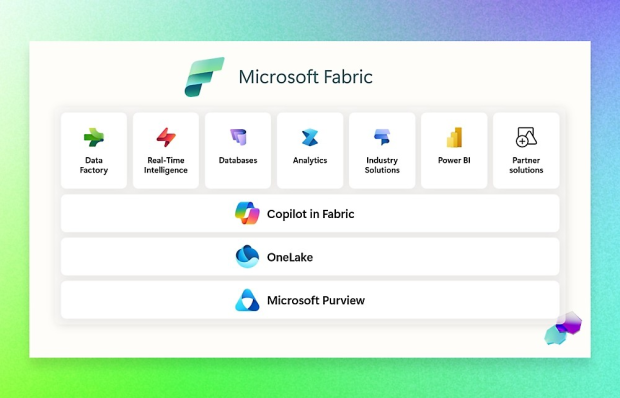
Fabric’s foundation rests on OneLake, a centralized data lake that requires all data to be ingested and converted to Delta-Parquet format before advanced capabilities become available. This creates a unified experience across Microsoft tools but locks organizations into Azure infrastructure and Microsoft’s data processing approach.
The platform combines several capabilities:
- Data Factory for data integration and ETL/ELT processes
- Synapse Analytics for data warehousing and big data processing
- Power BI for business intelligence and reporting
- Purview for data governance and catalog management
- Real-Time Intelligence for streaming analytics
- Data Science workspaces for machine learning development
What Fabric Does Well
For organizations fully committed to the Microsoft ecosystem, Fabric offers compelling advantages. The unified licensing model provides predictable costs across all data workloads, while deep integration with Microsoft 365 creates seamless workflows for knowledge workers. The platform’s governance capabilities through Purview provide comprehensive data lineage and policy enforcement across all connected services.
The SaaS deployment model eliminates infrastructure management complexity, and Microsoft’s enterprise support provides single-vendor accountability for the entire data stack. Teams already skilled in Microsoft technologies can leverage existing expertise across the integrated platform.
Critical Considerations
However, Fabric’s integrated approach comes with significant constraints. All data must be moved to OneLake, creating migration projects that can take 6-18 months for complex enterprise environments. The Azure-only deployment limits multi-cloud strategies and may conflict with existing cloud investments or regulatory requirements.
Organizations using best-of-breed tools outside the Microsoft ecosystem face integration challenges, as Fabric’s capabilities are optimized for Microsoft’s own services. The platform’s batch-oriented ingestion approach can create latency issues for real-time use cases, and costs can escalate quickly without careful capacity management.
To learn more about the different architectural approaches between open and closed data fabrics, download our strategy guide.
Vendor-Neutral Evaluation Framework
Successful data platform selection requires objective evaluation across multiple dimensions. Our framework weights evaluation criteria based on their typical impact on enterprise success:
Architecture and Data Access (25%)
The fundamental approach to data management determines implementation complexity, ongoing costs, and strategic flexibility. Evaluate whether platforms require data movement, support multi-cloud deployment, and preserve existing infrastructure investments.
Key Questions:
- Does the platform require migrating existing data or support in-place access?
- What cloud environments are supported, and are there vendor lock-in concerns?
- How does the architecture handle real-time vs. batch processing requirements?
- What are the infrastructure and storage cost implications?
Time to Value (20%)
Speed of deployment and user enablement directly correlates with project success rates and stakeholder buy-in. Consider both initial implementation timeline and ongoing development velocity.
Key Questions:
- How long does typical deployment take from decision to production use?
- What migration or integration work is required for existing data sources?
- How quickly can business users become productive on the platform?
- What training and change management is needed for adoption?
AI and Analytics Capabilities (20%)
Modern data platforms must support both traditional BI and advanced AI/ML workloads to meet evolving business requirements and enable competitive advantage.
Key Questions:
- What AI/ML development and deployment capabilities are included?
- How does the platform support both human analysts and autonomous agents?
- What natural language or conversational interfaces are available?
- How well does the platform integrate with external AI tools and frameworks?
Integration and Ecosystem (15%)
Compatibility with existing tools and future extensibility preserve technology investments and maintain strategic flexibility as requirements evolve.
Key Questions:
- How well does the platform integrate with existing BI tools, databases, and applications?
- What APIs and extensibility options are available for custom development?
- Does the platform support open standards or proprietary formats?
- How does vendor roadmap alignment compare to your strategic direction?
Total Cost of Ownership (10%)
Beyond platform licensing, consider migration costs, infrastructure requirements, training, and ongoing operational expenses over a 3-5 year horizon.
Key Questions:
- What are the complete costs including migration, training, and infrastructure?
- How predictable are ongoing costs, and what drives cost escalation?
- What cost savings can be achieved from consolidating existing tools?
- How do licensing models align with your usage patterns?
User Experience and Adoption (10%)
Platform usability determines adoption rates and productivity gains across different skill levels, from data engineers to business analysts.
Key Questions:
- How accessible is the platform for non-technical business users?
- What training is required for different user personas?
- How does the interface design support common workflows and tasks?
- What collaboration and sharing capabilities are available?
Key Market Alternatives
Read this guide for a comprehensive analysis of Microsoft Fabric alternatives
Snowflake: SQL-First Analytics Platform
Snowflake provides a cloud-native data warehouse with separate compute and storage scaling, designed primarily for SQL-based analytics and business intelligence workloads.

Architectural Approach: Managed data warehouse requiring data loading but offering multi-cloud deployment and strong performance optimization for analytical queries.
Best For:
- Organizations prioritizing SQL-based analytics and BI
- Teams with strong SQL skills and traditional data warehouse workflows
- Multi-cloud strategies requiring vendor flexibility
- Workloads emphasizing query performance and data sharing
Consider When:
- Advanced AI/ML capabilities are not primary requirements
- Data centralization is acceptable for your governance model
- You have budget for potential cost scaling with usage growth
- Business analysts are key users of the platform
Databricks: Lakehouse for Advanced Analytics
Databricks combines data lake flexibility with data warehouse performance, built on Apache Spark with comprehensive machine learning and data science capabilities.

Architectural Approach: Unified analytics platform supporting both structured and unstructured data processing with multi-cloud deployment and open table formats.
Best For:
- Organizations with advanced AI/ML requirements and data science teams
- Complex data processing workflows requiring computational flexibility
- Multi-cloud strategies with preference for open standards
- Teams comfortable with notebook-based development environments
Consider When:
- You have technical expertise to manage Spark-based platforms
- Advanced analytics and machine learning are strategic priorities
- Open table formats and vendor independence are important
- Business user self-service is less critical than technical capability
Promethium: AI-Native Open Data Fabric
Promethium provides an open data fabric approach that federates access across existing data sources without requiring data movement, designed for AI-first organizations.
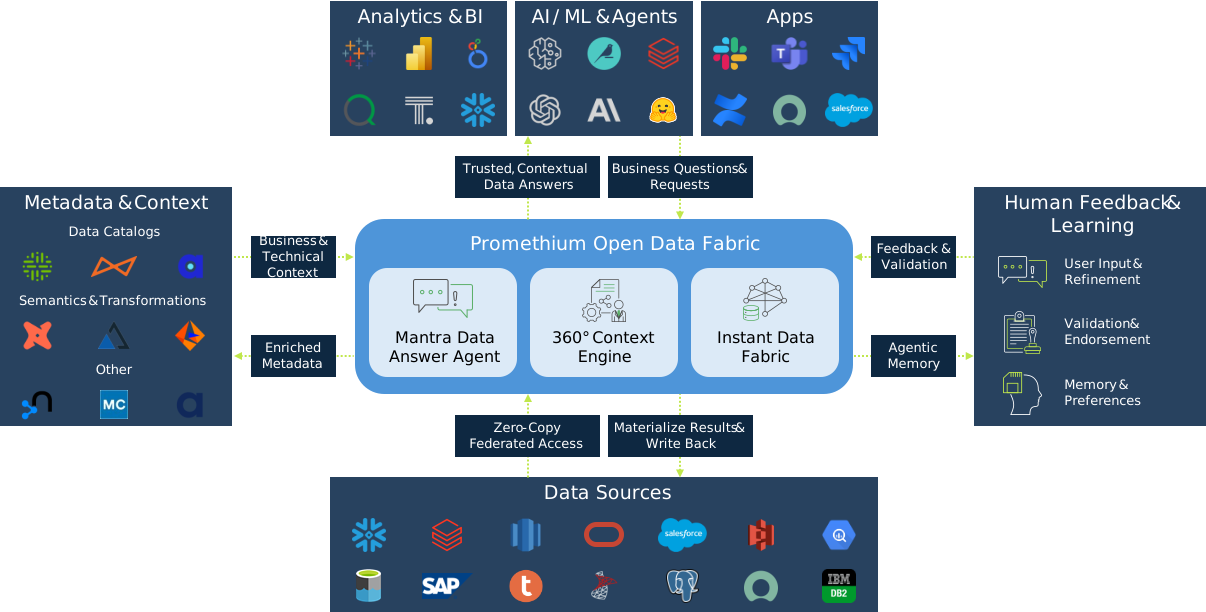
Architectural Approach: Zero-copy federation enabling queries across distributed data sources with AI-native orchestration and natural language interfaces.
Best For:
- Organizations requiring rapid deployment without data migration
- Multi-cloud or hybrid architectures with distributed data
- AI initiatives requiring real-time access across multiple sources
- Preserving existing technology investments while adding intelligence
Consider When:
- Time to value and deployment speed are critical success factors
- Data sovereignty or compliance prevents centralization
- Your organization values vendor independence and architectural flexibility
- Business users need self-service capabilities with conversational interfaces
Palantir Foundry: Enterprise Integration Platform
Palantir Foundry focuses on operational intelligence and complex data integration across enterprise systems, emphasizing workflow automation and decision support.
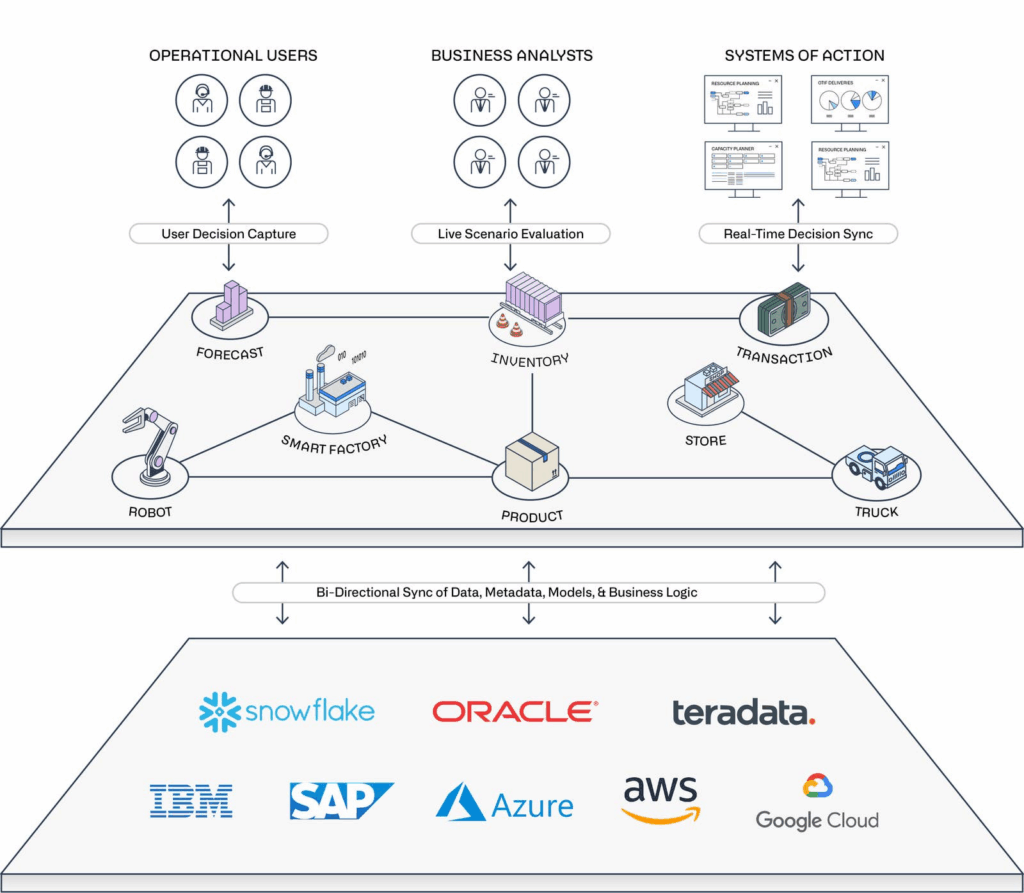
Architectural Approach: Data fusion platform connecting disparate systems while maintaining comprehensive governance, lineage, and audit capabilities.
Best For:
- Large enterprises with complex operational data integration needs
- Organizations requiring comprehensive audit trails and compliance
- Use cases emphasizing decision workflow automation
- Environments where data governance is the primary concern
Consider When:
- You have significant budget and resources for complex implementations
- Operational decision-making and workflow automation are critical
- Comprehensive governance and compliance are top priorities
- Self-service capabilities are less important than controlled access
Decision Matrix and Scoring
Use this framework to objectively score each alternative against your specific requirements:
| Evaluation Criteria | Weight | Microsoft Fabric | Snowflake | Databricks | Promethium | Palantir |
|---|---|---|---|---|---|---|
| Architecture & Data Access | 25% | Azure-only, requires OneLake migration | Multi-cloud, requires data loading | Multi-cloud, lakehouse approach | Zero-copy federation, multi-cloud | Complex integration, any cloud |
| Time to Value | 20% | 6-18 months migration timeline | 3-6 months with data loading | 3-6 months setup and training | 4-6 weeks deployment | 6-12 months implementation |
| AI & Analytics | 20% | Copilot integration, limited scope | Basic ML, SQL-focused | Comprehensive MLOps platform | AI-native, conversational interface | Limited AI, workflow-focused |
| Integration & Ecosystem | 15% | Microsoft-optimized, limited external | Good BI ecosystem, SQL focus | Open standards, extensive APIs | Universal connectors, open APIs | Enterprise focus, custom development |
| Total Cost of Ownership | 10% | Migration costs + capacity licensing | Predictable but can scale quickly | Usage-based, requires monitoring | Lower migration, subscription model | High implementation and licensing |
| User Experience | 10% | Familiar Microsoft interfaces | SQL-based, technical users | Notebook-based, data scientists | Natural language, business users | Complex, requires training |
Score each platform from 1-5 for your specific requirements, multiply by the weight, and sum for an objective comparison.
Implementation Recommendations
Phase 1: Requirements Assessment (Weeks 1-2)
Document your current data landscape, identify key use cases, and establish evaluation criteria weights based on organizational priorities. Engage stakeholders across IT, data teams, and business units to ensure comprehensive requirements gathering.
Create specific scoring criteria for each evaluation dimension, considering both current needs and 3-5 year strategic objectives. Identify any architectural constraints, compliance requirements, or strategic initiatives that should influence platform selection.
Phase 2: Vendor Evaluation (Weeks 3-4)
Score each alternative against your established criteria, using vendor-provided materials, analyst reports, and reference customer discussions. Avoid relying solely on vendor demonstrations — instead, focus on architectural fit and strategic alignment.
Request detailed implementation timelines, migration requirements, and total cost projections from each vendor. Pay particular attention to hidden costs like data movement, application rebuilding, and ongoing operational requirements.
Phase 3: Proof of Concept (Weeks 5-8)
Test top-scoring platforms with real data and actual business use cases to validate capabilities and performance assumptions. Include both technical evaluation of platform capabilities and user experience assessment with actual end users.
Evaluate not just technical functionality, but also implementation complexity, user adoption potential, and integration requirements with your existing environment. Document lessons learned and refine your evaluation scoring based on hands-on experience.
Phase 4: Strategic Decision (Weeks 9-10)
Synthesize evaluation results with broader strategic considerations including vendor relationships, long-term technology direction, and organizational change capacity. Consider both quantitative scoring results and qualitative factors that may impact success.
Make your decision based on objective evaluation results while considering strategic factors like organizational readiness, change management requirements, and alignment with broader technology initiatives.
Key Decision Factors
Choose Microsoft Fabric When:
- Your organization is strategically committed to the Microsoft ecosystem
- Unified governance across all data workloads is a top priority
- Azure infrastructure aligns with your cloud strategy
- You can accommodate 6-18 month migration timelines
- Microsoft 365 integration provides significant workflow benefits
Consider Alternatives When:
- Multi-cloud flexibility is strategically important
- Rapid deployment and time to value are critical success factors
- Advanced AI/ML capabilities beyond basic analytics are required
- Preserving existing technology investments is preferred over replacement
- Data sovereignty or compliance requirements prevent centralization
Total Cost Considerations
Platform selection requires understanding complete costs over 3-5 years, not just initial licensing. Factor in migration expenses, infrastructure requirements, training costs, and potential productivity impacts during transition periods.
Microsoft Fabric’s migration requirements can create substantial upfront costs, while alternatives like Promethium’s zero-copy approach eliminate migration expenses. Consider both hard costs like licensing and soft costs like team productivity during implementation.
Evaluate cost predictability and scalability — some platforms offer transparent pricing (see here for a breakdown of MSFT Fabric pricing) that scales with usage, while others may create unexpected costs as requirements evolve. Factor in the cost of vendor lock-in and reduced negotiating flexibility over time.
Conclusion
Microsoft Fabric represents a compelling unified approach for organizations fully committed to the Microsoft ecosystem, but it’s not the right choice for every enterprise. The platform’s OneLake-centric architecture and Azure dependency create both advantages and constraints that buyers must carefully evaluate.
Success depends on honest assessment of your organization’s specific requirements, strategic direction, and tolerance for vendor dependency. Use the evaluation framework provided to objectively compare alternatives rather than defaulting to familiar vendors or impressive demonstrations.
The data platform decision you make today will impact your organization’s agility and capabilities for years to come. Invest the time in thorough evaluation — the cost of getting it wrong far exceeds the effort required to choose correctly.
Remember that the “best” platform is the one that best aligns with your specific requirements, organizational capabilities, and strategic direction. There is no universally correct choice, only the right choice for your unique circumstances.
To learn more about how Promethium Open Data Fabric enhances your teams while maximizing existing investments, reach out to our team today.
Share This Article
SHARE THIS:



Share This Article
SHARE THIS: