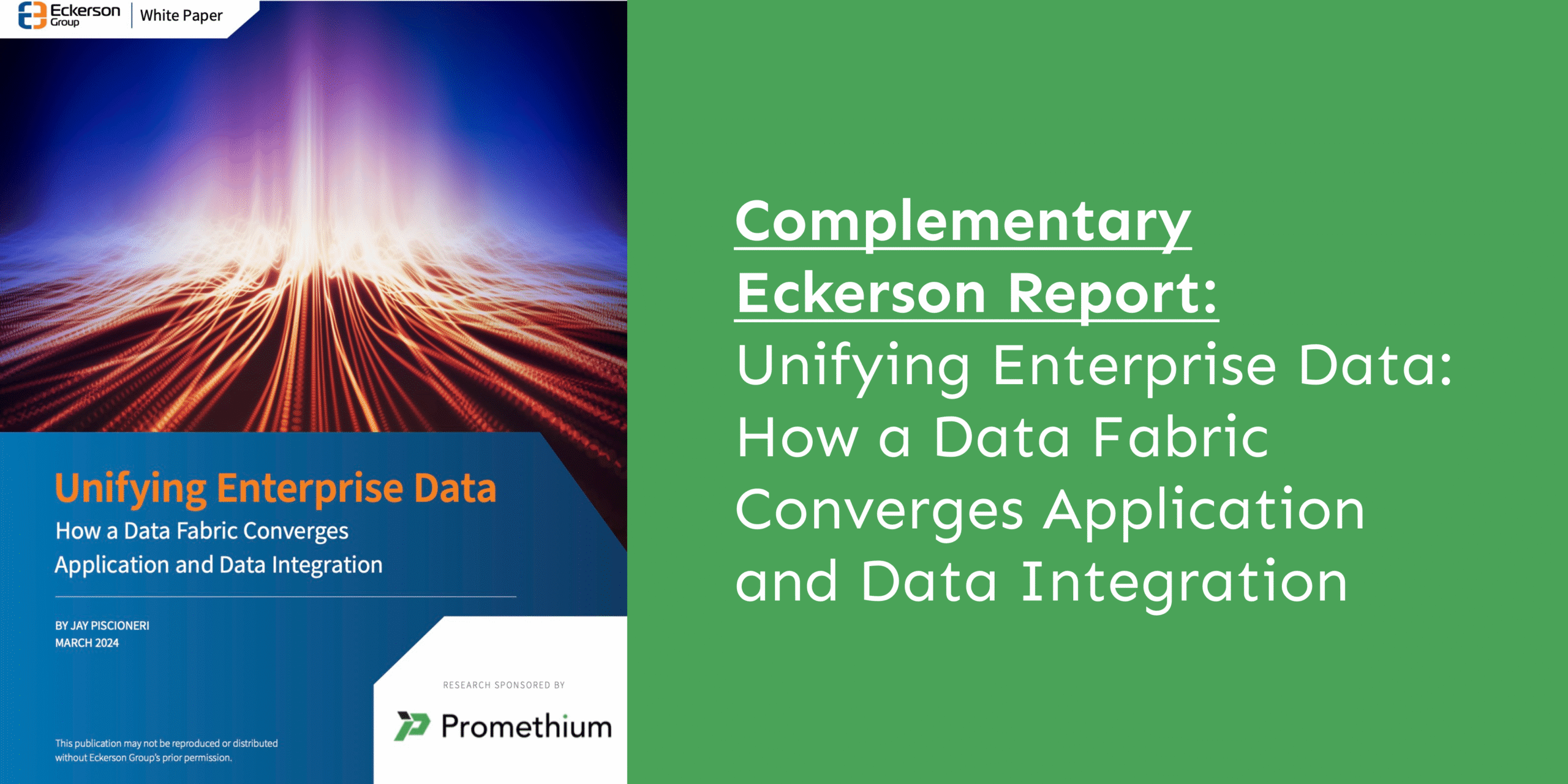
Leveraging data remains pivotal to every enterprise. In the white paper ‘Unifying Enterprise Data,’ Jay Psicioneri offers insight into how a data fabric can serve as the linchpin in aligning application and data integration.
Read the full report: Eckerson

“The separation between application and data integration creates a barrier preventing businesses from gaining a holistic view of their data landscape,” Psicioneri remarks, highlighting a fundamental challenge in current enterprise data management. This observation echoes the challenges encountered by data engineers and data strategists.
“Data fabric is an architectural approach for analytics that integrates and simplifies data, making it easily accessible for business users,” the white paper explains. This is not just a technical advancement, but empowers businesses and their CDOs who are often bogged down by data fragmentation.
For analytics users, the reality can be bleak: “Analytics users often can’t access or even find operational data in SaaS applications.” Data fabric, therefore, is a necessity that promises to bridge the divide, tearing down existing silos between systems and data.
“Analytics users often can’t access or even find operational data in SaaS applications.”
CDOs will appreciate the practicality of data fabric, as Psicioneri elaborates, “By extending data fabric with an EAI tool, companies can enable their business teams to leverage the entire data ecosystem for informed decision-making and innovation.” The Eckerson paper not only defines a solution but also charts a pathway for practical implementation.
The report calls for a unified approach to data strategy: “Bringing all enterprise data under a common democratizing framework will lead to more agile, responsive, and data-driven businesses.” As businesses stand at this time of decisions, the guidance offered by Psicioneri is timely.
“Bringing all enterprise data under a common democratizing framework will lead to more agile, responsive, and data-driven businesses.”
In aligning with these insights, we invite all data professionals, from data analysts to AI Engineers, to delve into the full white paper. It offers not just a vision, but a detailed blueprint for harnessing the full potential of enterprise data, ensuring that data fabric is not just understood but effectively integrated into the data strategies of tomorrow.
For complete exploration of this approach to enterprise data management and how it can elevate your organization. This is not merely reading; it is redefining the future of your data landscape.
SHARE THIS: