Ask a D&A leader where they’re investing their AI budget today, and the answer is usually some version of “we’re piloting code generation for our data engineers.” It’s the most visible win — pipelines built faster, less manual SQL, happy engineers.
But is that really where the ROI lives?
According to the Gartner CDAO Agenda Survey 2026, D&A teams that apply AI to analytics use cases see up to a 42% lift in business value — measured across revenue growth, cost optimization, stakeholder satisfaction, and competitive differentiation. AI for data management comes in second at 33%. AI for code generation, the place most teams are spending their attention, trails at 27%.
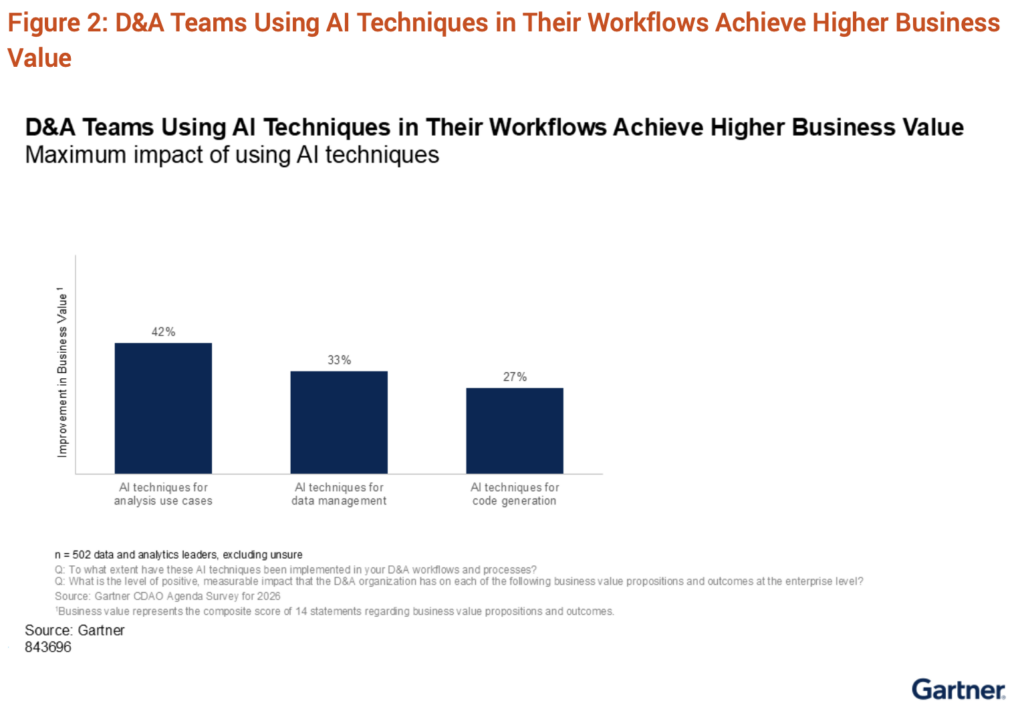
The gap is significant. And it lines up with what we keep seeing in the field: the bottleneck isn’t writing the pipeline. It’s getting an answer to the business question on the other end of it.
What “AI for analytics” actually means
The Gartner research groups analytics use cases into a specific set — and it’s a useful checklist for any D&A leader trying to figure out where to put their next dollar:
- Agentic analytics
- Autonomous decision making
- Data storytelling
- Composite AI
- Feature engineering and selection
- Insight generation from multimodal data
- Business scenario simulation for prescriptive actions
What ties these together? Every one of them sits closer to the decision than to the pipeline. They turn data into something a business leader can act on, in language they can understand, at the speed they need it.
That’s where the compounding value is. A faster pipeline saves engineering hours. A faster, more trustworthy answer to a revenue-impacting question changes what the business does next.
Why teams under-invest here
If analytics use cases deliver the highest return, why isn’t everyone leading with them? A few reasons stand out from the research:
The wins are harder to demo. A code-generation pilot produces a clean before-and-after — “this used to take a day, now it takes an hour.” Analytics outcomes are messier to attribute. The benefit shows up downstream, in a decision someone else made faster or better.
The foundations aren’t ready. Gartner’s survey is blunt about this: 90% of D&A leaders haven’t adopted AI across their full delivery model, and governance and data quality are the least-adopted categories. You can’t deploy agentic analytics on top of a data layer no one trusts.
The org chart is fragmented. Up to 70% of D&A teams have data scientists, BI developers, AI developers, and software engineers working in silos. Analytics use cases need all of them moving together.
The harder question underneath: how do you measure AI’s value?
There’s a bigger problem sitting behind all of this, and it’s one we hear constantly from D&A leaders: companies are still struggling to quantify the ROI of their AI initiatives, full stop. And when teams do try to put a number on it, they reach for what’s easiest to count — hours saved, FTE equivalents, lower cloud spend. Efficiency and cost reduction are clean metrics, so they become the default story.
But efficiency is the smaller half of the AI opportunity. The bigger half — the part that makes AI genuinely transformative — is doing more, and doing things you couldn’t do before. Asking questions no one had time to answer last quarter. Running scenarios at a scale a human team couldn’t match. Giving every business user direct, trusted access to data instead of routing through a four-week ticket queue.
That kind of value doesn’t show up on a cost-savings dashboard. Which is exactly why analytics use cases — and agentic analytics in particular — are the most under-claimed lift in the survey. What does the business look like when self-service is finally real: scalable, trusted, and available to anyone who can ask a question? That’s where the 42% lives.
What to do about it
If you’re a D&A leader planning your 2026 agenda, the practical move is to rebalance. Keep your code-generation pilots — they’re worth doing — but treat them as supporting infrastructure, not the headline.
Put weight behind the use cases where the survey says the value actually shows up: agentic analytics, scenario simulation, data storytelling, autonomous decision making. Build the governance and data-quality foundation underneath them so the outputs are trustworthy. And get the people who deliver analytics into the same room as the people who build the data products.
The teams who do this well won’t just ship faster, but they’ll ship answers their business actually uses. That’s the work we’re focused on at Promethium. Building a system for trusted agentic analytics so the business can self-serve accurate answers at scale, and so “doing more with AI” becomes a number leaders can actually point to.
Want the full picture? The Gartner CDAO Agenda Survey 2026 breaks down adoption patterns across every AI use case in the D&A workflow, the business-value lift by category, and the specific gaps holding most teams back.
SHARE THIS: