Recently I met two leaders at Lowe’s. Marvin Ellison joined Ike Anand at St. Jude Children’s Research Hospital – ALSAC and shared his thoughts on leadership in times of change and the importance of service and community. He is inspiring and authentic. Check out his simple and enduring observations he learnt from his father. Marvin was clear eyed about the challenges and opportunities with AI.
Later, I caught up with Chandhu Nair, the SVP, Stores, Data, AI and Innovation, at Lowe’s. Chandhu’s new book is just out and called the “Enterprise Brain” (an Amazon Best Seller).
- The book’s thesis is that the agentic movement is the third transformation wave, starting first with industrial revolution (where machines replaced human muscle), followed by the digital & internet revolution (where data & software became the nervous system). AI and agentic have the potential to re-wire the brain of an enterprise. The book starts a conversation about how to take advantage of this capability and build the new organization and the business processes around it.
- Chandhu describes experimenting with Mylow, the Lowe’s AI assistant, initially just with two stores and learning the experience of enabling the store employees as they fielded deep questions across thousands of SKU’s. They tracked leading indicators on engagement and were hyperfocused on reducing the friction of the experience as they expanded to many more stores. They found that “voice” was a key modal enabler as an example. The biggest surprise was that even the tenured workforce leveraged the tool (for areas beyond their expertise) not just the newer workforce as they ramped up.
- Chandhu’s career trajectory includes large companies (DHL, Staples, and now Lowes) and his own startup. He credits other leaders who gave him a helping hand. His advice to other CDAIO’s is to accept that the role has transformational potential, and to partner and learn from business teams and jointly enable new outcomes.
Listen to the episode on Spotify or Apple Podcast.
Full Transcript of the Episode
The AI Data Fabric Show
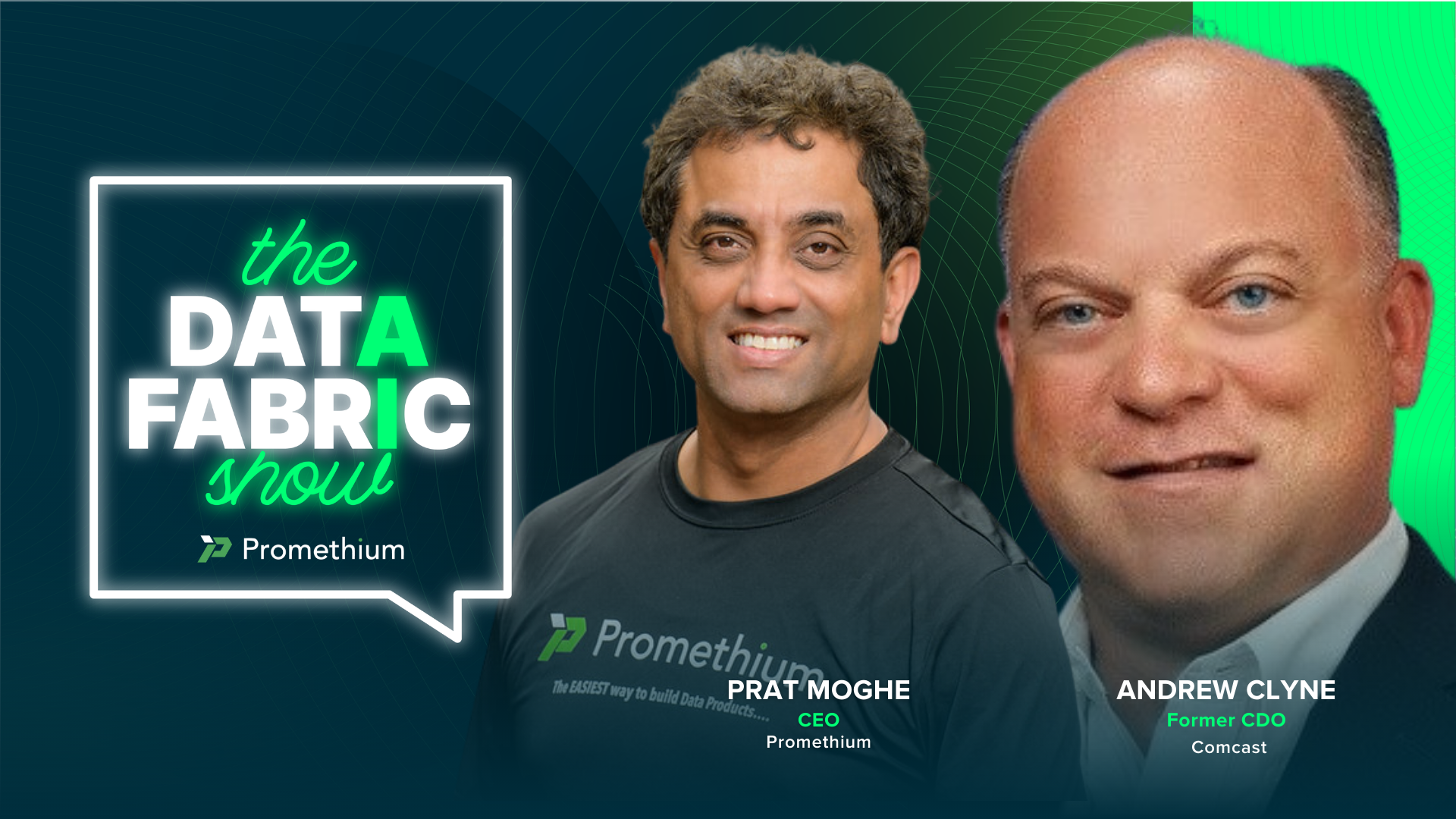
Host: Prat Moghe
Guest: Chandhu Nair
Prat Moghe: Hi everyone, this is Prat Moge, host of the AI Fabric Show. I’m super excited today — we have an amazing leader who’s joined us for this conversation on agentic AI and its evolution in the enterprise. I’d like to introduce all of you to Chandhu Nair, who is the SVP of Stores, Data, AI, and Innovation at Lowe’s. Chandhu, thanks again for joining. It’s great to get a few minutes of conversation with you.
Chandhu again has a long and illustrious career doing startups and being a leader at large, well-known institutional brands, including Staples and Lowe’s — and then, probably most consequentially, he’s just written a book on the enterprise brain, a collaboration between him and two other leaders in the industry. So I’m really excited to get to know his journey, get his perspective on where the industry is going and what organizations can do to learn, but I also want to learn a little bit about the book. Chandhu, I tried to get the book, but Amazon unfortunately delayed the shipment. So I was supposed to get it last night and be up all night reading, but I didn’t get it in time. So I guess you’ll have to share with us what the book is about, and then we’ll make sure we let people know so they can order it as well. Anyway, thanks for joining, Chandhu. Really appreciate the time.
Chandhu Nair: No, thank you, Prat, for having me. It’s always exciting to talk with another leader who’s pioneering something in the AI space, so I’m glad to be here. And I’ll make it a point to make sure you get the book soon. But happy to talk about it today.
Prat Moghe: Okay, awesome. So, you know, I’m firstly super curious, Chandhu. I know you’re based in Charlotte, but your journey in the US has gone all over — I noticed you were in Boston, the great city I live in now. Just going back to where you grew up and your early years, what sparked the idea and the excitement for you to think about data, AI, and retail? I know you have a lot of interesting analytics background. What sparked that? If you could share some of your early journey and the mentors that shaped you.
Chandhu Nair: Absolutely. So I’m originally from the southern part of India. Traditionally, as you probably know, Prat — you grew up there — you were either looking to be, or your parents wanted you to be, an engineer or a doctor. My parents wanted me to be a doctor. I couldn’t see blood, so that was off the table pretty quickly. But I did like computers. So I started playing around with computers, did my degree in computer science, and I’m an engineer at heart — that’s how I am. But I’m an engineer who likes to connect things, connect people, bring solutions, and build a company around it. So that’s been my mental model, if you will.
Now, a lot of things, just like for any young kid growing up in India, come through being at the right place at the right time. That was kind of how I got into retail. This was the early 2000s — just like we’re talking about AI now, e-commerce was the big thing then. I happened to work at a very early-stage startup, a spin-out from a large company that was doing the back end of e-commerce: order management, shipping, logistics. Being an early engineer there shaped my thinking around how fast the world is evolving. That eventually got acquired and became part of IBM’s commerce practice. And that put me on the map with retail, because the next phase for me was literally trying to implement this technology in various retail or retail-related spaces.
That’s what got me to the US, again in the early 2000s, originally with DHL, as DHL was running the 3PL for a lot of e-commerce — for the Nikes and Microsofts of the world. So that’s where I got started, in Scottsdale, Arizona, believe it or not. And then I started moving diagonally toward the East Coast. For some reason I must have loved the weather, the cold, and the snow — I don’t know why. I did a gig at Gap launching the Piperlime brand — essentially bootstrapping in an empty building, with all the automation, all the data, getting the e-commerce side going, getting the shoes shipped out. Those were, to me, a very formative part of my journey.
And then I decided to come to Boston, a city I love. I spent the majority of my adult life there before I moved to Charlotte. I did my master’s there and worked at Staples. At Staples, I saw two things. There was definitely a pre-2008 period and a post-2008 period. There was a transformation our CEO brought in — he brought in a lot of West Coast leaders, mostly from Amazon, eBay, and so on. One thing that struck me — fantastic leaders — was how they leveraged data to drive the growth of the e-commerce business. And they gave me plenty of opportunities.
The second thing that has always helped me — talking about being at the right place at the right time — is that there’s always a helping hand that pulls you forward to the next thing. I’m grateful and lucky to have had a lot of leaders who’ve helped me along the way. It was one of those leaders who pulled me into that space, looking at running the retail business with a very data-centric mindset. And then it became, how can I harvest the data for more and more? — and I started running the analytics space.
To the point where I was starting to work with a lot of the Boston-area startup ecosystem, which was fantastic exposure for me. That’s one thing Boston definitely provides, Prat. When you start working with startups, that bug will catch you at one point or another. So I decided to go build my own startup, and I created a company, Cognitive Retail, which looked at all of the camera systems in the stores to help drive optimizations around the store — store safety, et cetera. I could see firsthand the power of AI. This was not when AI was as popular as it is now. But my time building the startup and really trying to scale something with AI gave me a lot of lessons that I carry to this day as a leader.
And then the next opportunity came when COVID hit. We went through some changes within the startup, but I knew some leaders — again, the helping hand — at Lowe’s, and I decided to come here and work initially in the marketing and digital space, and then took on the broader data and AI challenge. And then the world got turned upside down in November of 2022 with ChatGPT, and that’s been the journey. But the theme has always been surrounding yourself with great people, getting the mentorship and the helping hand from the right mentors, and always being a curious, continuous learner. It’s very important in today’s world, as you’re going through that same shift with AI and generative AI.
That’s been my path. There’s something you learn every day, just from the people you meet and everything you can read about these days. It’s much easier to learn now.
Prat Moghe: Yeah, a hundred percent. Well, thanks for sharing that. I ran into your CEO recently, just this past week, coincidentally, and he’s very excited about AI and what it can do. What struck me, Chandhu, was the clarity of thinking, from the top all the way down, in terms of what AI could do, how it could help, and how it fits in with the organizational goals and objectives. I was very impressed with that. So I learned about Mylow and a bunch of other cool things.
So let me ask you this. The book you’ve just published, The Enterprise Brain — I found that perspective fascinating. A lot of people are talking about AI, how to adopt it, and what you can do with it. It feels to me like you’ve gone further: you’re really thinking about it not as a technology, but about the truly transformative power of AI and putting it into practice. So could you share what the book is about, what the genesis of it was, and some of the key tenets you outline?
Chandhu Nair: Yeah, absolutely. But before I do, I should say I’m glad you met Marvin. He’s been a big champion of this. It really goes down to that top leadership being able to connect the growth of the business with it. To me, there’s a lot of talk about AI and productivity, but AI is really about the possibilities. If you start there and anchor that to your growth strategy for the enterprise — I’m grateful to be working under Marvin and his set of leaders, who were all thinking that way, and that makes a lot of my job easier.
So, not to digress, but coming back to the book — you’re absolutely right. The book is called The Enterprise Brain, and we kept that name intentionally. The core thesis is this. If I were to take you back to the Industrial Revolution, the machinery — which was really the technology of that time — decoupled the muscle from the core business, or enterprise, because the machines could do more than the physical limits of a human. But what that also meant was that businesses had to build factories and redesign themselves around it. This decoupling of the physical muscle from the enterprise meant you had to redesign it: new factories, new job titles, new layouts, new flows. Everything changed. That was the first decoupling.
The second decoupling is what we call the decoupling of the nervous system of the enterprise. With digital — with computers and the internet — you could collect a lot of data, more than a typical human can process at any point in time, and you could share it across the world. That meant you again redesigned the enterprise around it. You have global supply chains, manufacturing in different parts of the world, your workforce in different parts of the world. So while it was a technology shift, as a business you redesigned yourself around it. That was the second decoupling. The muscle got decoupled, the nervous system got decoupled. We believe this third decoupling is about decoupling the brain.
That’s what AI is doing. If you can create an enterprise brain that’s much more powerful and intelligent than any single human brain in an enterprise, you take away a lot of the information asymmetry that happens in a traditional enterprise. But that also means you have to redesign your enterprise around it. So that’s the real transformation. It’s less about the technology shift itself. The technology is a critical part of building the spine, but you’ve got to build everything around the spine. If you want to move from speed to decisions, to speed to actions — just like how your brain makes you do things — you really have to redesign it.
So that’s the core thesis of the book. We intentionally said this is not about predicting the future or trying to make it a playbook for everybody — we wanted the conversation to start. And it has to start with people. It has to start with how you enable people to have the superpower and take away the information asymmetry that may be limiting them in what they do today, so they can redesign what the new factories and the new global supply chains would look like. We walk through some of our thinking and frameworks around it, and then the technology side of things — truly an enterprise operating system view, if you will. So that was the thesis of the book. Hopefully it comes to you soon from Amazon.
Prat Moghe: Yeah, I’m looking forward to it. Can you give one or two simple use cases so people understand what that means — in terms of applying a technology versus designing the process to leverage the technology? You’re basically talking about rewiring the process to take advantage of the technology.
Chandhu Nar: That’s absolutely right. In our world, we call it: as a business leader leading a specific function, you have to reimagine the business. As though you were starting the business today and had the leverage of this technology, how would you rethink it? I’ll give a simple example of what we were trying — you just talked about Mylow.
Mylow is our online agent. Anybody, digitally, can come in and ask any home-improvement question. And we have a similar one called Mylow Companion — an agent we’ve deployed in the stores. If you think about a Lowe’s store, it’s a hundred-thousand-square-foot store with multiple departments and categories, right? From Lawn and Garden — I’m sure you’ve gone through some sort of home-improvement project — to appliances, lumber, rough plumbing, and electrical. I do a lot of store walks myself, learning how the technology is getting operationalized, and you have to wear a red vest and walk the store. There are a few aisles I don’t walk when I’m wearing a red vest — like rough plumbing or electrical — because if a customer came and asked me a question, I wouldn’t know the answer.
And it was very difficult to solve, because you had trade specialists who could do it — you couldn’t pick somebody from Lawn and Garden and make them work in other departments. We used to have hours and hours of training to help associates get trained on all the different categories. But these categories are evolving, each product is evolving. We’ve got forty-thousand-plus SKUs in a store, so it’s hard to train everybody on everything.
Talking about the possibilities with AI, now you suddenly have an opportunity with generative AI to have this companion — a set of agents inside it — that can help you address any project solution for your customer. How to build a deck, how to build a raised garden bed, how to fix a leaky faucet — it doesn’t matter, it’s all available to you. So that’s the solution. But if you think about that solution, you now need to change how your associates in the store support the different categories. That process has to change. You have to give them the confidence that you have this tool.
So we had to work with the store operations leaders — it was a hand-in-hand partnership — and we worked with several stores in this process to say, “Hey, when a store manager does a Monday-morning walk, how do you let associates know they can just use this tool, so they can now support multiple categories? How do you create champions in the store who can help drive the adoption of these tools?” So, fundamentally, how retail operations used to work — in retail or home improvement — you now have the possibility of reimagining that completely with this.
To put that in perspective, those are some of the learnings we had. Because the technology by itself, if I just rolled it out as one more app in the store, really didn’t matter. We had to drive up the confidence of the associate, we had to make them feel good, and we also had to get feedback and change. I’ll give one more anchoring example around that. We had a lot of ideas on what this product could be, and all the features — just like any product team would have. But once we rolled it out to about 10 stores, we realized one of the things every associate was doing was speaking to it — and then the agent would respond back and they would listen to it. That’s because nobody wants to type on the phone when they have a customer in front of them. So we said, okay, we need to make it voice-based. We consistently collect that feedback from the floor, and then the training and enablement also had to change. So it was very much a hand-in-hand operationalization and reimagination of the store workflows alongside the technology roadmaps — if that helps.
Prat Moghe: What was the biggest surprise for you as you saw this? Anything that clearly stood out where you thought, “I didn’t expect this. This is a non-obvious thing”?
Chandhu Nair: Yeah, I think the biggest surprise — we initially thought this would be super helpful for some of the newer workforce. If you get hired in, you’d expect to need much more help. But what we saw was several tenured associates in the store, who had spent years in, let’s say, the paint department, now using the tool, because they’re confident to go work in other areas. We thought the trend would be that the newer workforce coming in would obviously use the tool, but what surprised me was how quickly — it’s actually the fastest-adopted tool in the store environment to date. And that’s credit to the business leaders and how they operationalized it, how they reimagined the business, how they worked with both the newer and the tenured workforce and gave them the same level of confidence.
Prat Moghe: Got it, that’s awesome. By the way, I was in a Lowe’s store just a couple of weekends ago, my wife and I. We were looking for houseplants. We get like seven or eight plants, we put them on the cart, and then we’re both looking at each other. We have two Siberian cats at home. So we’re like, wait a minute, which of these plants are the cats allergic to? And we were on ChatGPT trying to figure it out. That took me back — and I didn’t realize this, but maybe Mylow could help me. If I could say, “Tell me which of these plants are toxic,” or things like that — this is something that could really help shoppers.
Chandhu Nair: Absolutely, that’s what Mylow does. And we enable the same on our app and on Lowe’s.com. So you could ask that same question and get that answer, because those are real problems. The key was to make sure we address real problems for our customers and our associates — and to do it not just as a technology solve, but to operationalize it with how you rewire your business around it.
Prat Moghe: Yeah. So change management is something I think you note a lot in your blog posts, and I’m sure it’s a big part of the theme. How do you get an organization rewired? Assuming this technology is here, Chandhu, what are you seeing in terms of how you get folks to change, to adopt? Changing the business process is not easy. How do you re-engineer? Any observations or thoughts for business leaders and tech leaders to take away, in terms of do’s and don’ts?
Chandhu Nair: Absolutely. And look, I’ll say this with the caveat that we’re still learning, and it’s continuing to be adapted and evolved. But number one — you talked about our CEO, Marvin — it comes top-down. We intentionally created very specific “leadership in the age of AI” programs for our ELT and SLT leadership team, and every officer-plus in the company, as a way to make them rethink how to lead in the world of AI. That was a big part of it.
Two, it was important that, as leaders in a company, we set the example by using the tools available to us — using them in our staff meetings and things like that — so that everybody feels comfortable doing it.
Third, we had to anchor on the point that it’s about the art of the possible, and that it can really superpower you as an associate, no matter what function you do. That was a big part of how we worked with HR, our training partners, and our communication partners around it.
The other thing we’ve done is work with every business function to run these reimagination, rewiring sessions to help them think through this. I’ve got a transformation office team set up to look at that and track it to the outcomes, so we can see whether the leading indicators on adoption are happening. Is that a technology solve, or is it because you need to rewire something in the workflow or process? We start by looking at the processes, the workflows, the skills, and then try to see what needs to evolve or change.
But it’s not a one-time thing — it has to be ongoing. We enable the business functions with the tools and the workshops that are needed to bring them on board. It’s a continuous journey, because some areas — like field roles: stores, supply chain — there are different techniques that apply. And then, what I’ve also learned is that in the corporate headquarters — the store support centers, or SSCs, as we call them — a lot of knowledge functions require very different types of change management, methodologies, and tricks. We continue to put that into a playbook and continuously adapt. And reinforcement learning, just like in AI, is key for humans as well.
Prat Moghe: There’s also sometimes, in a rollout, very high expectations and at the same time very low tolerance for things that don’t work out. Have you seen that, and if so, how do you manage it?
Chandhu Nair: Yeah. I think it’s important to start small and iterate with all of these things. In fact, Mylow Companion is a good example — we started with really two stores and iterated. In the age of AI, you can build and make changes fairly quickly, and if you have a committed business sponsor for that line of business, you can work with them to iterate. But it’s also about setting expectations. When we started, we said, “Hey, this is only going to be sixty percent accurate,” because to bring in all the tribal knowledge and wisdom that’s there in the stores, you need to get the associates to engage with the tool and tell you whether the feedback and the recommendations are right or not. But we set expectations up front, saying the more you use it, the better it gets. And then there were things we thought would work, like I said in the roadmap, and then we found that’s not what the associate wanted — they wanted the voice. So we had to be very nimble and pivot.
So we created a good initial measurement framework to identify the leading indicators. Before you go to lagging indicators, like financial outcomes, let’s make sure the leading indicators are taking us in the right direction. And if they’re not, then we have to make choices. That’s an ongoing exercise in how you roll this out. Starting small and iterating is super key. And it’s also important, from a culture-of-innovation standpoint.
Prat Moghe: So engagement and those kinds of things could be the leading indicators you want to make sure of.
Chandhu Nair: Correct. Engagement, net promoter scores — we use something called LTR, or likelihood to recommend. It’s now been a year since we rolled out, and we see about a two-hundred-basis-point improvement in LTR, which is significant for a store. So we track that. And we know that as we do, service levels get better, which means sales get better, and we can track that as well. So that’s the idea.
Prat Moghe: That’s awesome. Any parting advice — particularly, we talked quite a bit about business leaders, but there’s also a transformation in tech, and in leaders who understand agentic AI. How is the role of the data and AI leader shifting, Chandhu? Any thoughts, or advice to other aspiring leaders in the profession?
Chandhu Nair: I would say, from my learnings, two things. One, you have to be very nimble and a curious, continuous learner. You know this, Prat — you’ve got frameworks coming at you every hour. The models are improving by the minute, which actually means the scaffolding you’re building to build applications is getting thinner. So you have to be very nimble and pivot away from how you’ve traditionally dealt with data — from surfacing up insights to actually going into agentic actions or human actions. It’s a combination of both. That’s an important part.
Two, thirty percent of this is technology; seventy percent, I believe, is all about driving change with your business sponsor. It’s really bringing them along and helping them reimagine the business — not saying you know how to run their business, because I don’t, but here’s how you could think about it in the world of AI. Helping them understand this goes a long way in building credibility, and in getting them to give you the space, like you said, to iterate and test new things. It’s important, because this is happening fast. I always call it a fast race on a tightrope. So you have to balance that. And I think your traditional data and AI roles are becoming much more of a transformation role. There’s a tech component to it, no question, but it’s becoming much more of a transformation role.
Prat Moghe: Awesome. Speaking of that, I’m looking forward to seeing and reading the book. Chandhu, thanks so much for joining us and sharing very interesting perspectives. Really appreciate the time and the conversation.
Chandhu Nair: Thank you, Prat. I really enjoyed the conversation as well.
Prat Moghe: Awesome. Thanks. Take care. Bye.
Chandhu Nair: Thanks.
SHARE THIS: