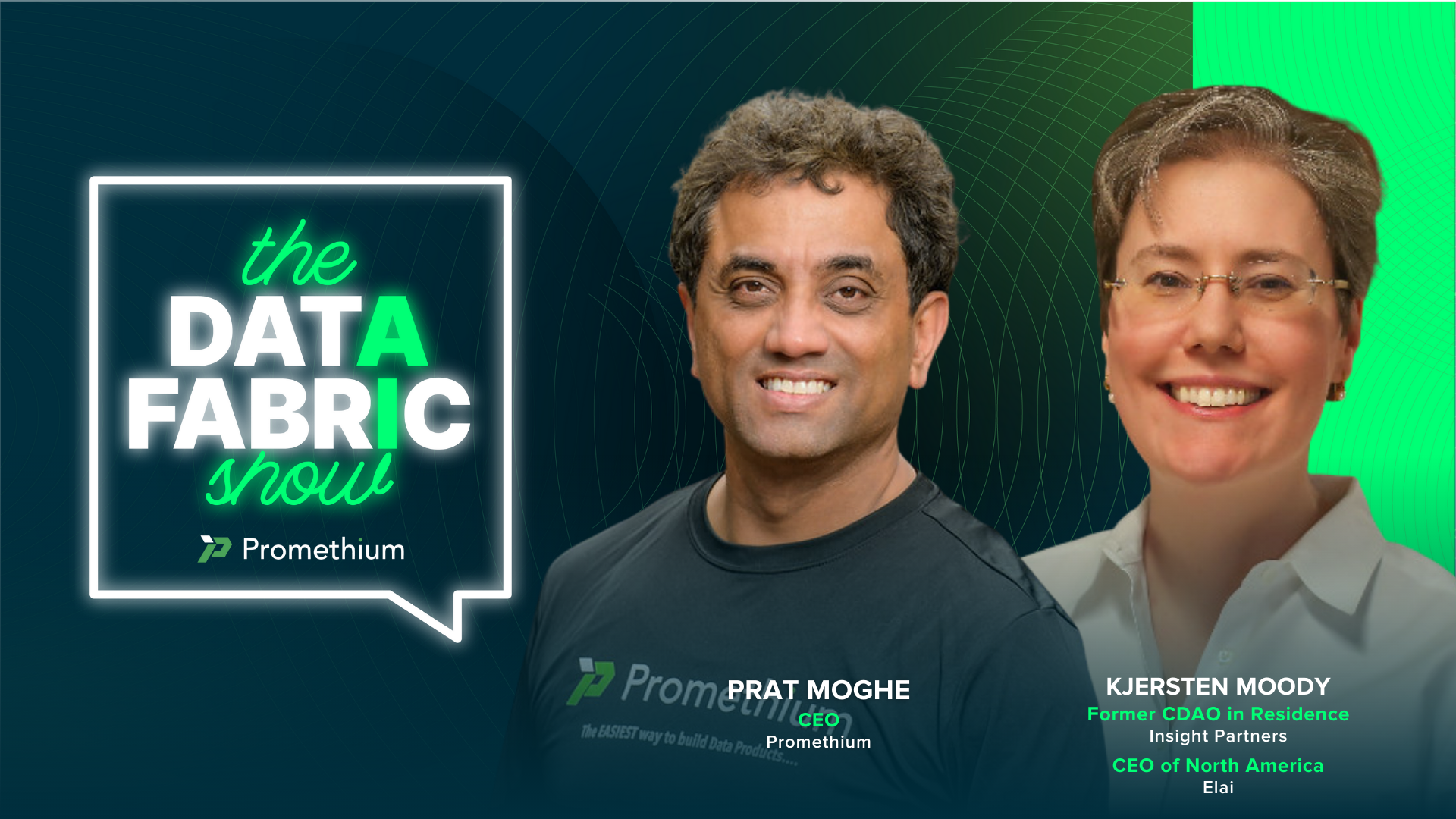
I sat down to talk to Kjersten Moody, former CDAO in Residence at Insight Partners, and former CDO at Prudential, State Farm, Unilever and now CEO of elai, about her amazing journey and lessons for all AI & data practitioners.
Here are the top takeaways:
- To be successful “globally” in a large organization, it is super important to think local first. Kjersten’s learnings on the power of data at Unilever, were to truly understand the customer. As an example, they drew insights by combining internal and external data to optimize the product stock and timing in convenience stores next to schools, hyper focused around meeting the needs of kids and their parents when schools got out. Same product, same pricing, same stores, huge difference in impact, upsell and customer sat.
- Governance is not a liability – it is actually a huge asset for AI – it allows AI to get deployed faster and by more folks in an enterprise. Her analogy (from State Farm) was to liken it to “brakes”. How fast would you drive without brakes? I love this analogy because all of us think of governance as friction, but it can actually be liberating if framed the right way to enable speed.
- AI changes everything. Kjersten is now seeing how CEOs and Boards are curious and opinionated about transformation. She believes we are at the “beginning of the beginning” of democratization (the dreaded “D” word), where capabilities and cultural acceptance will drive every part of an enterprise to use data and insights to drive competitive outcomes. Kjersten believes it is a unique time for all CDAIO’s and leaders who can engage meaningfully with the business and lean into this opportunity.
There is a lot more here in the full podcast. (Click here to listen on Spotify or Apple).
Full Transcript of the Episode
The AI Data Fabric Show
Guest: Kjersten Moody
Host: Prat Moghe, CEO of Promethium
Prat Moghe: Hi everyone. This is Prat Moghe welcoming you back to the next episode of the AI Data Fabric podcast. I am super excited to welcome Kjersten Moody. Welcome Kjersten.
For those of you who have not heard about her in the data and analytics community—and I think it’s a minority of you—she’s been a serial accomplished chief data officer, analytics officer, AI officer. I’m really excited to have her on the show and hear about her journey. She has a long journey and I want to ask her a whole bunch of questions on that journey, including running as a CDO at large enterprises—Unilever, State Farm, Prudential, forgive me if I’m probably missing one or two more. Most recently she’s at Insight Partners, also guiding where this industry and the markets are going in terms of data and analytics. I want to hear more about that and more.
So Kjersten, really excited to have you on the show.
Kjersten Moody: Thank you. Excited to be here. It’s my honor. Thank you.
Prat Moghe: So Kjersten, first off, you are I think the shining example of folks who figured it out and figured out the challenging role of running data, running analytics, helping do the AI transformations in the business. I’d love to ask you questions that help flesh out dos and don’ts so that we can have some practical tips for the peer group—either aspiring CDOs, enterprise leaders, also the business leaders who are looking and hearing about AI and they have a lot of questions on how do you actually transform.
So maybe we start first with where did you grow up? What was the professional training? How did you get into this line of work?
Kjersten Moody: Happy to. Thank you very much for having me today. My professional training actually has nothing to do with my career path. I’m trained as an economist out of the University of Chicago and originally thought that I would be entering into either the foreign service or banking.
When I graduated, we were right at the very beginning of what today we would brand as digital transformation, but this was in the dotcom era. I ended up actually working in consulting, which was a small regional consulting firm based out of Chicago, working with a variety of mid-market and large enterprise clients to take that first generational leap of digital transformation—taking processes from paper and building out the new definition of process and how you could use computers and digital technology to make that more efficient in some way. That’s really how it all started.
Prat Moghe: But you had a quantitative background because of the econ training?
Kjersten Moody: Quantitative background, and then you started in consulting which meant you needed to talk to business and figure out what they needed.
Prat Moghe: Exactly.
Kjersten Moody: And then I really learned the programming part of it, the software part of the skill set on the job. It’s an unusual career path, but as I’m into it, it’s been incredibly beneficial to have had a quantitative but not technical formal training and then these amazing formative professional experiences in technology, in working with the business. And then having over the last 15-20 years or so roles that have really required the merging or the blending of those two types.
Prat Moghe: You were blazing the trail. So the first part of your career was in Thomson Reuters and Unilever, right? What were the takeaways when you are in industries like CPG or retail? Particularly as you think about it as a CDO and analytics—I mean these are typically very fast, intense, fast-paced industries where analytics really matters to the business. What were the takeaways and learnings there worth sharing with the audience?
Kjersten Moody: A couple of key takeaways. At both companies—and any company really—the number one thing to always keep at the forefront of the mind, if you’re coming from more of a technical or functional role and expertise, is you have to understand the business and the domain and the customers that you are serving. It’s not a super cool technical playground. It’s actually a business where the work you are doing needs to be driving some portion of that business in measurable ways. That is the number one lesson anywhere.
Unilever, if I can double-click on that for a second, is a massive global business—really a beautiful business actually—but it is truly massive. There was this phrase that one of the senior leaders in finance shared with me which is: “If you want to be more global, you actually need to be more local.”
Prat Moghe: Interesting.
Kjersten Moody: It sounds like a paradox when you first hear it, but it’s so true. It’s not just about the abstract notion of the customer. To really deliver, you have to be local and respecting the needs of that local customer to understand how to apply your technical skills to move the needle for the business and for the consumer groups that you’re serving.
It was a very important lesson in what does it really mean to serve customers in their context, not in your context as an AI leader or as a global leader.
Prat Moghe: When you think back on the Unilever journey, is there an example that stands out in terms of an interesting or challenging problem, or maybe something that didn’t work and there was a learning from there? Anything that stands out in terms of uniqueness or impact or challenge?
Kjersten Moody: It was a magnificent role. Pretty much everything in the portfolio has a good story attached to it. There’s one that stands out in particular because it was a very stark and good example of the power of data.
In Southeast Asia we were working on distribution routes, and we had incredibly rich data from our own systems. What we did is we took cell phone data—just tracking movement of people, perfectly legal in the jurisdiction where we were—and we were able to blend that with the internal data that we had. We had insights, very simple insights, around how people were moving relative to how we were moving our product for restocking and so forth, and found a number of disconnects that in retrospect were super obvious but were never revealed until we started to think about our input data sources.
Things like: we have a convenience store next to an elementary school. So we really should be restocking that convenience store before school lets out because parents pick up their children and they stop in for a snack. And the mix in this particular convenience store really should be optimized for kindergarten through grade five, not adult workers coming off a night shift.
Very powerful insights that turned into a 4% overall sales uplift in that geography where we were testing it. We didn’t change anything about the product. We didn’t change anything related to pricing or promotions. It was simply driven by the insights from a combined data set—external and internal—and asking the right questions for the business against that data.
It was a very powerful and tangible example of just being smarter about data can truly drive outsized business results.
Prat Moghe: Very cool. And then when did you have to start thinking about building teams? How did you go about doing that? I’m sure that’s different when you went from Unilever to State Farm to Prudential—very different—but in general, what are your takeaways when you think about a CDO building a team? What do you look for in terms of characteristics and skills? What makes a good functioning team?
Kjersten Moody: I’ve had the privilege of doing some type of team building in each of the data officer roles where I’ve been. I think the most successful result of that was where I spent time with my peer group in the technology department, with my stakeholder and sponsor groups across the business, and really listened to what was needed and what success could look like.
From there we were able to put together a mission, a vision of what the data office was going to be working on. Here’s what we do. Here’s what we don’t do—that’s a very powerful statement actually: here’s what we don’t do. And then from that flows a few things that are very important for a team: here are the jobs that we need to accomplish the mission and the vision; here is the operating model—how we are going to integrate into the larger ecosystem of the enterprise; and here is the sponsored first generation of initiatives that come with their own success criteria, contribute into the overall enterprise vision, and are funded. So the team can hit the ground running with purpose.
When you have that, you can start to demonstrate earlier wins. The teams that are forming are really energized, and that energy sustains itself over time. The momentum within the business continues to accelerate because you have smart people who understand their job, who know the purpose, the mission, and the vision, who are executing in that first generation of portfolio, building trust with the business partners. You can take your hands off the wheel a little bit and let the scale of the team that you’re building start to propel value within the enterprise.
Prat Moghe: In that situation, do you typically hire most people new? Do you move them from inside? Do you do a combination? What has typically worked for you?
Kjersten Moody: It’s a combination of both. Within large enterprises, there’s a lot of institutional knowledge.
Prat Moghe: Correct.
Kjersten Moody: And there’s a lot of very trusted relationships that have come from longer tenures within that enterprise. Those are incredibly valuable to have and to generate goodwill for what is a new, potentially a little bit riskier portfolio relative to maybe what has been undertaken in the past.
When we get into the AI space, new skills, new ideas, the fresh thinking, the importation of experiences from other enterprises—that’s a very healthy mix. Really looking as a common denominator for individuals who are very comfortable working with other individuals. The teamwork, the collaboration, the acceptance of open and honest debates.
Prat Moghe: You brought up teamwork, which is obviously super important. What is your frustration when you look at—is there any common frustration where you’re like, if I had this I would have gone faster, or I would have taken the risk out, or I could have sold this better? Anything where—I mean you’ve been super successful, don’t get me wrong—but I’m just curious directionally, do you feel like there is something that’s a drag that holds people back?
Kjersten Moody: There’s two things. If I translate your question: if I had a magic wand, what would I change?
Prat Moghe: That’s correct.
Kjersten Moody: I joke that my magic wand got lost in the mail like 30 years ago. It still hasn’t arrived. But in the event it were to arrive, what would I change?
The first is in American business—but it is observable globally—in particular in American business, we’re very nice in certain ways but it can translate into passive aggressiveness. There’s agreement in the meeting and then there’s non-agreement in the behaviors after the meeting. I would much rather have the open and honest debate where we can arrive at what we’re going to do and the behaviors match that conversation.
The second thing relates to the business strategy at an enterprise level or at a P&L level. If the success of the execution of that strategy does not require the use of these new capabilities like artificial intelligence to be successful, then you’re taking a very powerful potential and you’re making a statement about it—in a sense—that it is not mission-critical for the execution of my strategy and the meeting of my goals.
Prat Moghe: Right.
Kjersten Moody: For all the words that we might say about it, the incentive structure does not require the larger enterprise to figure it out and go through the culture change of bringing AI into the daily ways of working.
I don’t necessarily think that’s intentional. It’s just that the strategy hasn’t always taken that next leap to require the power of data and AI in order for it to be successful.
Prat Moghe: Do you feel AI is changing that, Kjersten? Just by the fear of—the FOMO kind of driving this idea of “oh I need to have AI”—and then you ask the question of “what could I do with AI?”
Kjersten Moody: Exactly. I think boards are changing it, honestly. Management teams are starting to change it, but boards are very much asking the question: educate us on AI, tell us how AI is coming into the business and elevating results. The governance layer for the enterprise and for the management team is asking more direct, more pointed questions, which is prompting the change within the enterprise.
I think management teams are becoming more comfortable with it, or at the very least becoming less comfortable with the fear of missing out feelings and just saying “okay, we just need to do something about this.”
It is changing, and I want to give a lot of credit to business leaders and boards for pushing themselves in the direction of that change. As somebody who’s coming from the data and AI world, I can see clearly what the potential is. You always wish that it would change faster, but the direction is largely correct and I think the momentum will continue to build.
Prat Moghe: You made this comment to me which I thought was interesting—about what is really different as a CDO, what do you see exciting that was not possible before with AI—and you talked about the D-word, the “democratizing.” Tell us about that.
Kjersten Moody: Democratization has been used for decades as it relates to this, and it was an unfulfilled promise for a really long time. I can remember 15-20 years ago looking at kind of low-code, no-code proto-solutions and thinking, you know, one day this is going to be great, but not today.
Now I believe we really are at the beginning of the beginning of what real democratization—capabilities and cultural acceptance—looks like for access to data, management of the data, the building, the deployment, the maintenance of models, whether it’s on the predictive side for machine learning type models or generative AI.
That is incredibly exciting because it’s taking these very powerful concepts from kind of the metaphorical corner of the enterprise portfolio of work and really bringing it front and center and infusing it as a way to drive competitive differentiation for the business.
That’s amazing. That’s a moment that many of us have been waiting for for quite a while, and to experience it within my professional lifetime is pretty special.
Prat Moghe: It certainly does infuse energy into the CDO role, right? The purpose. What would you say are your top lessons or takeaways in terms of succeeding in that role? Because one of the things I’ve seen commonly—and seen that firsthand—is the role requires a combination of tech and business skills, and that’s not an easy combination. Any lessons in terms of how does an aspiring candidate for this job prepare themselves? How do they educate themselves? How do they advocate for themselves?
Kjersten Moody: I think there’s a lot. We could talk for hours. The top three that immediately come to mind:
Lesson number one: make sure you are becoming a trusted partner, a trusted advisor of your business—especially if you’re coming from more of a technical background—to really learn the business domain that you’re serving. So you’re not speaking your language to the business, you’re speaking business language to the business. That is an unlock for integration of the capability and the potential that data and AI represent, to infuse that into the business strategy and really have business leaders willing to go on the journey with you.
Prat Moghe: By the way, you’re giving me a really interesting example, which is: if you are that person who wants to do this, go spend time at the right conferences as an example, right?
Kjersten Moody: 100%. If you’re from a technical background in insurance—I’ll just go ahead and say it—skip the technical conferences for some period of time and go to the industry conferences. If you’re in the consumer products industry, go to the retail conferences, go to the Gartner conferences, go to the LIMRA conferences in the life insurance industry. Go where your business partners are going.
Prat Moghe: Yeah.
Kjersten Moody: And listen and learn and think about what this is. It’s an eye-opener, and I highly recommend doing it. There’s so much technical training that is available for free online, typically within organizations, that for a certain period of time you can compensate through self-study in keeping your technical skills fresh.
The second thing is results. You have to show results, and those results need to be expressed in a metric that the business understands and that is provable. If you’re working in growth, ROI, margin improvement, speed to market for something—the KPIs that you use to measure yourself, a portion of those can be personal and about a data office, but the ones that you really need to treasure and take care of are ideally shared with the business community that you’re serving, to make sure that your entire portfolio is organized and in service to some portion of the business.
Prat Moghe: If you’re interested in that one—talking to several other CDOs—that is usually not an easy one, because some of these KPIs are so high level and data is enabling something that then feeds into something that then allows something to happen. So to a large extent this is about who you report into, how do they help you frame it, right?
Kjersten Moody: Yeah, I mean, if you’re working in the first generation of portfolio with a particular P&L as a primary sponsor, go talk to the CFO of that business.
Prat Moghe: Yeah.
Kjersten Moody: The answer’s there. You just—
Prat Moghe: Basically it’s about going and putting yourself in a position where you draw out what is important.
Kjersten Moody: Yeah, exactly. And you’re 100% right—it’s not easy, but it’s certainly not impossible either.
Prat Moghe: And you’ve always reported into business, or you reported into IT, or you—
Kjersten Moody: For most of my career I have been in the technology organization. At State Farm I reported into the CFO. But other than that it has been in the technology organization.
Prat Moghe: And that has clearly not held you back because you were successfully able to build the bridges, figure out what’s meaningful to the business, and work it backwards.
Kjersten Moody: Exactly. And then the third major lesson: be very careful and hire a great team. As C-suite departments scale, you find yourself being less and less hands-on unless you’re very intentional about it. But there’s a tremendous amount of work and you really need to trust the team that is executing against that vision.
Who you hire, who maybe you say goodbye to, are some of the most important decisions that you will make as a leader, because it will really make or break the execution of vision if the team isn’t up for the environment that you’re working in.
Prat Moghe: Do you believe you are able to attract the right people? That’s not easy—with AI there is a bit of a divide now where there’s the traditional thinking and then the AI thinking. You’re seeing that even in the startup community where the AI-first or AI-native startups are reinventing how things are done, how the stack’s built out, how the experience goes. How do you see that percolate into large enterprises which are hierarchical, methodical?
Kjersten Moody: It is a culture clash. There’s no sugar-coating the problem. I don’t think there’s a new formula really for it, so you go back to basics when you have these sticky technical but also cultural moments that you need to work through.
Are we aligned on the destination we’re going to? Who needs to be sat around the table? We need to work through it and make sure that we have alignment. And let’s not let perfect be the enemy of good. The win is progress and demands for results that allow for continued successful execution.
It’s about what, it’s about why, it’s about understanding how we’re going to start this pivot. And then the upskilling, the reskilling, the purpose, the energy of the teams that need to do the engineering work—which is an incredibly heavy lift.
It’s a leadership moment. The enterprises that are making that pivot faster than others—I think if you look inside, you will find the animated, trusted leaders who are helping the large organizations make that pivot faster.
Prat Moghe: And it comes from the board, CEO on down?
Kjersten Moody: Ideally, yes. Ideally.
Prat Moghe: We talked about what scares you with AI, and how you blend that into speed. You had some very interesting analogies. Please share that with the audience.
Kjersten Moody: A colleague at State Farm shared this phrase with me. He said, “Kjersten, why do cars have brakes?”
That’s a puzzling question. The answer is actually: cars have brakes in order that you can go fast. Imagine how fast you would feel comfortable driving if your car had no brakes. You would probably never go more than one or two miles an hour, and you would certainly never go downhill. You would probably prefer the horse over the car if the car had no brakes.
That is an effective analogy for governance. Governance is a frame of reference within which teams and the enterprise need to execute. Governance with the philosophy of “why do cars have brakes?”—well, it’s so that they can go fast.
Here’s your frame of reference, and so long as you’re within this frame of reference—which is clearly defined and it’s easy to understand the dos and the don’ts and it’s well-provisioned with the tools to help you go—then your accountability as a participant within this frame is speed. It’s speed to market for competitively differentiating solutions for the business.
Prat Moghe: Super. That’s a very interesting way of looking at it. So any other thoughts you would like to share with the audience? And I know you’re on to a new thing with Insight. That sounds super exciting. What sparked that? What’s the mission?
Kjersten Moody: Insight Partners is a phenomenal investor in the space—really a top-flight institution.
Prat Moghe: I agree, by the way. Yes, fantastic.
Kjersten Moody: I have really had the privilege of working for the last few months as their CDAO in Residence, where I’ve had the opportunity—probably the most exciting part of it—to work with portfolio companies on a very wide variety of topics that are helpful to that portfolio company. It’s really an open agenda when we first meet, and then we start to fill it in and paint the picture of how to partner and really drive benefit with the new portfolio for Insight.
It’s a phenomenal team. I think their portfolio is really impressive. The feedback that I’ve received has been very helpful for the portfolio, and it’s been a phenomenal opportunity for me, coming from operating within a large enterprise, to really have the moments to get to know a wide variety of companies that are truly driving this paradigm shift that we’re at the very beginning of. It’s been incredible.
Prat Moghe: Awesome. Anything else, Kjersten, that you would like to add? This was great. There’s so much that you said. But I’m really excited that we got to talk. Just looking at the breadth of your experiences across verticals, size of companies, across different technology disruptions, and now with AI—and now you’ve got the front-row seat in terms of the new startups that are disrupting the space. Congrats. This is a great journey.
Kjersten Moody: Thank you very much. I think if I can just say one thing: I’ve been at this for a little while now. This is probably the most exciting era I personally have experienced. This is a very interesting, exciting, and important moment in business and in our personal lives for how we allow the adoption of technology and artificial intelligence into that.
It’s very exciting and it’s also very important. I’m delighted to be a part of it, and it’s wonderful to see companies such as Promethium participating in this paradigm shift, because that quality is necessary for the successful transformation and evolution that we’re working through now.
Prat Moghe: Thank you. Appreciate it. Well said. Thank you. Talk soon.
Kjersten Moody: Beautiful. Thank you. Bye.
Prat Moghe: Bye.
SHARE THIS: