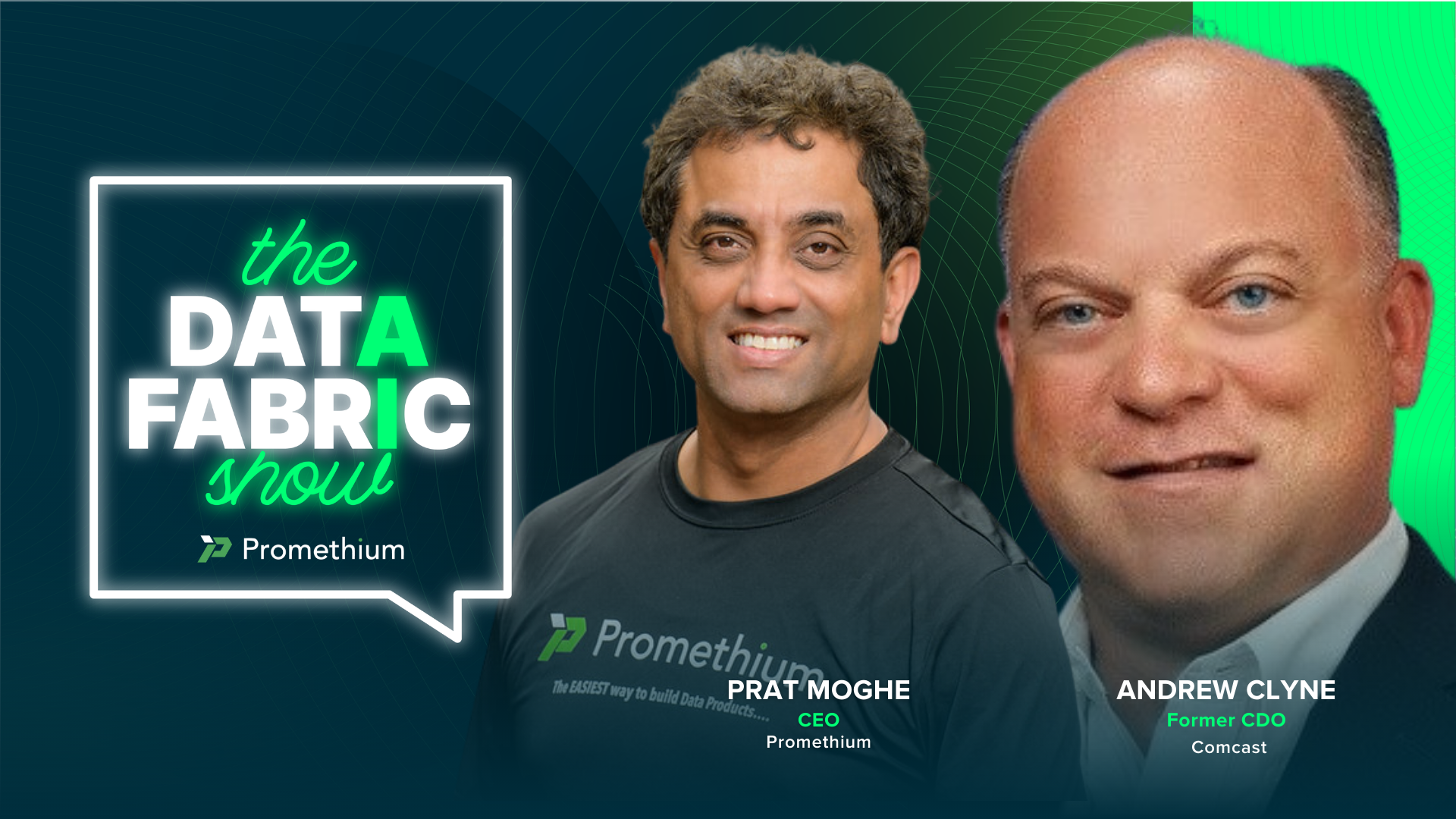
I had a great conversation recently with Andrew Clyne about AI, Data and Leadership.
Hear more for his amazing journey:
- Andrew is excited about AI, but cautious about its social impact and unrest. He believes there is a huge opportunity (& responsibility) to help blue collar and white collar workers with this transformation.
- He led some of the most formative data teams at companies like Comcast and Visa. At Visa, he bet early on big data and nascent technologies like Cloudera and drove new engines for data processing (like Impala).
- He helped build one of the first data warehouses at Mastercard launching analytics products that we all use today.
- He helped engineer the data dictionary and early standards for command and control systems in the Air Force, so that various components could interoperate.
- He takes his job like a mission and learnt his early lessons serving as a Captain in the Air Force and also served during Desert Storm.
- When I asked him what he is most proud of, he pointed to his teams that have gone to become successful leaders elsewhere
- He is a constant learner. He points to mentors like Rick Rioboli (CTO of Comcast) and how great bosses make all the difference and explains the importance of empathy and putting people first.
- Fun fact – as a 16 year old in St Louis, Andrew got his flying license before his driving license. He is an avid flier to this day.
Listen to the episode on Spotify or Apple Podcast.
Full Transcript of the Episode
The AI Data Fabric Show
Host: Prat Moghe
Guest: Andrew Clyne, former CDO of Comcast
Andrew: If you were to ask me about 10 months ago who my favorite, most productive employees were, I would have given you a list of six names.
It’s Grok, Gamma — the things we can accomplish using AI are exponential. Throughout my career, I was the data guy in the back. Now you need CDOs and CDAIOs to drive top-line growth. Everyone’s going to be looking at that and saying, hey, let’s speed up our adoption of AI — but at the same time, you’ve got all the legacy challenges, especially in big enterprises, that you have to deal with. I’m concerned about the social unrest and the social implications today. We see a K-shaped economy evolving, and I don’t think our politicians have that figured out.
Prat: All right, everyone — welcome to the AI Data Fabric show. I’m Prat Moghe, and today I’d like to welcome Andrew Clyne. Andrew is a serial CDO, CDAO, CDAIO — whichever you want to call it — a thought leader and a leader in our industry, former CDO at Comcast, Expedia, Visa, and a number of other places I’m probably forgetting. And he’s starting to think about his next adventure. Andrew, welcome to the show.
Andrew: Thank you. It’s good to see you again, Prat.
Prat: We’ve known each other for many years, and it’s great that we’re reconnecting. There’s a lot to talk about, particularly given what’s going on with AI, data, and enterprises. You’ve been with some of the biggest companies, you’ve seen very innovative companies grow at scale, you’ve done startups, medium companies, large companies — you’ve kind of seen it all. So I was excited to talk to you and learn about your journey and share that with our community.
What really struck me about you, Andrew, is that you’re one of those rare enterprise executives who started with humble beginnings and at the same time served in the Air Force. First, thank you for your service. Take me back through your early beginnings — what was childhood like, what were some of your early influences, and what got you into the Air Force?
Andrew: Yeah, thank you. So, I’m one of seven kids — second oldest. Born in New York City, raised in Michigan. I realized early on that my parents weren’t going to be able to put us all through college, so I set a goal to either get a scholarship or go to the Air Force Academy. I always loved flying — I had a passion for it, and I still fly today. I set that goal at a very young age, probably in middle school. And by the grace of God, I made it. I got in, and it felt like I’d hit my first milestone.
I graduated in 1987. In fact, one of my roommates was Eric Boe — good friend of mine. He flew two Space Shuttle missions. Seriously. So you can talk about my accomplishments, but compared to some of those guys I graduated with, I’ve got a long way to go.
Prat: What was your first plane — the one you got your license on?
Andrew: My first plane that I flew was a Mooney. I got my pilot’s license as a 16-year-old. I’d work at a furniture store after school and help deliver furniture, and the guy owned another store across the street — a Montgomery Ward — so I’d deliver washing machines and things like that too. The money I saved up, I’d use to take flying lessons on the weekends. I got my pilot’s license early on — in fact, I got my student pilot’s license before I got my driver’s license.
Prat: That’s crazy. Where was this — St. Louis?
Andrew: Alma, Michigan.
Prat: That’s awesome. And what did your dad do?
Andrew: My dad was an attorney — he practiced law, and he also did real estate. He owned some properties in Michigan.
Prat: That probably influenced you later, because I know that post-Air Force, you got a law degree too. You have a JD, right?
Andrew: Yeah, but it wasn’t really my dad that had anything to do with that. Although I got to watch him in court a few times. He actually put me on the stand once, because he tried to get me out of a driving ticket. So I learned a bit about the law early on.
But after the Air Force Academy, my eyes went bad, so I couldn’t fly anymore. I still fly now with corrective lenses, but back then the Air Force wouldn’t let you fly with LASIK — you had to have perfect vision. So I ended up being a computer systems officer in the Air Force. To go up the ranks, you had to get a secondary degree at the time. I looked around and found myself negotiating contracts on behalf of the Air Force through the GSA, dealing with interagency money and so on. I thought, okay, I’ve got to learn contract law if I’m going to do this — and the only way I could get a class in contract law was to enroll in law school. So I figured, kill two birds with one stone.
And one thing led to another. I’m one of those people that, once I start something, I have to finish it. So I just kept going to night school and ended up graduating from Saint Louis University Law School in ’95.
Prat: That is so cool. One of the things I find fascinating — and probably not too many people know this — when you were doing the command-and-control problem, you had a really interesting insight. Talk to us about that. Where does data figure into command and control, and how did you get onto that track?
Andrew: Yeah, I kind of stumbled into it. Out of computer systems school, I ended up getting assigned to Scott Air Force Base. At the time it was Military Airlift Command — think of the big C-17s and C-5s flying all the cargo from the US into theater. The mission then was to build the first command-and-control system using modern technology. So you could walk in and see, on the screen, all the airlift, all the logistics information, all the passenger movement, cargo movement, the war plans — all the different systems coming together into one command-and-control system.
I was assigned to the unit to do the enterprise architecture for it, define the concept of operations and the requirements, and then help with the design. Very early on, there was IDEF1 and IDEF0 modeling as standards for the military. I’m not sure what they are now.
Prat: Most people don’t know what those acronyms are. Do you remember what they stand for?
Andrew: I don’t remember exactly. I just remember one is for process modeling and the other is for logical data modeling. I think what they were trying to do was make sure that — you know, you’re building custom systems, and back then everything was custom.
Prat: That’s right.
Andrew: We had Oracle Database and CA, but beyond that it was custom code. So they wanted to make sure we were building to best practices, and I think that’s where those standards came from.
But very quickly I realized that the data elements in the other systems didn’t match up. We had to integrate with systems in the Navy and the Army, because we had to get the manifest information and the war planning synced up — and the data elements in those databases didn’t match. So very quickly I realized the complexity, the problem, was inconsistent data. My proposal was: let’s build a data dictionary and data standards. I got sucked into that whole problem.
Next thing you know, I wrote a paper about the challenges we’d have if we ever went to a theater war, because the theater command-and-control systems were different from the strategic ones back then. Different data elements, different challenges. That’s kind of how the career started.
Prat: That’s really cool. You were sharing with me that some of these objects — Navy versus Air Force — actually have completely different formats: four digits versus five digits in tail numbers, that kind of thing. So it’s a real problem, and what’s fascinating to me is that you took it on very early. Most people won’t recognize or appreciate what you’re talking about, but it’s very much in action in these theater wars today.
What took you from there to Mastercard? It seems like a very different jump. How did that happen? And I know that at Mastercard you did super-innovative things very early on, across very different sets of problems. It’d be great to share that.
Andrew: Yeah, absolutely. I wanted to stay in St. Louis at the time because I was still doing my law degree at night. To pay for law school, I worked during the day as a consultant. I got placed at Mastercard initially to build their first data model for their first data warehouse. One thing led to another, and I ended up getting hired there — which kept me in town. My career kind of took off at Mastercard.
I ended up running the project after a while, and then we helped deliver the first — at the time, industry-leading — data warehouse. Banks could log in over a secure connection; back then we called it a wide-area network. Early days, we had encryption through the network. So all the banks could log into the central data warehouse and analyze their portfolios.
We launched products and kept calling them the “advisor” products. The first one was Market Advisor — so banks could analyze how they were marketing to all their cardholders, see cause and effect, and watch their volumes increase. Another was Portfolio Advisor, so they could compare different co-branded programs — think American Airlines card versus, say, an AAdvantage card versus an Amex card. Another one was Authorization Advisor — how quickly cards get authorized at the point of sale. All these analytics products got sold to the banks.
We ended up creating a whole consulting program at Mastercard called the Advisors — it’s a big deal now. We also delivered — John Meister, who went on to be the CIO at Panera Bread, worked for me. Great guy. He helped build the first reward system with me back then — swipe your card and get points. We supported the launch of the World card.
A lot of cool projects. This was back in the ’90s when the dot-com boom was taking off and we were losing good talent to startup companies — but we were able to innovate fast. It was a fun startup culture, and we did more and more projects like that.
Prat: I’m guessing, Andrew, that was probably the first time people were calling it a “data” group. Did you have a label called data?
Andrew: We had to come up with an identity, and that’s where I learned to build a team of my own at Mastercard. We called it Mastercard IDEAS — something that attracted the business back to us, that said, hey, we’re innovative and delivering stuff. IDEAS was an acronym — Information Delivery Architecture Services — and we threw the E on just because it sounded cool and it made a word.
Prat: That’s pretty innovative. Very cool. What followed after that?
Andrew: Then I went on my walkabout. I spent about nine years at Mastercard and felt like, okay, we’d accomplished a bunch of things, my boss wasn’t going anywhere — where do I go next in my career? A recruiter convinced me I should go be a CIO at a bank. I thought that was a good idea at the time, and I ended up leaving.
Prat: You did Regions Bank — a couple of spots like that. And then I remember you had a really innovative journey at Visa. You came back to Visa when Visa was in growth mode — this was post-IPO, right?
Andrew: No, actually pre-IPO. Another recruiter called at the time. I’d missed the Mastercard IPO because I took that other opportunity, and coincidentally, out of the blue, this guy called and said, “Hey, we’d like you to come help us run the data team and get ready for the IPO.” It was great. I worked for John Maine — one of the best bosses I ever had — and Mike Dreyer at the time.
Back then, Visa pre-IPO was six different companies worldwide. The good news is, the first thing they did to get ready for the IPO was collapse the business side into one central structure under the Foster City / San Francisco leadership. But the underlying data and technology still resembled the old structure — it doesn’t just change overnight.
So our mission was to come in and collapse all the data into one place — still honoring all the early versions of data sovereignty and privacy laws. Gramm–Leach–Bliley, I think, was passed somewhere around there. Early days in terms of data governance, but we stood up the data governance function, working with the architecture team. And we delivered a number of projects similar to what I did at Mastercard, except with more modern technology.
Prat: Yeah, big data was happening. I remember you were actually one of the early customers for Cloudera, right?
Andrew: That’s right.
Prat: And a big influence on several of the early founders, so we appreciate that very much. Tell us the story for Impala — I know you were one of the people behind it.
Andrew: Yeah. At the time, we had this analytics team in the business — there were other analytics teams too — but they were using SAS. If you remember SAS — Dr. Goodnight’s product. Trying to get them weaned off SAS was like stealing a rattle from a baby. So I tried to get them to use Cloudera. They were like, “No, no, no” — and so it was just trying to do that change management.
What I realized was that we really needed another layer on top of Cloudera to make it feel like what they were used to in terms of SQL access and those interaction patterns. So I kept meeting with Cloudera saying, “Hey, we need this extra layer and these tables that sit on top.” They came out with Impala, and once they did, we were an early adopter. That helped us migrate off SAS — and save a lot of money.
Prat: Again, in your journey, it looks like you built teams, you scaled things, you dealt with change management, you worked with the business. The general theme when I chat with chief data officers is that it’s a hard job — because, first, not everybody knows what the job is. You have to partner with the business and at the same time you have to be technical.
Andrew, when you think about your growth along the way — from Mastercard to Visa, then Comcast, and in between you did a startup — anything you can share in terms of principles? What’s the secret? You’re one of those people who has not just lasted but thrived in these scenarios — you’ve consistently delivered. Congrats on that. What’s the secret, and what can others learn from it?
Andrew: Well, I don’t know if I have all the answers, for sure — I’m still learning, right? But I can reflect back and point out some nuggets. There’s a picture here somewhere — I used to be six-foot-four and I had a full head of hair. I was much better-looking than you.
Prat: So you were playing basketball and…
Andrew: Over the years, I certainly got a bunch of scars and lost a lot of hair, just through the challenges. But all kidding aside, if I look back, I always treated my job as two things.
First, I treated it as a mission. Once you’ve been to — I was in Desert Storm, and we helped deliver over there very quickly, with a team of developers, to solve a problem successfully. Once you’ve been there, with Scud missiles coming in and you’re working 12-hour shifts, you realize: that’s really delivering for stakeholders, that’s really delivering for the business. That’s the mindset I brought to every initiative, every project — failure is not an option. I brought that intensity with me, for the most part, wherever I went.
Prat: Is it easy for teams to work with you, or…?
Andrew: So this is the second part of the story. I always treated each job I was at as sort of college — I had more to learn at the same time. I tried to learn how to be a better leader. I always worked at it: okay, how do I get better at leading people? I don’t think I ever fully figured that out, by the way — I’m still figuring that out, even with my own family or friends.
My biggest enjoyment and joy in what I’ve done in the past isn’t all the accomplishments — it’s really seeing my employees succeed, achieve their full potential, and get to the next level. There are lots of stories in my career: TJ Jean, who started as a database administrator for me at Mastercard and years later went on at Expedia with me, then later at Visa, where he now runs a whole division of development — very successful. John Meister we already talked about — he did very well. And some of my admins, who started as administrative assistants and later became directors or senior directors in HR — one actually runs a company now. Those are the things that are most enjoyable.
But I guess my employees would say I’m really hard to work for. I’m very demanding. Others would realize that, on one hand, I’m very demanding, but on the other hand I reward well. I’m out for their best interest, and I’m hard on them — not just for the mission, but because I see their potential. I’m trying to get them to the next level. I don’t think I always did that well, by the way. I have some employees — well, I’m friends with all of them — and one of them joked once, “Andrew, you’re one of the best bosses I’ve ever had.” I got all excited, like, “Oh, thank you, that’s great.” He goes, “Yeah, I’ve been so successful because of you — I’ve learned everything what not to do from you.” Of course, I couldn’t punch him because it was over the phone. So next time I see him, I’m going to hit him in the arm.
Prat: The other thing that struck me about our conversation is that you’re quite self-aware. You were talking about how you’ve learned from different bosses — was it Rick at Comcast? Can you share some of that, because it’s also very interesting. You take away different things from different people. Empathy, I think, was the thing you brought up.
Andrew: Yeah. If I had to do it over again, I would have picked Rick as my first boss, not my last boss. Of all the bosses I’ve had — and I’ve had great bosses, learned different things from each one along the way, which is kind of cool.
Prat: This is Rick Rioboli, right?
Andrew: Yeah, Rick Rioboli — my most recent boss. I spent about seven years working for him at Comcast. Every year I kind of re-upped, in my mind and with him, because I felt like I had more to learn.
What I learned from Rick is how to care for people, how to love people. In the Bible, Jesus says everything — all the rules — comes down to two things: love God with your whole heart, soul, and mind; and the second commandment is like it — love your neighbor as yourself. From Rick, I learned in the corporate world what that second commandment really looks like. Holy cow. I never got it right myself, by the way. But that part of emotional intelligence — what does it really take to lead with empathy and get people to really follow you — that’s what I learned from Rick, and I think I’ve improved over the years working for him. He’s a natural at it.
Prat: You’ve been through so many interesting technology disruptions over your career, Andrew. When you think about it — early days of data, then big data, then SAS, then cloud, and now AI — as you’ve been looking at this over the last few years, particularly at the scale of a large enterprise with its legacy business modernizing, what’s your take? What does AI in this enterprise world mean for somebody in that role? How do you see it as a challenge and an opportunity?
Andrew: When I think about AI, I just look at the last year. If you’d asked me about 10 months ago who my favorite, most productive employees were, I would have given you a list of six names. Boom, boom, boom — these are the people. Now, obviously, I don’t have any employees, but if you ask me now who my favorite employees are — because I’m doing a lot of my own stuff — yeah, it’s Grok, Gamma, Base44, and now the new one is going to be Open Claw, probably.
The world has changed so fast, and the things we can accomplish using AI are exponential. It’s very hard to predict, but I think the challenges for enterprises are going to be: how do you adopt AI at the pace of AI? Because the demand from shareholders and the demand in the boardroom is going to be, “Hey, look at what the other guys are doing.” You just saw Dorsey laid off half his staff — you can argue there was some bloat there anyway, who knows — but everyone’s going to look at that and say, “Hey, let’s speed up our adoption of AI.”
At the same time, you’ve got all the legacy challenges, especially in big enterprises, that you have to deal with. That’s going to be very difficult for CDOs and CDIOs — to manage that legacy data challenge, which is still there in a lot of cases, while adopting the latest shiny object across so many stakeholders in the business, at the pace of AI. I saw a bit of this in the dot-com boom — but it’s like dot-com times a thousand right now.
Prat: Yeah, it’s exciting, though. There are a lot of new opportunities for companies to reinvent themselves and manage that AI transformation — a whole new facelift for their business, really, if they can exploit it. But I think your point is also that there’s a huge opportunity for CDOs right now.
Andrew: Oh, big time. The role — suddenly it’s not a back-end role anymore. It’s a front-end role. It’s funny — I’m leaving the profession at a time when, all throughout my career, I was the data guy in the back, right? Like, “Oh yeah, we need one of those.” Over the years it got more and more important. Then privacy hit and it was, “Oh yeah, we really need one of those now.”
And now, with AI — it used to be that data people were, “Hey, let’s protect the bottom line. Yeah, by the way, we need that — it’s a cost center.” Now you need CDOs and CDAIOs to drive top-line growth. It’s vital. And it used to matter more whether you were in a service business — service was more important than manufacturing, per se. Now it’s like, overnight, every industry — it’s vital to the success of the company.
Prat: Any lessons — anything for an aspiring leader, either a business person looking to build that role, or — because essentially many CEOs are struggling with this: who do you bring on? It’s not the CIO anymore. It’s a different function, more strategic, that understands technology and business and data. Anything you can share?
Andrew: Yeah. Two things I’ve learned, working for so many different companies over my career and through different phases of technology mega-trend shifts, I guess I’ll call them.
One is, each company operates at a different RPM, depending on its season and the type of business it is. Regions Bank, for example, was a very different RPM than Expedia or Visa or Comcast. Comcast was yet another RPM. You’ve got to be able to adjust to the season and where the company is. Sometimes that means you’ve got to slow down a bit and fit into their culture and the speed at which they drive business — make those gears connect. Pull the clutch out, but don’t pop the clutch — get the engine going where the company is, and then take it.
That’s a skill I think CDOs or CDIOs are going to have to develop. Like, okay, I’ve got to upshift now. I’ve got to help upshift the company. That takes finesse with the business. It takes some creative business-case development, working alongside finance people. I’ve done that very well in certain cases in my career, and I’ve struggled with it in certain places. But I think that’s a big muscle for CDOs, especially now.
The other thing is just leadership. You talked about empathy. Every company is going to be going through, over the next three to five years, this challenge — this pressure — of, A, “What did you do for me lately for the business to help drive top-line growth?” but also, B, “How come you’re so expensive, and why aren’t you using AI in your own processes? You’ve got a lot of people over there — we’ve got to cut budget. AI is supposed to…” So there’s this extra budget pressure, and I think that’s going to be every year now with the growth of AI, and then robotics coming on. Every CDO or CDAIO — or whatever — is going to be faced with that, no matter what industry they’re in.
And the third thing tied to that is: how do you keep employees motivated when there’s this extra downward pressure that’s going to just continue to be relentless? It’s not “How technical or how smart are you?” It used to be, “Oh, you’re really good at machine learning, you’re the guru on the best modeling techniques.” Those are table stakes. It’s these three things that are going to rule the day, I think, in helping companies with the transformation to AI and then to robotics.
Prat: Sounds like a tough rec. So what’s next, Andrew? After all these high-RPM serial gigs, what’s next?
Andrew: I’m advising a bunch of new startup companies, which is exciting and fun. And I’m building some of my own ideas on the side, which are kind of fun.
Prat: Do you have anything you want to demo, or not yet?
Andrew: We’ll come back for that.
Prat: Anytime. Awesome. It’s been a great chat again, Andrew. Thanks for your time — I really appreciate reconnecting. Any last thoughts? Anything you want to share with the community?
Andrew: Yeah. For anyone in the data field or AI — and even engineers — it’s tough. A lot of stress, a lot of pressure. Where does this all lead? I think getting out there, taking a risk, and playing around with the new AI tools is important.
I also think blockchain, by the way, is going to come into vogue here very quickly. You’ll have agents talking to agents in all areas of different types of business, and the only way to do that — with authentications done the right way, and with payments (agents paying agents) — will be over blockchains. Solana, Near, and other types of blockchains.
So, learning those new technologies. I’m on the board of trustees at a university — Maryville — and we have new ways of helping coach students through that learning curve quickly. Plug into programs, part-time. I did it at night at law school years ago — but always be learning at the same time. That’s going to help engineers upskill.
And I think there’s always going to be a place for engineers who figure out how to rise up — not just on the background of how the underlying puzzle pieces fit together, but on being able to figure out: okay, how can I look above and use the new tools and technologies to drive new business value? That’s where these engineers — and AI and data folks — will find new opportunities and continue to stay relevant.
Prat: So, overall, you’re bullish on what this means?
Andrew: I am. If I fast-forward the tape, I am — in terms of the productivity gains and the opportunities. Human beings in general are going to be better off with the new services that will come from robotics — whether it be robotaxis coming on with Elon Musk and some of the cool stuff you see coming online, and with agentic AI.
But I’m concerned about the social unrest and the social implications. Today we see a K-shaped economy evolving, and I don’t think our politicians have it figured out. I don’t think our leaders have it figured out across corporate America. And I think therein lies an opportunity also — to help with the transformation. I call it “transform AI” and robotics — helping the blue-collar and the white-collar worker with that transition. I think that’s going to be a huge opportunity. But I’m concerned that right now that’s a challenge, that’s a gap.
Prat: Yeah, no doubt. Awesome — we are out of time. It was great chatting with you, Andrew. Thanks again. Take care.
Andrew: Thank you. Take care. Bye.
SHARE THIS: