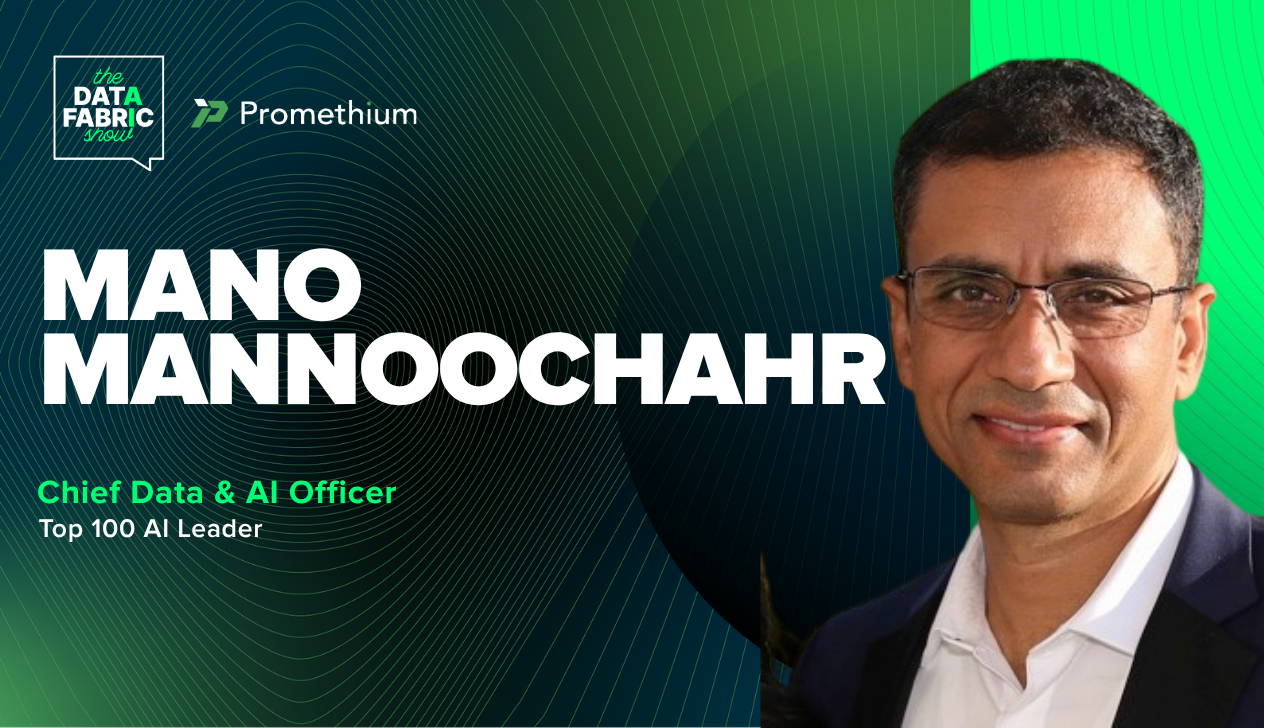
I interviewed Mano Mannoochahr, a top 100 AI Leader, as part of the AI Data Fabric Show last week. Mano has been CDAIO at iconic companies like Verizon, Travelers, John Deere etc.
He is super bullish on AI and his assessment is grounded on three takeaways –
- Data can be transformative. At John Deere, a 175 year-old agricultural leader, Mano witnessed how Petabytes of data collected over farms and equipment could arm owners with insights and new business models. What’s the expected yield? How to size fuel tanks. Data-based optimization had a huge impact on even the most physical and commonplace processes.
- To bring lasting change, you have to bring the people along. At Travelers, an insurance leader there was no dearth of actuaries or data scientists. As the first formal CDO, Mano built collaboration between these groups to build a data culture. 20K people were trained and new data driven use-cases were launched. For example, real-time imaging on roofs of houses could improve accuracy of assessments vs. recorded data by an order of magnitude.
- As enterprises go agentic, with palpable anxiety about skills and change management, the past holds interesting lessons. In 1900 over 50% of the US population was engaged in agriculture. Today that number is just 1.5%. Automation (including tractors made by John Deere) had a huge role to play. But the overall impact was positive – whether in GDP, food yield and productivity. There are interesting parallels today with the impact of AI and the agentic. The lesson is that while there can be a significant displacement, the workforce evolves and adapts out of necessity to newer (and yet unknown) frontiers.
Listen to the episode on Spotify or Apple Podcast.
Full Transcript of the Episode
The AI Data Fabric Show
Host: Prat Moghe, CEO of Promethium Guest: Mano Mannoochahr — Top 100 AI Leader
Prat Moghe: This is Prat Moghe with the AI Data Fabric Show. I’m super excited today to welcome to the show Mano Mannoochahr, who is a top 100 AI leader in the community. I am super excited. He’s been a leader in some of the biggest places out there — Verizon, Travelers, GE, John Deere. Prolific in terms of his contributions to the community, things he’s done as a data leader, AI leader, CIO — he’s played multiple roles, hands-on as well as strategic. So I’m very excited and looking forward to the conversation, Mano, so that we can get some of the lessons out for the aspiring leaders in the community. Thanks again for your time. Really appreciate it.
Mano Mannoochahr: Of course. Yeah, great to be here. Looking forward to it.
Prat Moghe: Awesome. So Mano, again, because your journey has so many different milestones, it’s hard to cover everything in a short conversation. But anything like when you started this journey — where did you grow up and what are some of the early influences? If you can touch on that, and then I’m very eager to dig into your work at a number of these places because I know they’re all very different.
Mano Mannoochahr: Yeah, great question to start with, Prat. I think I’ll borrow Steve Jobs’s words — you cannot connect the dots looking forward, but I can certainly connect the dots looking back. What led to this? So, I think my first foray with computers was really right after I graduated high school. I had some time to kill. I was waiting for my results of the exams and whatnot that we go through back in Pakistan. And also there was a period where I was applying to universities in the US. During that time I ended up taking some programming classes just down the street from my house where we used to live and just really started taking a liking to computers and programming. I still remember my first language was Microsoft Basic that I learned, and then soon thereafter I learned COBOL. I don’t try to share that second part with anybody based on the demand for COBOL programmers that’s out there. But that’s kind of what got me started, and of course then I ended up going to undergrad at University of Kansas in computer engineering and the rest is history.
One data point that I think I probably should mention is that in my master’s work back in ’93–’94 time frame, I did a lot of neural networks and machine learning programming back then. And I think we were officially in an AI winter back in those mid-’90s. So I’m not sure what my advisor thought that I should pick that as a topic. But that certainly helped me get those real insights into how neural nets and machine learning works. Because I still remember staring at a blank sheet of paper where I was supposed to be writing C code to start building my first neural net.
Prat Moghe: Got a little easier these days though.
Mano Mannoochahr: That’s right. Yeah. All these kind of interesting random things are not that random.
Prat Moghe: What is ironic is your son goes to Dartmouth, and if you drive to Dartmouth, which is in New Hampshire, you come across a small obscure building on the right side on the way and it’s basically where BASIC was first created and there’s a small little plaque there that says, “This is where BASIC was created.”
And then obviously what was interesting is the first AI term was also coined in a conference at Dartmouth, I think in the ’50s.
And then what is interesting is you mentioned COBOL. COBOL is hot again because there is a lot of work going on currently in some of the top labs in terms of figuring out how to transform COBOL code into modern languages. And not just the code but also the business logic, so that essentially you can transform all these applications on mainframe and make them more agentic.
I think all of these things kind of come back again. So I know you’ve been a leader in many large places where it’s not easy to innovate. It’s not easy to bring people together. It’s certainly not easy when data is not well understood. And you were, I think, one of the pioneers in terms of figuring out how to become a data leader and educate people on the value of data and using it to transform. John Deere — what, 180-year-old company? You were there. Can you share some of the lessons from John Deere and also explain to some people what John Deere does? Because let’s not assume that everybody really knows the key products.
Mano Mannoochahr: Yeah. So I spent the majority of my career with John Deere. Most of my professional learnings and lessons came through that 17-plus years of tenure at the company. I would say that most people think of John Deere as maybe an agriculture equipment company, and they certainly are — they’re number one in the world. But they had moved beyond equipment, and I think that started back around the time I had been there.
The company was lucky — and I was lucky — to have some visionary leadership back in the late ’90s, early 2000s, where they believed in technology and what was going to happen from a precision agriculture perspective. The demand for food was going to continue to go up, and the production of the world needed to double in the next 40-plus years to feed the population of the world. They started to invest in technology and precision agriculture as early as the late ’90s. There was a company they acquired called NavCom which allowed them to use GPS-corrected signal to be able to pinpoint any part of the world up to about 2 centimeter accuracy. We’re used to our GPS signals from our phones that are about plus or minus 15–20 feet accurate on a good day. But they were able to do that at a very, very high precision.
Using that precision, we were able to then start connecting the work that the machines were doing to specific GPS locations. And of course as more and more sensors made it into the machines, it really became their “factory in the field,” so to speak, because you’re measuring every part of the process. Sensors are giving you data, and one of my jobs became to get those machines connected back to the company and internet so we could get insights from that data.
As part of that — massive amounts of data. I haven’t been there in the last maybe 10 or so years, but I’ve heard that one pass in a season of a fleet of planters can produce tens of petabytes of data as it goes through and is planting seed and recording the downforce, which seed, the depth the seed went into. Thousands of seeds per acre — tens of thousands — are being planted. So information about all those seeds, everything that’s happening on the farm, started to come back to us.
It was one of those learnings where we started to learn that through this data you can now really start to marry not only the science of agronomy — here’s what the best practices are that help you deliver the best results — but also the experience of the farmer’s intuition that they have developed through their life of farming, and of course then the data-based insight.
This is back in 2010–2012 time frame when we started to get those insights into where the human intuition and experience and the science and the data-based insights will all have to coexist. Because that’s really the only way for you to generate acceptance with the customers, who believe in their intuitions — and rightfully so. But at the same time, each farmer customer has very limited amount of lifetime in terms of gaining those experiences.
In fact, there’s a book out there by Howard Buffett — Warren Buffett’s brother — who was big into agriculture, big into Deere, and owned farms. He published a book saying “40 Chances,” basically saying an average farmer has 40 chances in their lifetime to get the crop cycle right — from seeding to spraying to harvesting and then planning for the next year. So they don’t have that ability to learn from mistakes quickly because you’re only going to get 30 to 40 chances in your lifetime.
So the goal was: how do we start to marry the data-based insights across thousands of customers and bring those to their fingertips?
I think it was a very early learning that these have to coexist. And I know we’re going to maybe get into that topic as well later on as we talk about agentic AI, but that was even a couple decades ago a topic of discussion.
Prat Moghe: Super interesting. Can you share maybe one or two insights that — when you get all of this, like you said, it’s insights plus intuition plus the science — what was like a non-obvious or very interesting finding?
Mano Mannoochahr: I think, if I recall correctly — now the stuff is 15–16 years old in my mind — but there was a time where, as you can imagine, farmers are trying to maximize their profits. They’re trying to manage their costs. But at the same time, if they don’t have visibility into field by field in their large farm — they might be farming 20, 30, 40,000 acres — they’re not going to see where they’re making more money versus less, where the cost of input exceeds the revenue that they get from that part of the farm.
When we started to get these data-based insights, it was those aha moments like, “Oh, wait a minute. That south part of your farm — you’re never making money on it. So why don’t you just quit farming that land and turn that into pasture for your animals maybe? And then you’re going to lose less money and maximize your profit.”
It was those counterintuitive insights where they may be trying harder and harder to get more yield out of that part, but for whatever reason data is telling you that you’re not making money. So maybe move on and find a different use for it.
Prat Moghe: Interesting. So you were kind of — in some sense, the data allowed you to partner with these customers in building a longer-term relationship, I’m assuming.
Mano Mannoochahr: Exactly. As they were going to start gaining the trust in the data — and I think we had a saying where basically said, each customer is going to go through this journey of “show me, advise me, do it for me” as far as from an automation perspective. Which, by the way, two decades later still holds true as we were talking about agentic AI — where “show me” as in show me the data and let me make the decisions. “Advise me” as in I will take your advice, but I’ll still decide. But then “do it for me” — when they start to trust the data and advice, maybe they’ll push the button saying, “Hey, why don’t you do this scenario for me next time on your own?”
And I think that’s certainly where we’re going to see the journey go as well.
Prat Moghe: And I also remember another interesting thing that you shared with me around this — all those insights also help optimize the product, which is very interesting. Can you share?
Mano Mannoochahr: Yeah, definitely. We were creating value for the end customers through maximizing the outcomes for them. But at the same time, I took on a different role in the company where I went to a corporate role where the goal was to apply this data to improve the company’s operations as well, in addition to creating value and tools for the customers.
Certainly, as you can imagine, from a predictive maintenance perspective, from parts and service availability — matching that to what we were seeing from the fleet of equipment in terms of type of problems, type of issues. I remember there were lots of scenarios where in the past a problem in the field with maybe a new model or new update might have taken us months to learn what the issue was and then correct it before more machines went into the field.
I remember there was a distinctive issue where machines had an issue with the park brake — as in staying in park. Deere was able to see the alerts related to that and take quick action within weeks and of course keep the issue from becoming bigger.
There are dozens of examples like that — how the data could be used to improve the company’s own operations whether it was engineering, supply chain, or parts and service. I think there were a number of insights like, what’s the optimal size of a fuel tank? How much fuel gets used in a day versus in a week? Maybe there’s some excess there that needed to be corrected to save some cost. There were just dozens of examples like that over the years.
Prat Moghe: That’s an awesome example. So Mano, I’ve got to obviously ask you this question. As we are approaching the agentic world and you’re sitting from the vantage point of a Chief AI Officer, Data Officer — looking at the C-suite, looking at the CEOs and the boards now thinking about what does this mean — what does this mean for enterprises in terms of challenges and opportunities? What does it mean for the people, where there’s a lot of anxiety about displacement and skilling? Give us your take. Are you bullish? Are you bearish? I know you’ve kind of taken some lessons from your past history which I found super interesting, so share those with the community.
Mano Mannoochahr: Yeah. I would say from my perspective, just being a little more optimistic person by design, I’m pretty bullish on the power of it versus the bearish scenarios that get thrown out. And maybe I can share a few data points and then we can talk about what this may look like.
Going back to my roots in the agriculture industry — at the turn of the 20th century, early 1900s, nearly half of the US population was employed by just one sector, and that’s agriculture. So as automation and tractors started to come along, there was this fear that if farming gets automated and tractors are doing the work versus humans and cattle, the US is going to have joblessness. And that was the prevailing view 120-some years ago.
But fast forward to now — I think the latest stats in terms of agricultural employment in the US is less than 2%. I think it’s like 1.5–1.6% of US jobs now are in the agriculture sector. So you’ve gone from over 50% a hundred years ago to less than 2%, and of course not half the country is unemployed. New jobs were created.
Let me give you another stat. I heard this last year — the US Department of Labor says that 60% of the jobs that exist right now didn’t exist more than 25 years ago. So over the last 25 years, more than half of the jobs are new that never existed before. And certainly the speed of that is starting to change, and you’re going to see even more newer jobs being created. Maybe certainly there will be some job destruction that will happen on the low end. But at the same time, I think the technology creates more opportunity than it takes away is kind of how I think about it.
So I think AI and humans are going to coexist. I think there’s plenty of data points that point to the fact that AI actually makes people stronger, not weaker. I think deeper knowledge will have to be possessed by fewer and fewer people as applications of knowledge are going to become even more from an innovation perspective.
And maybe there’s another data point I can share, Prat. If you look at the game of chess and the grandmasters that exist today — the highest levels of grandmasters in the history of humankind exist right now, in terms of their ranking and their levels. And the hypothesis at least goes that the reason why you have so many grandmasters at their highest level ever is because this is the generation that grew up playing chess against computer AI, and got trained on that and have now learned how to get even better than any of the grandmasters in history.
So I think those three data points at least speak to the fact that we will survive and we will evolve and we’ll figure out a way to continue to grow.
Prat Moghe: Yeah. And what does this mean for the role of a CAIO, CDAIO, whatever you think of that acronym? In your view, what are the three keys to success, Mano?
Mano Mannoochahr: Yeah, certainly. I think the role has continued to evolve faster than probably any other role that has existed in the technology space. You went from kind of defensive, governance-oriented to technology and cloud and modernization-oriented, to now over the last five years it’s become really more forward-facing — as in driver of innovation and transformation for the companies.
From my perspective, this is the prime time for this C-suite role to start really collaborating with the business leaders and figure out how data can be used to optimize the business that we have and of course transform the business over time. Because I do think that through these AI tools, through data-based insights, there’s a lot of opportunity to just optimize the performance of the current business. But then of course, using AI, agentic AI, and opportunities for automation and more intelligence to improve outcomes — that’s where the transformation comes in.
Where you’ve got to be careful is that you don’t fall in the trap of paving the cow paths, so to speak — as in not changing the way work gets done and trying to automate the work as it exists now, because that’s a recipe for disaster. You’ve got to figure out what are those selective few areas that you should transform that are critical to the company, that can generate value for the bottom line, and then really go after it. I think it’s all about the partnership and aligning the outcomes that you want to go after and improve, and then of course delivering on it.
Prat Moghe: Awesome. Very much appreciated. Any other parting words for the community?
Mano Mannoochahr: I think maybe one area as we are talking about this topic — most people maybe get too indexed on how will AI and humans coexist and what are the types of work that AI agents will take on versus the humans. And certainly there’s a whole spectrum of possibilities from frontline repetitive work that AI can assist and automate and take on, to higher-end knowledge work that typically exists at the corporate offices and how that can be augmented.
I think there’s another category of work, Prat, that most people don’t think about right away, which is: AI is just uniquely positioned to do a type of work that humans could never do or should never do. Work that can be done at scale, that requires some intelligence and has variations — AI is uniquely positioned for that. So I think there’s a category of work that’s unimaginable previously to be done by humans that we should go after and apply AI to.
Certainly there’s lots of examples that came through in my career, including as recently as Verizon. If you think about it, every carrier has some customer churn and risk models that help you understand where the customers are at risk. But given how many may fall into that — it could be millions — and it turns out they have some kind of a risk, the question is what can you do about it? You can’t have people make millions of calls all the time trying to reach customers. But maybe there’s a role for AI to play there.
So I think those are the types of things where there’s a type of work that we just couldn’t do in the past at human scale. So how can we do it at AI scale?
Prat Moghe: It’s both the breadth and the depth problem — and hyper-targeting at the same time.
Mano Mannoochahr: Exactly. Because AI is just getting so good at having conversations in a very empathetic way — sometimes even better than some maybe not-so-well-trained humans who may be having a bad day. So how can you leverage something like that?
Prat Moghe: And I’m guessing in those examples you could train it so that even if there is some hallucination and things are messed up, you’re essentially looking at the cost of that error and saying, “That’s fine because I can make up for it.” Maybe you’re giving somebody an additional reward or whatever it is to keep them, and that’s fine as long as you don’t penalize people. The cost of making an AI call is essentially zero compared to humans trying to make calls.
Mano Mannoochahr: Yeah.
Prat Moghe: Fascinating. Awesome. This was a great conversation, Mano. And I know now you’re on to the next thing. I’m guessing you’re spending time looking at a variety of options. Any comments on what’s interesting going forward now?
Mano Mannoochahr: Well, yeah, that’s interesting. Maybe not for the wider consumption, but I’m certainly evaluating a lot of different options and trying to see what’s really interesting out there. I’ve got a few irons in the fire, so to speak.
Prat Moghe: I think any place would be lucky to have you. And again, thanks for sharing your observations and things from the experience with everybody. Thanks again.
Mano Mannoochahr: No problem. Thanks for having me. Enjoyed it.
Prat Moghe: All right. Thank you.
SHARE THIS: