
Enterprise AI Readiness Assessment: 7 Critical Gaps to Fix in 2026
Enterprise AI initiatives are failing at an alarming rate. Despite massive investments in foundation models and AI tools, recent research shows that 95% of generative AI pilots fail to deliver measurable impact on business outcomes. The problem isn’t the AI itself—it’s the infrastructure underneath. Organizations continue to deploy sophisticated models on fragmented data architectures that were never designed for AI-scale operations, creating an accuracy crisis that prevents production deployment.
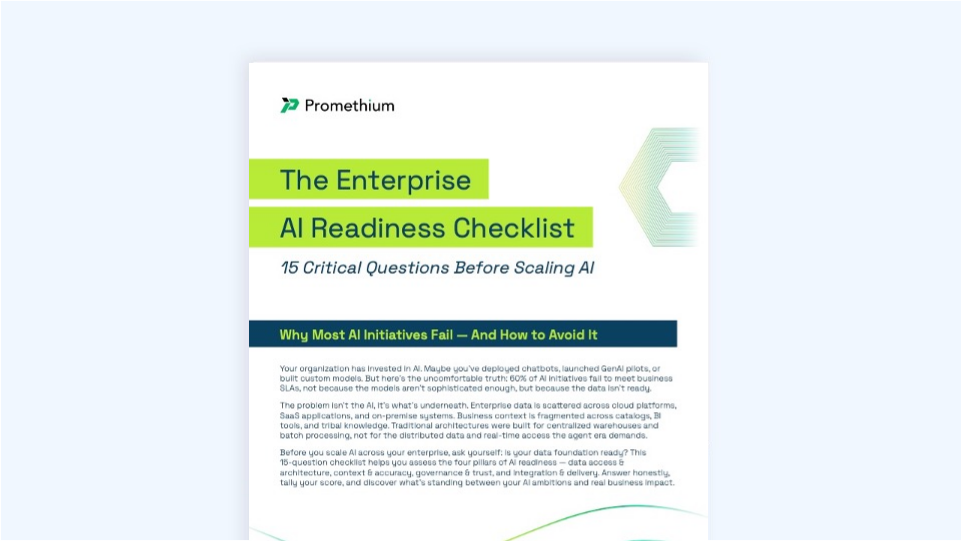
Download our 15 minute checklist to assess your AI readiness.
This assessment framework identifies seven architectural gaps preventing enterprise AI from scaling beyond pilots. Each gap includes measurable criteria for evaluation, benchmark data showing the cost of inaction, and actionable remediation steps with realistic timelines drawn from financial services, healthcare, retail, and manufacturing implementations.
Understanding the Enterprise AI Accuracy Crisis
The fundamental barrier to AI success isn’t model sophistication—it’s architectural mismatch between what AI systems require and what enterprises provide. MIT’s Computer Science and Artificial Intelligence Laboratory found that 80% of business-critical information exists in unstructured formats—emails, transcripts, contracts, presentations—while only 20% sits in structured databases. When AI systems make decisions on this incomplete picture, they’re essentially operating blindfolded.
A Capital One survey of 500 enterprise data leaders revealed that 73% identified data quality and completeness as the primary barrier to AI success, ranking it above model accuracy, computing costs, and talent shortages. The organizations succeeding in deploying AI at scale—a mere 5% of surveyed companies—didn’t deploy superior models. They fixed their data infrastructure first, then built AI on that foundation.
The consequences manifest directly in accuracy rates. DeepSeek’s chatbot demonstrated an 83% fail rate on information accuracy, providing correct responses only 17% of the time. For agentic AI systems executing autonomous workflows, individual errors cascade through automated processes before human detection, creating compounding business impact.
Purpose-built AI data platforms like Promethium’s AI Insights Fabric are designed from the ground up to address these architectural gaps—providing the unified, governed, and real-time data access that AI systems require to move beyond pilots into production reliability.
Gap One: Fragmented Data Architecture Preventing Unified Context
Most large organizations operate with ERP systems, CRM platforms, compliance databases, operational data stores, and external feeds that barely interoperate. A typical mid-market enterprise might store customer information in three different systems showing three different addresses. When AI queries across these fragmented sources, it receives inconsistent fragments rather than complete information.
This fragmentation has measurable costs. Knowledge workers spend disproportionate time searching for data across repositories rather than analyzing it. Unlike humans who synthesize information through intuitive reasoning, large language models require explicit context in their prompts. When context scatters across disconnected systems, AI systems either hallucinate based solely on training patterns or make decisions on fundamentally incomplete information.
Research analyzing the enterprise AI stack found that only 14% of organizations classify their architecture as fully AI-ready, with 86% running production AI on improvised integrations. Organizations with 75% or higher data accessibility within 24 hours outperform those with lower accessibility by multiples on AI accuracy metrics.
Measuring the Fragmentation Gap
Evaluate your organization across these dimensions:
Data Accessibility Latency: What percentage of enterprise data can you query within 24 hours? Organizations at AI readiness level one have 0-20% accessible within that window, while level five organizations achieve 100% real-time accessibility.
System Integration Breadth: How many mission-critical data sources can your AI systems query directly? Inventory every system holding relevant business data—ERP, CRM, data warehouse, document repositories, transactional databases, operational systems, external feeds—then determine which connect to your AI infrastructure.
Query Completeness: When business stakeholders ask questions requiring information from multiple systems, what percentage return complete answers versus requiring manual research? Track “unknown answer” rates as a critical metric.
Integration Architecture Consistency: Do you have standardized integration patterns, or is each connection built as one-off? Organizations with standardized patterns achieve deployment velocities five times faster than those with fragmented approaches.
Addressing Fragmentation: Remediation Pathways
The remediation pathway typically unfolds across three to six months. First, conduct a comprehensive data inventory cataloging every system holding relevant business information, documenting data content, assessing quality indicators, and identifying integration points to AI systems.
Second, establish data federation principles defining how data from multiple sources will be accessed, standardized, and presented to AI systems. Rather than consolidating all data into a single platform—a massive undertaking—federation allows AI systems to query across sources while maintaining consistency through governed definitions and standardized schemas.
Cloud-native architectures using platforms like Snowflake, Databricks, or BigQuery enable practical federation at scale through unified data catalogs presenting multiple sources through consistent query interfaces. Promethium’s Universal Query Engine takes a different approach, enabling zero-copy federated access across all enterprise data sources—Snowflake, Databricks, SAP, Salesforce, and 200+ other systems—without requiring data centralization or movement, addressing fragmentation while preserving data security and governance at the source. An alternative approach uses APIs and event streaming to create data virtualization layers presenting fragmented data as unified through middleware.
Third, implement automated integration using tools like Fivetran, Airbyte, or custom API connectors to move data from source systems into your AI platform in real-time or near-real-time. Integration should be automated and continuous rather than manual and episodic, as manual data movement introduces errors, delays, and organizational dependencies.
Organizations moving rapidly through remediation begin with data sources most critical for highest-priority use cases rather than attempting comprehensive integration immediately. A regional bank implementing AI lending systems would prioritize connecting applicant data from the loan origination system, credit bureau data, and transaction history before integrating peripheral sources. This focused approach delivers value faster while building internal confidence for broader integration efforts.
Gap Two: Unstructured Data Left Outside AI Processing Pipelines
The second critical gap addresses how enterprises handle unstructured data comprising approximately 80% of business-critical information yet remaining largely inaccessible to AI systems deployed on structured data alone. Unstructured data includes documents, emails, meeting transcripts, call recordings, presentations, internal knowledge bases, regulatory filings, contracts, customer communications, and operational logs.
While structured data might show a customer’s loan application was declined, unstructured data in email chains reveals critical context about why the decision was made or what exceptions were considered. Agentic AI systems making autonomous decisions need this context; without it, they operate blind to potentially critical information.
The challenge extends beyond mere access. Extracting meaning from unstructured data requires specialized natural language processing, optical character recognition for scanned documents, and often manual effort to prepare data for machine learning. A financial institution might receive hundreds of pages of customer correspondence, regulatory guidance, and internal policies relevant to a specific decision, yet connecting that information to an AI system requires parsing, contextual extraction, and integration with structured databases.
Organizations accessing both structured and unstructured data through unified AI pipelines achieve accuracy improvements of 20-40% compared to organizations relying on structured data alone. Legal firms using AI contract review systems show hallucination rates below 5% when systems access relevant precedent cases and regulatory guidance, compared to rates exceeding 30% when systems rely solely on training patterns.
Assessing Your Unstructured Data Gap
First, catalog what unstructured data exists and assess its relevance to AI use cases. Create an inventory categorizing unstructured data by system of origin—email platforms, document repositories, knowledge management systems, customer communication platforms, regulatory filing archives—and evaluate relevance to highest-priority AI applications.
Second, measure current accessibility: what percentage of relevant unstructured data can your AI systems query? Most enterprises begin at 0-5%, with only email archives potentially ingested.
Third, quantify decision-critical context in unstructured data. Working with domain experts, identify specific instances where unstructured data would materially change an AI system’s recommendation. This fundamentally questions what information humans consult when making similar decisions.
Fourth, measure manual interventions required. When AI systems provide recommendations, what percentage require human follow-up research in unstructured sources to verify or adjust the recommendation? Baseline this metric now, as improving it measures remediation success.
Bridging the Unstructured Data Gap
Organizations with limited unstructured data processing typically require four to nine months for comprehensive implementation. First, conduct a targeted pilot selecting one relevant unstructured data source and one high-priority use case. Financial services firms might select customer complaint letters combined with complaint resolution use cases. Healthcare organizations might select provider notes combined with coding accuracy use cases.
Second, implement document parsing infrastructure. Modern enterprises typically deploy cloud-native services—Google Document AI, AWS Textract, or Azure Form Recognizer—that handle document extraction, optical character recognition, and initial structure extraction with minimal manual configuration.
Third, implement semantic extraction using natural language processing or large language models to extract decision-critical concepts from unstructured text. This often involves fine-tuning models on domain-specific documents or using prompt-engineering approaches to identify relevant document sections.
Fourth, integrate extracted information into AI retrieval systems. Rather than storing unstructured data separately, modern enterprises use hybrid storage approaches where both structured records and unstructured documents are indexed and searchable through unified query interfaces. Vector databases like Weaviate or Pinecone enable semantic search across unstructured content, so when an AI system queries for customer communication about a specific topic, it retrieves all documents containing semantically relevant information rather than simple keyword matches.
Organizations accelerating through remediation select unstructured data sources strategically based on how decision-critical the information is for highest-priority use cases, how structured the data is in practice, and how much technical work is required to access it. Email represents a common starting point because it contains structured elements alongside narrative content.
Gap Three: Inconsistent Business Logic Creating Semantic Fragmentation
The third gap addresses semantic inconsistency manifesting when the same business concept receives different definitions, calculations, or interpretations across enterprise systems. This phenomenon particularly damages AI because machine learning models require consistent meaning to function reliably.
Three business teams each defining “customer lifetime value” differently illustrates the damage. Finance calculates cumulative revenue minus churn probability. Marketing calculates cumulative revenue weighted by customer acquisition cost. Product calculates revenue per feature adoption tier. When an enterprise AI system recommends which customers receive high-touch support based on customer lifetime value, it receives inconsistent input depending on which system provides the calculation, leading to contradictory recommendations.
Enterprises relying on semantic standards—explicit, machine-readable definitions of core business concepts—achieve 25-40% improvements in AI accuracy compared to enterprises where business logic is embedded inconsistently. The advantage compounds over time as AI systems scale. Initial pilots might operate on single data sources where semantic consistency is enforced implicitly, but scaling to multiple sources without consistent business logic definitions creates decision inconsistency undermining stakeholder trust.
Semantic fragmentation is particularly problematic for agentic AI systems because autonomous agents making repeated decisions need consistent logic. An agent that sometimes uses one definition of “high-value customer” and sometimes another will make inconsistent decisions over time, creating operational unpredictability and regulatory exposure.
Measuring Semantic Consistency
First, identify core business concepts relevant to AI use cases. For financial services, these might include customer, account, transaction, risk, profitability, and compliance. For retail, they might include product, inventory, customer, order, and profit margin. For each concept, query different systems to understand how they define the concept and what attributes they track.
Create a concept matrix for your highest-priority AI use case documenting how each relevant concept is defined across systems. For customer lifetime value, document the three different definitions, the data each requires, and the calculation logic.
Second, measure the cost of semantic inconsistency. Interview domain experts who work across systems and quantify time spent reconciling conflicting definitions when making decisions. This time currently spent by humans is time your AI system will also spend unless you establish consistent definitions.
Third, audit existing AI deployments for semantic inconsistency issues. When AI systems provide recommendations that stakeholders question or override, investigate whether semantic inconsistency contributes to the problem.
Fourth, measure query ambiguity. When business stakeholders ask the same question across teams, what percentage receive different answers due to definitional differences? Baseline this metric because improving it measures semantic consistency improvements.
Establishing Semantic Consistency
Establishing semantic consistency typically requires four to eight months for mid-market organizations. The remediation pathway involves implementing a semantic layer—a governing layer that centralizes business logic definitions and enforces them consistently across tools and AI systems.
Organizations have several architectural options. First, use universal semantic data models through platforms like Semantc or Atlan that catalog business concepts, relationships, and calculations and make them accessible to analytics and AI tools. These platforms serve as the source of truth for business meaning, so when different tools query the same concept, they receive consistent definitions.
Second, implement a semantic layer within your data platform. Modern cloud data warehouses like Snowflake include semantic layers that define metrics, dimensions, and relationships once and expose them through consistent interfaces to all downstream consumers. Promethium’s 360° Context Hub provides another approach, unifying business definitions, technical metadata, and semantic rules in a single layer that applies consistent business logic at query time across all federated sources—ensuring every AI agent receives the same definitions regardless of which underlying system holds the data.
Third, combine business logic definition with data governance workflows. Organizations establish semantic working groups where domain experts from finance, marketing, operations, and other functions jointly define core business concepts and agree on consistent calculations. Once defined, the organization embeds these definitions into AI systems through feature stores or metadata systems.
Regardless of technical approach, the process involves these stages. First, assemble domain experts from teams that care about core business concepts and facilitate their development of consistent definitions. This is fundamentally a business exercise, not technical—the role of technical teams is to implement what business teams agree upon.
Second, document definitions in machine-readable formats so they can be enforced automatically. Third, communicate new consistent definitions to all teams and retrain stakeholders on new standard logic. Organizations often discover this stage requires more effort than technical implementation because teams have developed workarounds around old inconsistent definitions.
Fourth, embed consistent definitions into AI systems. When training machine learning models or configuring retrieval-augmented generation systems, data scientists and AI engineers use standardized definitions rather than creating local variations. Fifth, monitor consistency over time. As business conditions change and new data sources are added, consistent definitions must be updated and enforced consistently across systems.
Gap Four: Inadequate Data Quality Governance Creating Cascading Errors
The fourth gap addresses data quality governance specifically as it relates to AI systems. While data quality matters for analytics and reporting, it becomes absolutely critical for AI because models inherit quality issues and often amplify them. A dataset containing a few inaccurate records might cause a reporting dashboard to show slightly incorrect totals, but a machine learning model trained on that same dataset learns the inaccuracies as patterns, embedding errors into every prediction at scale.
Organizations are abandoning 60% of AI projects unsupported by AI-ready data, with data quality issues being a primary cause. The specific dimensions of data quality that matter most for AI differ from traditional concerns. While completeness and accuracy matter for both analytics and AI, AI systems also require explicit attention to consistency, freshness, and semantic coherence.
An organization might have complete and accurate customer records in their CRM and accurate customer records in their ERP system, but if those records define customers differently or use different customer identifiers, the inconsistency will create AI errors. A machine learning model trained on historical data from one period will make poor predictions if current data has shifted in distribution—a phenomenon called data or concept drift that analytics systems handle relatively gracefully but AI systems often handle poorly.
Nearly half (49%) of executives cited data inaccuracies and bias as barriers to embracing agentic technology. Projects implementing continuous data quality monitoring alongside AI deployment consistently achieve 20-30% improvements in AI accuracy compared to projects without systematic data quality management.
Assessing Your Data Quality Gap
Establish baseline measurements across six dimensions of data quality that matter for AI. First, measure accuracy by testing a sample of records against independent sources of truth. Financial institutions might sample customer account balances against bank statements; healthcare organizations might sample patient demographics against original admission records. Establish your organization’s current accuracy percentage, with the understanding that enterprise accuracy often ranges between 70-85% for critical domains.
Second, measure completeness by identifying required fields for highest-priority AI use cases and tracking what percentage of records have complete data. Track separately the percentage missing due to not applicable scenarios versus missing due to data capture failures.
Third, measure consistency by comparing how the same entity is represented across multiple systems. For customer entity, this might mean comparing customer name spelling, address formatting, and contact information across CRM and ERP systems. Calculate the percentage of customer records that match identically versus those requiring reconciliation.
Fourth, measure freshness by tracking the lag between when data is updated in source systems and when that updated data is reflected in AI systems. For real-time data, measure latency in seconds or milliseconds; for batch data, measure latency in hours or days. Establish an acceptable freshness threshold for each AI use case.
Fifth, measure validity by identifying business rules and constraints that should apply to your data. For example, customer age should fall within 0-125 years; account balances should be positive for certain account types. Calculate what percentage of records violate defined business rules.
Sixth, measure uniqueness by identifying entities that should have unique identifiers and tracking duplicate records. In customer databases, organizations often find 20-40% duplicate or near-duplicate records when comprehensive matching is applied.
Establishing Data Quality Governance
Establishing comprehensive data quality governance typically requires three to six months for moderate implementation. First, establish data quality baselines using automated profiling tools that scan datasets and calculate accuracy, completeness, consistency, freshness, validity, and uniqueness metrics. Tools like Great Expectations, Databand, or Acceldata automate this profiling and establish quality scorecards.
Second, prioritize remediation by focusing on issues with highest business impact. An accuracy problem affecting 5% of customer records used by one AI use case is less critical than an accuracy problem affecting 40% of a large, high-impact dataset.
Third, implement data cleansing and correction using a combination of automated and manual approaches. Automated deduplication and standardization tools handle routine problems; manual review handles exceptions. Modern AI-powered data quality tools can automate cleansing more extensively than traditional rule-based approaches, learning patterns from manually corrected examples.
Fourth, implement continuous monitoring. Rather than running quality checks episodically, embed quality checks into data pipelines, monitoring data as it moves from source systems through transformation processes to AI systems. When quality metrics degrade below acceptable thresholds, automated alerts notify responsible teams.
Fifth, establish governance processes that define roles, responsibilities, and escalation paths for data quality issues. Who is responsible for investigating accuracy problems in customer data? Who has authority to remediate consistency issues across systems? Organizations establishing clear governance achieve faster remediation than those with unclear responsibility.
Gap Five: Governance and Compliance Controls Lagging Behind AI Deployment
The fifth gap addresses how enterprises manage governance, compliance, and risk management for AI systems operating at scale. The challenge stems from fundamental misalignment between the rapid velocity at which AI systems deploy and the deliberate pace at which governance frameworks traditionally operate. Organizations report deploying AI use cases in weeks or months while governance approval processes traditionally operate on quarter or annual cycles.
This velocity mismatch creates “shadow AI”—unsanctioned systems deployed quickly by business users without proper governance oversight, creating compliance and security exposure. Research examining enterprise AI governance maturity found that while 42% of organizations believe their strategy is well-prepared for AI adoption, only 40% have actually institutionalized AI governance committees or formal oversight structures. Only one in five companies has a mature governance model for autonomous AI agents—the systems that most require oversight because individual errors can scale into business impact without human detection.
The consequences of governance gaps compound in regulated industries. Financial institutions face regulatory exposure if AI systems making lending decisions cannot explain their reasoning. Healthcare organizations face liability if AI systems affecting patient care lack proper validation. Organizations deploying ungoverned AI systems often discover governance gaps only after regulatory examination or negative incidents occur.
Assessing Your Governance Gap
Evaluate your organization along multiple dimensions. First, measure governance structure clarity: does your organization have a formal AI governance committee with defined membership, authority, and decision-making processes? Organizations at governance maturity level one have ad-hoc discussions with no formal structure; organizations at level five have governance deeply embedded in business operations with clear accountability.
Second, assess policy coverage: does your organization have formal policies addressing data privacy, AI ethics, model risk management, and compliance procedures relevant to your industry? Financial institutions need policies addressing algorithmic bias in lending; healthcare organizations need policies addressing model validation in clinical settings.
Third, measure governance automation: what percentage of governance checks and approvals happen manually versus automated? Organizations relying on manual review boards and email approvals experience governance bottlenecks where approval can take weeks or months. Organizations embedding governance into technology platforms enable approval in minutes while maintaining rigor.
Fourth, assess compliance evidence availability: when regulators ask for documentation explaining how an AI system reached specific decisions, can your organization provide traceable evidence? Organizations maintaining complete audit logs and model documentation can answer these questions immediately; organizations without systematic documentation face weeks of manual reconstruction.
Fifth, measure risk assessment formality: when considering new AI use cases, does your organization follow a formal process to identify risks, assess their likelihood and impact, and define mitigation approaches?
Building Effective Governance
Establishing effective AI governance typically requires two to four months for basic implementation and six to twelve months to mature. First, establish governance structure by forming an AI steering committee with representatives from IT, business, compliance, risk, legal, and operational functions. This committee meets monthly or bi-weekly to review new AI use cases, assess risks, and make go/no-go deployment decisions.
Second, develop policy framework. Organizations should develop AI-specific policies addressing responsible AI principles, data handling, model validation, explainability requirements, bias monitoring, and incident response. Rather than writing policies from scratch, organizations typically adapt frameworks from industry associations. The NIST AI Risk Management Framework provides a comprehensive starting point for most organizations.
Third, implement governance automation. Rather than requiring every AI project to get manual approval through email and meetings, embed governance checks into development platforms. IBM’s internal governance approach creates a provisioning process that automatically checks data governance, privacy, and security requirements before allocating development resources. Promethium enforces query-level governance where policies defined once in the 360° Context Hub are applied universally across every AI agent query without per-agent configuration, enabling compliant AI data access at enterprise scale.
Fourth, establish observability and monitoring. Deploy observability platforms that continuously monitor AI systems in production, tracking decision patterns, potential bias, accuracy degradation, and regulatory compliance. When monitoring detects concerning patterns, automated alerts notify responsible teams.
Fifth, define incident response procedures. When issues are discovered, what is the escalation process? Who decides whether a system continues operating or is taken offline? Document these procedures before incidents occur, ensuring rapid, consistent response when problems arise.
Gap Six: Real-Time Data Access Unavailable for Agentic AI Requirements
The sixth gap addresses whether enterprise data architectures support real-time data access, increasingly critical as agentic AI systems expand. Traditional enterprise analytics operated on batch-updated data with acceptable latency of hours or days. However, agentic AI systems making autonomous decisions throughout the day require current data. An AI agent handling customer service requests needs real-time access to current account balances, pending orders, and recent customer communications.
The challenge is architectural. Many enterprises store analytics data in data warehouses or data lakes that are refreshed on fixed schedules—nightly, hourly, or at best every fifteen minutes. The pipeline that moves data from operational systems to analytics has built-in latency because data must be extracted, transformed, validated, and loaded before it becomes available.
Research examining enterprise AI deployment found that real-time inference systems fail when network latency exceeds tolerance, even when compute capability is sufficient. Autonomous agents executing complex workflows call multiple systems and retrieve data multiple times; cumulative latency from these calls determines system responsiveness. Organizations measured inference latency and found that total request latency directly correlates with system usefulness. Systems with average latency under two seconds achieve 40-50% adoption rates; systems with average latency exceeding five seconds achieve single-digit adoption rates.
The data freshness problem extends beyond real-time analytics. Machine learning models trained on historical data suffer concept drift when current data differs meaningfully from training data. A credit scoring model trained on data from 2023 makes poor predictions in 2026 if economic conditions, employment patterns, or borrower behavior have shifted.
Assessing Your Real-Time Data Gap
Measure several dimensions. First, assess data pipeline latency by measuring the time from when data is updated in operational systems to when that update is available in your analytics or AI systems. Test this for highest-priority AI use cases.
Second, measure query response time. Once data is available in analytics systems, how long does it take to query that data and return results? Test this for typical queries your AI systems need to execute.
Third, assess data source integration breadth: how many operational systems have near-real-time data feeds to your analytics or AI systems? Organizations typically find that only highly critical systems have integrated data feeds; the majority depend on batch integration.
Fourth, measure model performance degradation rate: how often do deployed AI models see accuracy decline due to data drift? Track this metric continuously through production monitoring.
Building Real-Time Data Capabilities
Establishing real-time data capabilities typically requires four to eight months. First, identify highest-priority AI use cases where real-time data most impacts decision quality. Not every use case requires real-time data; many function adequately with hourly or daily updates.
Second, evaluate data architecture options. Stream processing platforms like Apache Kafka enable continuous data movement from operational systems to analytics systems, creating near-real-time data feeds with latency measured in seconds to minutes. Cloud-native data warehouses like Snowflake include incremental refresh capabilities that update portions of datasets rather than full batch refreshes.
Third, implement monitoring for data drift and concept drift. Rather than discovering model performance has degraded only when stakeholders complain, continuously monitor model accuracy, feature distributions, and prediction patterns. When metrics drift outside acceptable ranges, automated alerts trigger model retraining or investigation.
Fourth, implement feature stores, which are specialized systems that provide AI models with pre-computed features that are continuously updated as underlying data changes. Rather than having every model compute identical features from raw data, a feature store computes features once and makes them available to all models.
Gap Seven: Missing Explainability and Grounding Preventing Trust
The seventh gap addresses whether AI systems can explain their reasoning and ground their outputs in verifiable evidence, increasingly critical as enterprises deploy autonomous AI systems and as regulation tightens. When an AI system recommends denying a customer’s loan application, loan officers need to understand the reasoning. When an AI system recommends a specific treatment for a patient, physicians need to understand the basis.
The problem manifests particularly acutely in retrieval-augmented generation systems attempting to ground AI outputs in enterprise documents. These systems retrieve relevant documents, then ask language models to generate answers based on retrieved content. When working correctly, the system provides not just an answer but also citations to source documents, making the answer verifiable. When working incorrectly, the system generates confident-sounding answers that are actually fabrications—hallucination.
Research examining hallucination in enterprise settings found that the primary cause is not model inadequacy but rather insufficient grounding in enterprise context. Models are highly capable when given relevant information but generate hallucinations when operating without sufficient context. A language model asked “What is our company policy on remote work?” without access to company policy documents will hallucinate a plausible-sounding policy.
The consequences of ungrounded AI outputs are severe. Enterprises report that hallucination undermines stakeholder trust more than any other AI failure mode because confident-sounding errors erode trust more deeply than honest uncertainty. An AI system that says “I don’t know” preserves some trust; an AI system that confidently provides incorrect information destroys trust.
Assessing Your Explainability and Grounding Gap
Evaluate several dimensions. First, measure source availability: for highest-priority AI use cases, what percentage of relevant information exists in documents or knowledge bases that can be connected to your AI systems? Inventory what source documents, knowledge bases, and data are available for top use cases.
Second, assess retrieval quality. If you have connected documents to AI systems through retrieval-augmented generation, measure retrieval accuracy. When the AI system queries for relevant documents, what percentage of retrieved documents actually contain relevant information?
Third, measure hallucination rates by testing your AI systems by asking questions where you know the correct answers and measuring what percentage of responses are factually accurate versus hallucinated. Track hallucination rate separately from answer relevance.
Fourth, assess explainability capability: can your AI systems explain their reasoning? For rule-based or tree-based models, explainability often comes naturally. For neural networks and large language models, explainability requires additional work.
Building Explainability and Grounding
Establishing strong explainability and grounding typically requires three to six months. First, establish retrieval infrastructure by connecting relevant documents, knowledge bases, and reference data to AI systems. A financial services organization implementing investment recommendation AI needs connection to research reports, market data, and regulatory guidance.
Second, implement retrieval optimization. Simply making documents available is insufficient; the AI system must retrieve the most relevant documents efficiently. Organizations typically employ hybrid retrieval combining keyword search and semantic search.
Third, implement citation and grounding. Rather than having AI systems generate free-form responses, require systems to cite sources. When an AI system claims that a specific policy applies, it should cite the policy document where that policy is stated. Promethium’s AI Insights Fabric provides query-level lineage for every data access, making every AI-generated insight traceable, auditable, and explainable—critical capabilities for regulated industries like financial services and healthcare.
Fourth, implement hallucination detection. Organizations can detect hallucination through various approaches. One approach compares AI outputs against source documents to verify whether claims in the output actually appear in sources. Another approach uses fact-checking models that assess whether generated claims are logically consistent with retrieved documents.
Fifth, establish confidence scoring. Rather than presenting all AI outputs with equal confidence, systems should indicate when they have high confidence versus low confidence. A system that retrieved comprehensive relevant documents and synthesized them consistently should indicate high confidence.
Closing the Gaps: A Practical Roadmap
Moving from identifying AI readiness gaps to actually remediating them requires disciplined execution across multiple timelines. Organizations attempting to address all seven gaps simultaneously fail due to resource constraints and priority conflicts. Effective organizations follow a phased roadmap that sequences remediation activities strategically.
The first phase, spanning two to three months, addresses gaps one through three simultaneously: fragmented data architecture, unstructured data access, and semantic consistency. This phase establishes the foundation for all subsequent AI work. The deliverable from phase one is a unified data platform where the majority of business-critical data is connected and accessible to AI systems through consistent interfaces.
The second phase, spanning three to four months, addresses gaps four and five: data quality governance and governance structures. As more data becomes accessible through unified platforms, ensuring quality and managing risks become critical. The deliverable from phase two is confidence that data reaching AI systems is accurate and that deployments are properly governed.
The third phase, spanning three to four months, addresses gaps six and seven: real-time data access and explainability. Once foundational architecture is established, organizations focus on performance and trust. The deliverable from phase three is AI systems that respond quickly to current data and provide explainable, grounded outputs.
Across all three phases, organizations typically require six to twelve months of sustained effort to meaningfully address major gaps. Organizations with simpler environments and strong existing data platforms complete this work in four to six months; organizations with complex legacy environments require twelve to eighteen months.
The enterprise AI transformation is not a race won by accessing the most powerful models or deploying the most agents. It is won by organizations that build the essential foundation that transforms AI from an expensive experiment into a reliable business capability delivering measurable value at scale. Organizations that invest in fixing these gaps first will find themselves dramatically ahead of competitors who continue chasing the latest AI model while their infrastructure remains broken.
Click here to download our 15 minute checklist to assess your AI readiness.
Share This Article
SHARE THIS:



Share This Article
SHARE THIS: