Self-service analytics is undergoing its most significant transformation since Tableau pioneered visual exploration two decades ago. The shift isn’t about faster dashboards or prettier charts — it’s about fundamentally changing how humans interact with data.
In 2025, the evolution is from tools you learn to operate to intelligence that understands your questions. Conversational AI, augmented analytics, and real-time streaming are moving from experimental features to production infrastructure.
But transformation brings confusion. Vendors promise “AI-powered” everything while practitioners struggle to separate substance from marketing. This guide cuts through the noise, explaining what’s real, what’s hype, and what actually matters for your self-service strategy.
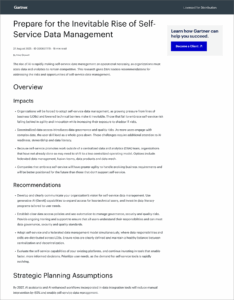
The inevitable rise of self-service data management. Get your complimentary copy of the Gartner report.
The Fundamental Shift: From Query Tools to Intelligence Systems
Understanding the transformation requires context on what’s changing architecturally.
Traditional Self-Service (2010-2020)
How It Works:
- Users navigate to BI tool (Tableau, Power BI, Qlik)
- Select pre-built dashboard or create new visualization
- Choose dimensions and measures from available fields
- Configure filters and parameters
- Interpret results manually
User Experience: Visual but technical — requires understanding data models, choosing appropriate visualizations, and knowing which metrics answer which questions.
Strengths: Powerful for analysts comfortable with data concepts. Flexibility to create custom views.
Limitations: Steep learning curve for business users. Requires knowing what to look for. Passive — waits for users to ask questions.
AI-Native Self-Service (2025+)
How It Works:
- Users ask questions conversationally (“Why did revenue drop in Q3?”)
- AI interprets intent, generates appropriate queries
- System proactively surfaces relevant context and patterns
- Results explained in business language with reasoning
- Follow-up questions refine understanding iteratively
User Experience: Conversational — like talking to knowledgeable analyst rather than operating software.
Strengths: Accessible to anyone who can articulate business questions. Proactive insight discovery. Contextual explanations.
Limitations: Requires robust semantic layer. AI accuracy varies. New governance challenges.
The shift is from users needing to understand data to data systems understanding users.
Trend 1: Conversational AI and Natural Language Querying
Natural language querying (NLQ) has evolved from buzzword to production capability — but with critical caveats.
The Evolution: Three Generations
Generation 1: Keyword Matching (2015-2020)
Early NLQ matched keywords to field names and dashboard titles:
- User types “sales 2024” → system finds dashboards containing those words
- Simple synonym mapping (“revenue” = “sales”)
- Breaks on slight variations or complex questions
Limitation: Not actually understanding questions, just matching patterns.
Generation 2: Template-Based Parsing (2020-2023)
Systems recognized common query patterns:
- “Show me [metric] by [dimension]” → generates grouped query
- “Compare [metric] to last year” → applies date logic
- Handles moderate complexity through pattern libraries
Limitation: Rigid templates — creative questions fall outside patterns.
Generation 3: Intent Understanding via LLMs (2023+)
Generative AI models understand intent and context:
- Parses complex business questions into appropriate queries
- Handles ambiguity through clarifying questions
- Maintains conversation context across multiple exchanges
- Explains reasoning and highlights caveats
Example Capability:
- User: “Which products have declining margins in the Northeast despite increasing sales?”
- System: Understands this requires joining product, sales, and financial data, filtering by region, calculating margin trends, finding inverse correlation
- Generates appropriate multi-table query with temporal analysis
- Returns results with explanation of calculation methodology
The Critical Prerequisite: Semantic Layers
Here’s what vendors don’t emphasize enough: conversational AI accuracy depends to a large extent on the quality of context, including your semantic layer.
Without Semantic Layer:
- AI guesses at table relationships (often wrong)
- Invents metric calculations (plausible but incorrect)
- Produces confident answers to wrong questions
- Users can’t verify reasoning
With Semantic Layer:
- AI queries against governed definitions
- Metric calculations pre-defined and tested
- Complete lineage from question to source data
- Explainable, auditable results
The Hard Truth: Natural language interfaces don’t eliminate need for data modeling — they make data modeling more critical. Conversational AI amplifies whatever data foundation exists, whether solid or chaotic.
Production Readiness: What Works Now
Mature Capabilities:
- Simple aggregations and filters (“Total sales by region”)
- Time comparisons (“Compare Q3 to Q2”)
- Ranking and sorting (“Top 10 customers”)
- Basic calculations using pre-defined metrics
Emerging Capabilities:
- Complex multi-table joins inferred from context
- Statistical analysis (correlation, trends)
- Cohort analysis and segmentation
- What-if scenario modeling
Still Maturing:
- Fully exploratory open-ended investigation
- Multi-step analytical reasoning
- Nuanced business logic interpretation
- Creative analysis approaches
Vendor Landscape
Leading Implementations:
- ThoughtSpot: Search-first interface with AI-generated insights (SpotIQ)
- Tellius: Conversational analytics with automated driver analysis
- Promethium: Mantra™ agent combining conversational interface with unified context across distributed sources
- Power BI: Copilot integration with Q&A capabilities
- Tableau: Tableau GPT and Ask Data natural language features
Each takes different architectural approaches — some require centralized data warehouses, others federate across sources. Evaluate based on your data architecture reality.
To learn more about the latest trend in Text-to-SQL, read our trend report.
Trend 2: Augmented Analytics — Proactive Intelligence
Augmented analytics shifts from reactive (answering questions) to proactive (identifying what matters without being asked).
Core Capabilities
Automated Anomaly Detection:
Rather than users monitoring dashboards, AI systems continuously analyze data and alert to significant deviations:
- Revenue drops 15% in one region → instant alert
- Customer churn spikes above normal threshold → notification
- Website traffic patterns deviate from forecast → flag for review
Why It Matters: Humans can’t monitor everything constantly. Automated detection ensures nothing significant goes unnoticed.
Automated Driver Analysis:
When anomalies are detected, AI automatically analyzes contributing factors:
- “Northeast sales declined primarily due to 30% drop in Q3 promotional spend combined with 15% increase in competitor pricing”
- Identifies root causes without analyst manually investigating
Why It Matters: Moves from “what happened?” to “why did it happen?” automatically, saving hours of manual investigation.
Smart Data Preparation:
AI assists with data cleaning, joining, and transformation:
- Suggests appropriate table joins based on schema
- Identifies and flags data quality issues
- Recommends handling for missing values
- Auto-formats inconsistent fields
Why It Matters: Removes tedious preparation work letting users focus on analysis rather than data wrangling.
Predictive Forecasting:
Automated machine learning generates forecasts accessible to non-technical users:
- Inventory demand predictions
- Revenue forecasting
- Customer churn probability
- Equipment failure likelihood
Why It Matters: Democratizes predictive analytics — previously requiring data science expertise, now accessible through self-service interfaces.
The Maturity Spectrum
Production-Ready:
- Simple anomaly detection with statistical thresholds
- Basic automated insights (“Your sales increased 20%”)
- Guided data preparation recommendations
- Template-based forecasting
Promising but Maturing:
- Sophisticated causation analysis
- Multi-factor driver identification
- Automated hypothesis testing
- Complex predictive modeling
Still Experimental:
- Fully autonomous analytical reasoning
- Creative hypothesis generation
- Nuanced business context understanding
- Strategic recommendation generation
Gartner Perspective
Gartner predicts augmented analytics will augment 50% of business decisions by 2027. The research firm positions augmented analytics as the next evolution of business intelligence:
Key Predictions:
- Decision intelligence combining analytics, AI, and decision modeling
- Composable analytics with modular, best-of-breed components
- Continuous intelligence from real-time data streams
- Embedded analytics in every business application
Strategic Implication: Organizations treating analytics as separate from operations will fall behind those embedding intelligence in every workflow.
Trend 3: Real-Time and Streaming Analytics
The definition of “fresh data” is changing from daily batch loads to continuous streaming.
The Shift from Batch to Streaming
Traditional Approach:
- Data extracted from sources overnight
- Loaded into warehouse in batch jobs
- Dashboards reflect data as of last load
- Users see 12-24 hour old information
Modern Approach:
- Streaming platforms ingest data continuously
- Analytics query live streams alongside historical data
- Dashboards update in real-time or near-real-time
- Users see current state immediately
Use Cases Requiring Real-Time Data
Operational Intelligence:
- Fraud Detection: Identify suspicious transactions instantly for immediate action
- Dynamic Pricing: Adjust pricing based on real-time demand and competitive changes
- Supply Chain: Monitor shipments, inventory, and logistics continuously
- Fleet Management: Track vehicle locations, routes, and maintenance needs live
Customer Experience:
- Website Optimization: Monitor user behavior and adjust experiences immediately
- Contact Center: Real-time queue management and agent performance
- Mobile Apps: Live user engagement and error monitoring
- E-commerce: Inventory availability and promotional effectiveness
IoT and Sensor Data:
- Manufacturing: Equipment monitoring and predictive maintenance
- Smart Buildings: Energy optimization and facility management
- Healthcare: Patient monitoring and clinical alerting
- Transportation: Traffic patterns and route optimization
Technical Architecture
Streaming Platforms:
- Apache Kafka, Confluent for event streaming
- AWS Kinesis, Azure Event Hubs for cloud-native streaming
- Pulsar for global scale messaging
Stream Processing:
- Apache Flink, Spark Streaming for complex event processing
- ksqlDB for SQL on streams
- Materialize for real-time data warehousing
Hybrid Analytics:
Modern platforms blend streaming and batch:
- Current state from live streams
- Historical context from data warehouses
- Combined analysis comparing real-time to trends
Example: “Current website traffic is 40% above normal for this time of day based on last 3 months of data.”
Implementation Considerations
Not Everything Needs Real-Time:
Real-time infrastructure costs more and adds complexity. Evaluate based on decision latency requirements:
- Sub-second: Fraud detection, algorithmic trading
- Seconds to minutes: Operational monitoring, dynamic pricing
- Minutes to hours: Most business dashboards
- Daily: Strategic reporting, financial analysis
Don’t build real-time infrastructure for decisions made weekly or monthly.
Data Quality Challenges:
Streaming data often arrives incomplete, out-of-order, or with errors:
- Need robust handling for late-arriving data
- Schema evolution management
- Duplicate detection and deduplication
- Error recovery without losing data
Trend 4: AI Agents and Autonomous Analytics
The next frontier: AI agents that don’t just answer questions but take actions on behalf of users.
From Assistant to Agent
AI Assistant (Current Maturity):
- Answers user questions
- Provides recommendations
- Requires user approval for actions
- Operates within single session
AI Agent (Emerging Capability):
- Monitors conditions continuously
- Takes pre-approved actions automatically
- Learns from outcomes over time
- Operates across sessions and systems
Use Case Examples
Autonomous Inventory Management:
- Agent monitors inventory levels continuously
- Predicts demand based on historical patterns
- Automatically generates purchase orders when thresholds met
- Adjusts reorder points based on seasonal trends
- Escalates to humans only for exceptions
Smart Alerting:
- Monitors dozens of metrics simultaneously
- Learns which alerts matter to each user
- Filters noise, surfaces only significant changes
- Provides pre-analysis of what caused change
- Suggests specific actions to address issues
Automated Reporting:
- Generates regular reports without manual creation
- Adapts format and content based on what readers engage with
- Highlights changes from previous periods automatically
- Creates narrative explanations of trends
- Distributes to stakeholders on schedules
Governance Requirements
AI agents taking actions creates new governance challenges:
Approval Workflows:
- Define which actions agents can take autonomously
- Require human approval for high-impact decisions
- Implement kill switches for problematic behavior
- Audit trails for all agent actions
Safety Rails:
- Financial limits on autonomous transactions
- Rate limiting to prevent runaway behavior
- Rollback mechanisms for reversing actions
- Testing environments before production deployment
Explainability:
- Clear reasoning for every action taken
- Complete audit trails
- Ability to inspect decision logic
- Human override capabilities
Trend 5: Composable Analytics Architectures
Organizations are moving from monolithic platforms to composable stacks combining specialized components.
The Composable Approach
Rather than single vendor providing everything, modern architectures combine:
Data Layer:
- Snowflake, Databricks, BigQuery (warehouses)
- S3, ADLS (lakes)
- PostgreSQL, MongoDB (operational databases)
Semantic Layer:
- dbt, Cube, AtScale (metric definitions)
- Can be consumed by any visualization tool
Consumption Layer:
- Tableau, Power BI (traditional BI)
- ThoughtSpot (search-driven)
- Promethium (conversational AI)
- Custom apps via APIs
Advantage: Best-of-breed components rather than compromising on vendor’s weakest capabilities.
Challenge: Integration complexity and governance across components.
Industry Analyst Perspectives
Gartner’s Composable Analytics:
Organizations should decompose analytics into reusable components:
- Metrics layer separate from visualization
- Data catalogs separate from processing
- Governance policies separate from tools
Forrester’s Data Fabric:
Unified architecture connecting distributed data:
- Active metadata managing relationships
- Knowledge graphs connecting concepts
- Automated data integration
- AI-driven data management
The Convergence:
Both recognize movement toward architectures prioritizing interoperability over integration — components communicate through standards rather than tight coupling.
Trend 6: Embedded Analytics Everywhere
Analytics isn’t a destination you visit — it’s embedded in every workflow.
From Separate Tool to Embedded Intelligence
Traditional Model:
- Users work in operational systems (CRM, ERP, custom apps)
- Switch to separate BI tool for analysis
- Export data back to operational systems
- Context lost in transitions
Embedded Model:
- Analytics surfaces directly in operational workflows
- Sales rep sees account insights in CRM interface
- Customer service agent sees customer history in ticketing system
- Field technician sees equipment analytics in mobile app
Technical Approaches
iFrame Embedding:
- Embed dashboards as iframes in host applications
- Simple but limited integration
- Separate authentication and context
API-Driven:
- Query analytics backend via APIs
- Build custom UI in host application
- Full control over experience
- Requires development effort
Native Components:
- Analytics platform provides embeddable components
- Host application includes components directly
- Shared authentication and context
- Balance of control and simplicity
Strategic Implications
Organizations moving analytics closer to decision points see higher adoption and faster decisions. The strategic question shifts from “how do we get people to use our BI tool?” to “how do we embed intelligence everywhere decisions happen?”
What This Means for Your Strategy
Understanding trends matters less than knowing which apply to your situation.
Trend Prioritization Framework
Assess Based on Three Factors:
1. Business Value
- Does this trend address real pain points?
- What decisions would improve with this capability?
- Can you quantify impact?
2. Technical Readiness
- Do you have prerequisite foundations (semantic layer, data quality)?
- Is your data architecture compatible?
- Do you have skills to implement and maintain?
3. Organizational Readiness
- Will users adopt this approach?
- Does culture support AI-driven insights?
- Are governance processes adequate?
Recommended Adoption Sequence
Phase 1: Foundation (If Not Already Built)
- Implement semantic layer defining core metrics
- Establish data quality monitoring
- Build data catalog for discovery
- Create governance framework
Phase 2: Enhanced Self-Service
- Deploy modern BI platforms with strong UX
- Provide conversational interfaces for structured questions
- Implement automated anomaly detection
- Enable basic predictive capabilities
Phase 3: Proactive Intelligence
- Expand to complex natural language understanding
- Deploy AI agents for routine tasks
- Implement real-time analytics for operational use cases
- Embed analytics in operational workflows
Phase 4: Autonomous Systems
- Enable AI agents to take approved actions
- Implement continuous learning and optimization
- Deploy advanced predictive and prescriptive analytics
- Full composable architecture with best-of-breed components
Common Mistakes
Mistake 1: Chasing Trends Without Foundations
Implementing conversational AI before building semantic layer creates “garbage in, confident-sounding garbage out.”
Fix: Invest in data foundations before advanced capabilities.
Mistake 2: Treating AI as Magic
Assuming AI eliminates need for data literacy, governance, or human judgment.
Fix: Position AI as amplification, not replacement, of human capabilities.
Mistake 3: Deploying Real-Time Without Use Case
Building real-time infrastructure because it’s trendy without decisions requiring real-time data.
Fix: Match technology capability to actual decision latency requirements.
Mistake 4: Ignoring Governance for AI Agents
Allowing autonomous actions without approval workflows, audit trails, and safety rails.
Fix: Implement governance before deployment, not after incidents.
The Bottom Line: Hype vs. Reality
What’s Real and Production-Ready:
- Conversational interfaces for structured questions with semantic layers
- Automated anomaly detection and alerting
- Guided data preparation and recommendations
- Template-based predictive analytics
- Real-time dashboards for operational intelligence
What’s Promising but Maturing:
- Open-ended exploratory analysis through conversation
- Sophisticated causation analysis
- Complex multi-step analytical reasoning
- AI agents taking autonomous actions
- Fully composable analytics architectures
What’s Still Mostly Hype:
- Completely autonomous analytics requiring no human oversight
- AI replacing need for data modeling or governance
- One-size-fits-all natural language understanding
- Perfect accuracy without robust data foundations
Strategic Takeaway:
AI is transforming self-service analytics from tools requiring training to intelligence understanding questions. But transformation requires investment in foundations — semantic layers, data quality, governance frameworks.
Organizations treating AI as shortcut around foundational work will create expensive chaos. Organizations investing strategically in both foundations and AI capabilities will democratize insights genuinely and at scale.
The future isn’t choosing between traditional and AI-native analytics. It’s building architectures where both coexist — humans and AI collaborating, each contributing strengths the other lacks.
Ready for conversational analytics that actually works? Explore how Promethium’s AI Insights Fabric combines natural language understanding with unified context across distributed sources — delivering conversational self-service without months of semantic modeling or data centralization.
Share This Article
SHARE THIS:



Share This Article
SHARE THIS: