How Do You Get Claude To Talk To All Your Enterprise Data? >>> Read the blog by our CEO

Blog

February 10, 2026

Metadata Management Architecture: 5 Patterns for Enterprise Scale

Enterprise metadata management requires architectural choices balancing centralization with flexibility. This analysis examines five proven patterns with guidance on when each fits based on data distribution,...

Continue Reading »
February 10, 2026

Metadata Lineage: The Complete Guide to Tracking Data’s Journey

Data lineage has evolved from compliance checkbox to AI necessity. This guide covers technical and business lineage, granularity levels, capture methods, and how modern lineage systems support AI explainability.

Continue Reading »
February 9, 2026

Metadata Management ROI: How to Measure Business Value in 2026

Chief Data Officers need concrete metrics to justify metadata investments. This framework provides specific measurement approaches demonstrating 546% ROI with real benchmarks from healthcare, financial services, and...

Continue Reading »
February 9, 2026

Metadata Management Best Practices: 12 Lessons from Enterprise Leaders

Successful metadata programs start with business value not technical purity, automate from day one, and design for AI agents alongside humans. Learn 12 actionable best practices from enterprise leaders.

Continue Reading »
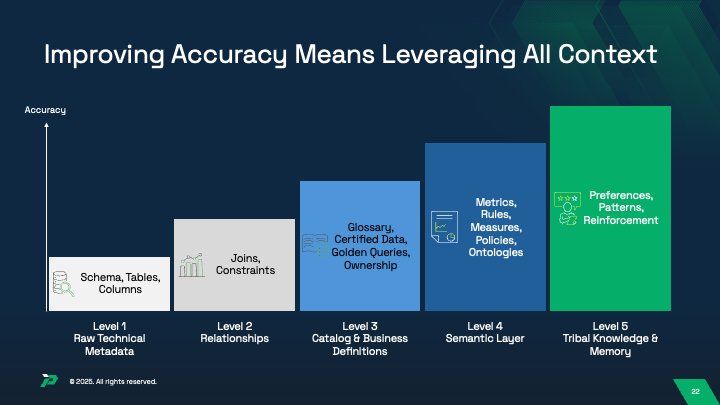
A stepped bar chart titled “Improving Accuracy Means Leveraging All Context,” showing five increasing levels of context that improve accuracy. From left to right: Level 1 Raw Technical Metadata (schema, tables, columns), Level 2 Relationships (joins, constraints), Level 3 Catalog & Business Definitions (glossary, certified data, golden queries, ownership), Level 4 Semantic Layer (metrics, rules, measures, policies, ontologies), and Level 5 Tribal Knowledge & Memory (preferences, patterns, reinforcement). An upward arrow on the left indicates accuracy increasing with each level.
February 9, 2026

Metadata Management for AI: Making LLMs Trust Your Data in 2026

AI agents need rich metadata to deliver accurate answers—yet most organizations struggle with fragmented metadata across catalogs, semantic layers, and BI tools. This guide explains how unified metadata management...

Continue Reading »
February 9, 2026

Metadata Management in Data Mesh: Federated Ownership Patterns

Data mesh promises agility through domain ownership—but creates metadata fragmentation. Explore proven patterns for federated metadata management that maintain coherence without sacrificing autonomy.

Continue Reading »
February 9, 2026

Active vs Passive Metadata Management: What Is It and What Fits Your Stack?

Understand active vs passive metadata management approaches, their architectural differences, and decision criteria for choosing the right strategy based on data maturity, scale, and AI readiness.

Continue Reading »