Agentic Analytics Platforms: 5 Enterprise Use Cases Delivering ROI in 2026
After two years of AI analytics pilots, one pattern separates enterprises achieving real ROI from those still stuck in proof-of-concept cycles: they deployed agentic analytics platforms against specific, structurally suited use cases rather than attempting broad transformation at once. The results are measurable — 95% reductions in time-to-insight, 10x faster data product creation, and 300%+ ROI in year one.
These outcomes aren’t accidents. They emerge from a deliberate match between agentic AI capabilities and use cases that share four structural traits: data fragmented across systems, chronic analyst bottlenecks, high cost of delayed decisions, and explainability requirements. Here are five enterprise use cases where agentic analytics platforms are delivering documented returns in 2026.
1. Post-M&A Data Unification: Insight in Weeks, Not Quarters
Post-merger integration is analytically intensive and brutally time-pressured. Leadership needs unified visibility into combined revenue, customer overlap, and synergy realization — but the acquired company’s ERP, CRM, and billing systems don’t speak the same language as the acquirer’s. Full data migration takes quarters. Decisions can’t wait that long.
Traditional approaches — manual data marts, spreadsheet extracts, bespoke reconciliation — produce fragmented outputs weeks after the questions are asked. By then, the window for fast synergy capture has narrowed.
Why agentic analytics fits: An agentic platform delivers virtual unification without physical migration. Agents map schemas from both legacy systems to a shared semantic model — resolving “cust_id” against “client_number,” normalizing inconsistent product hierarchies, and flagging quality issues for human review. Once mappings are validated, every subsequent query executes across both systems as if they were one.
A travel services company put this into practice after a large-scale merger. Rather than waiting months for architecture consolidation, they deployed an agentic analytics platform and went from kickoff to first production insights in under four weeks — with self-service access for leadership throughout the integration period. Zero data migration required.
The ROI math is straightforward: if a merger targets $100M in annual synergies, accelerating realization by even one quarter through earlier visibility yields tens of millions in net present value. Combined with labor savings from automated cross-system reporting (typically 70–85% faster month-end close), the financial case is strong.
2. Self-Service Marketing Analytics: Closing the Cross-Channel Gap
Modern marketing organizations span search, social, email, programmatic, CRM, and product telemetry — each platform reporting in its own schema with its own attribution definitions. Weekly performance rollups require analyst days to produce. By the time campaigns are optimized, the budget window has passed.
The core problem isn’t a lack of data — it’s the coordination overhead between where data lives and where decisions get made.
Why agentic analytics fits: Agentic platforms maintain normalized definitions across platforms (impressions, conversions, attribution windows) and execute heterogeneous queries across ad platforms, CRM, and data warehouses in a single conversational interaction. A marketing director asking “Which campaigns targeting enterprise accounts showed the best incremental revenue per dollar, net of email nurture touches?” receives a composed response — not a ticket number.
One enterprise healthcare organization — where marketing data was siloed across multiple systems with no unified view — achieved a 95% reduction in time to insights (from days to minutes) and a 5x increase in data team productivity after deploying an agentic analytics platform. Cost per data product dropped 90%.
Beyond efficiency, the revenue impact compounds. When organizations shorten the feedback loop between performance data and optimization decisions, return on ad spend improves measurably — often 5–15% in early adopters — because budget reallocation happens weekly rather than monthly.
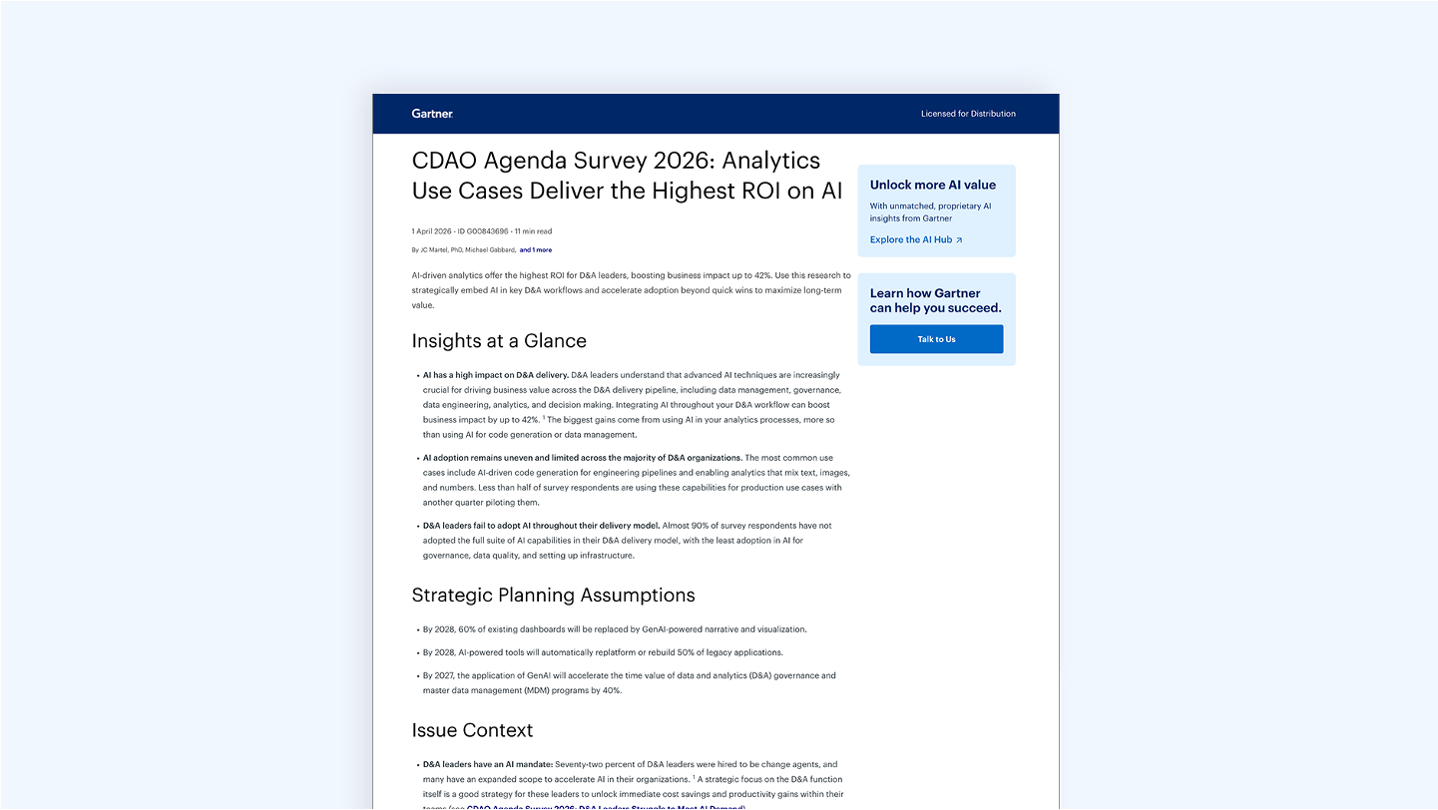
Which analytics use cases are CDOs prioritizing for AI ROI in 2026?
Get your complimentary Gartner report now.
3. Federated Analytics for Regulated Industries: Lineage-Backed, Audit-Ready
Compliance reporting in financial services, healthcare, and utilities demands more than accurate numbers — it demands a defensible trail from high-level figures back to source transactions. When a regulator asks “How was this calculated?”, the answer cannot be “let me find the analyst who built that spreadsheet.”
Traditional approaches embed logic in spreadsheets and ad-hoc scripts scattered across teams. When requirements change — a new metric, a revised threshold — teams spend months locating and updating every affected workflow. Error rates are high, audit preparation is expensive, and the risk of non-compliance is real.
Why agentic analytics fits: Agentic platforms centralize business rules and metric definitions in a governed semantic layer. Every query an agent executes is logged, every transformation tracked, every data source cited. The result is systematic lineage embedded in outputs — not reconstructed after the fact.
In federated analytics use cases where data cannot or should not be centralized (separate regulatory jurisdictions, different cloud environments, legacy on-premises systems), agentic platforms query data where it lives while maintaining full auditability. This combination — live federated access plus embedded lineage — is structurally superior to either traditional BI or warehouse-centric AI for compliance contexts.
Typical outcomes: 60–80% reduction in manual report assembly time, faster response to regulatory definition changes (weeks instead of months), and dramatically streamlined audit preparation. Given the fully loaded cost of compliance staff and the downside of violations, even conservative efficiency estimates generate strong ROI.
4. Self-Service Analytics for Non-Technical Users: Eliminating the Analyst Queue
The analyst bottleneck is one of the most expensive and least visible drags on enterprise performance. Central analytics teams triage an endless queue of requests; business users wait days for answers that take minutes to formulate; shadow spreadsheets proliferate as workarounds. The result: data-rich infrastructure serving data-poor decisions.
Traditional self-service BI partially addresses this — users can filter pre-built dashboards — but the moment a question requires a new join, a new metric, or data from a different system, users hit a wall and return to the queue.
Why agentic analytics fits: Conversational agents understand business intent, not just SQL syntax. A sales manager asking “How did my team perform against quota last quarter versus the same period last year, by segment?” receives a composed answer — with drill-down recommendations — without any analyst involvement. Follow-up questions maintain context. The interaction mirrors working with an experienced analyst at machine speed.
A global utilities provider deployed this model across CRM, cloud data warehouse, and legacy databases. Non-technical users can now lead data product creation independently. The result: 10x faster data product creation and self-service analytics across the enterprise — with unified governance ensuring every answer is trustworthy.
The productivity math scales significantly. If even 50% of routine analytics tickets are resolved through self-service, a 20-person analytics team effectively doubles its strategic capacity. For business users, reclaiming 2–3 hours per week of data-hunting time across hundreds of employees represents millions in aggregate productivity value annually.
5. Cross-System Operational Analytics: Product Quality and Supply Chain Visibility
Operational decisions — supply chain resilience, product quality management, asset maintenance — depend on data that spans procurement, manufacturing, logistics, CRM, and warranty systems. These systems were not designed to talk to each other. The cross-functional insight that leaders need requires stitching together data that no single system owns.
Traditional approaches build point-in-time data marts that answer yesterday’s questions. When a quality engineer needs to understand whether a spike in field failures correlates with specific production lots, a specific supplier, or specific usage conditions — across ERP, MES, warranty, and support data — the investigation takes weeks of manual coordination.
Why agentic analytics fits: Agentic platforms serve as an intelligent control plane across heterogeneous operational systems. Agents decompose complex cross-functional questions — “Are there failure rate patterns in product line X within six months of purchase that correlate with specific suppliers?” — into sub-queries across relevant systems, join results intelligently, and surface both patterns and recommended next investigation steps.
A global sports equipment brand used this approach to connect cloud data warehouse product data, CRM quality records, and BI reporting — enabling product quality teams to eliminate hours of manual data joining. Business users could validate insights with full context and present findings to executives with explainable lineage behind every number.
In utilities and industrials, enterprises deploying AI-driven operational analytics have reported up to 10x improvements in the speed of creating new analytics data products — outage pattern analysis, asset health dashboards, predictive maintenance models — compared to manual methods. For supply chain specifically, even 10–20% reductions in stockouts or expedited shipping costs translate into material financial impact at enterprise scale.
What These Use Cases Share
Mapping these five use cases against each other reveals why they consistently generate strong enterprise AI analytics ROI:
| Structural Factor | Why It Matters |
|---|---|
| Data fragmented across systems | Agentic platforms unify without migration |
| Dynamic, evolving questions | Conversational agents iterate; static BI cannot |
| Human capacity bottlenecks | Agents automate routine work, freeing experts |
| High cost of delayed insight | Compressing time-to-insight directly improves outcomes |
| Explainability requirements | Lineage and semantic clarity are built in, not retrofitted |
The financial services firms that have deployed agentic analytics for data product development report weeks saved per data product in prototyping — by eliminating the need for analysts to know SQL schemas or wait for engineering support. That acceleration, multiplied across dozens of data products per year, compounds into a substantial productivity return.
The enterprises generating 300%+ year-one ROI are not the ones that attempted the most ambitious transformations. They picked the right use cases, deployed against them with discipline, and let the results build organizational confidence for expansion. The five use cases here are the proven starting points.
Promethium’s Mantra AI Insights Fabric is deployed across healthcare, utilities, retail, travel, and financial services enterprises — delivering agentic analytics on live, federated data without migration or pipeline development.
Share This Article
SHARE THIS:



Share This Article
SHARE THIS: