Data Answers: Purpose-Built Data Products for the Age of AI
Talk to Your Data with Conversational Analytics
Data answers are self-contained, structured data artifacts that include SQL code, lineage, metadata, visualizations, annotations, and versioning — all packaged together for instant delivery, flexible consumption, and seamless integration across your data ecosystem.
Unlike traditional dashboards or static data products, data answers are purpose-built for the AI age: instant generation, iterative refinement, and flexible distribution to BI tools, data platforms, AI agents, and data marketplaces. They represent the evolution from rigid analytics to dynamic, reusable data intelligence that adapts to how modern organizations actually work.
In modern organizations, the speed of business has outpaced traditional analytics. Data answers bridge this gap by transforming how teams interact with data — from rigid dashboards to dynamic conversations that adapt to evolving questions and deliver actionable insights in minutes, not months.

Table of Contents
- What Are Data Answers?
- The Problem with Dashboard-First Analytics
- How Data Answers Work
- Data Answers vs Data Products vs Dashboards vs Datasets
- Use Cases: When Data Answers Shine
- Benefits of Conversational Data Analytics
- Implementation Considerations for Data Answers
- The Future of Data Access
- Getting Started with Data Answers
- Data Answers FAQs
- Further Resources
What Are Data Answers?
A data answer is a self-contained, structured response to a business question that includes all the technical components needed for trust, reuse, and evolution. Unlike simple query results or static reports, data answers package together the complete context and logic required to understand, validate, and build upon data insights.
Technical Components of Data Answers
Every data answer is a comprehensive artifact that includes:
SQL Code
The exact query logic used to generate the results, making the analysis transparent and reproducible.
Lineage
Complete data source tracking showing where information originated and how it was transformed.

Metadata
Rich context about data freshness, quality indicators, calculation methods, and business definitions.

Chart / Trend Visualization
Visual representation of results when appropriate, automatically generated based on data types and patterns.

Annotations
Business context, assumptions, and interpretations that help users understand what the results mean.
Version Control
Complete history of iterations and refinements, enabling teams to track how analysis evolved.
Flexible Consumption and Distribution
One of the key architectural advantages of data answers is their ability to integrate seamlessly across your entire data stack without requiring custom APIs or complex integration work. Because data answers are self-contained with all necessary metadata and context, they can be consumed by any system that needs structured, governed data — from traditional BI tools to modern AI agents.
This flexibility eliminates the need to rebuild analysis for different consumption patterns. A single data answer can simultaneously serve a dashboard requirement, feed an ML model, and provide context to an AI planning agent, all while maintaining consistent governance and lineage tracking.
Data answers are designed for maximum reusability across your entire data ecosystem:
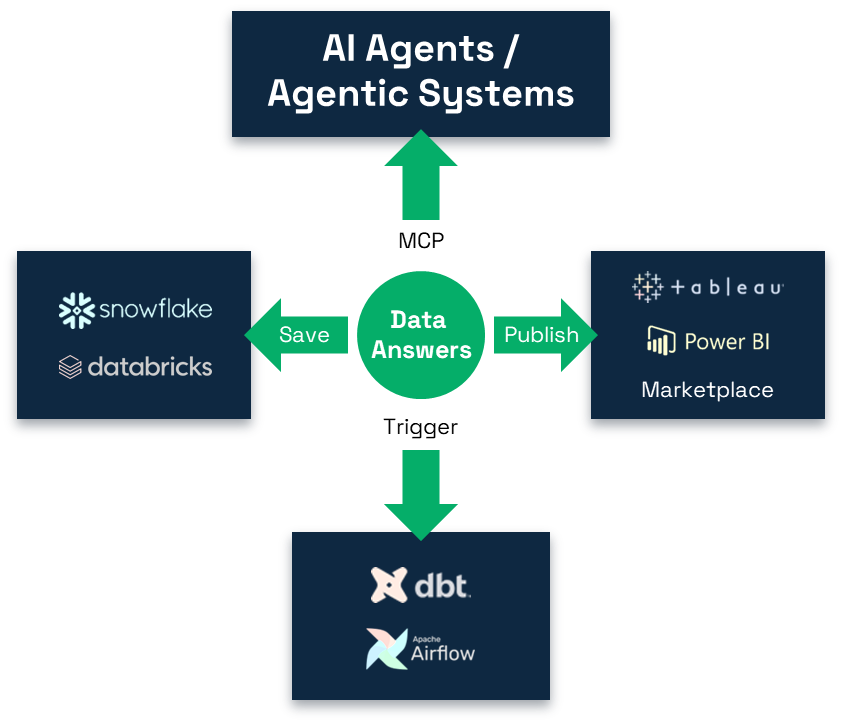

Save to Data Platforms
Persist results in Snowflake, Databricks, or other data warehouses for long-term access and further analysis.

Publish to BI Tools
Push insights directly into Tableau, Power BI, or other visualization platforms when dashboard views are needed.
Trigger Pipeline Development
Use validated data answers as specifications for building production-grade data products and automated pipelines via tools like dbt or Apache Airflow.

Agent-to-Agent Communication
Send structured answers to AI agents and agentic systems via MCP (Model Context Protocol) or A2A (Agent2Agent Protocol) for automated decision-making.

Data Answer Marketplace
Share and discover reusable answers across teams through internal data marketplaces and knowledge bases.
Core Design Principles
Data answers are built around five key characteristics that differentiate them from traditional analytics outputs:
Instant
Generated in real-time without requiring pre-built pipelines or data movement.
Iterative
Designed for refinement and follow-up questions that build on previous context.

Consumable
Structured for both human understanding and machine consumption across multiple systems.
Flexible
Adaptable to different output formats and integration patterns based on downstream needs.

Reusable
Self-contained with all necessary context for discovery, understanding, and repurposing by other users.
Why AI Demands a New Approach
Traditional analytics workflows assume stable requirements and predictable questions. But AI-powered decision making operates at machine speed, requiring data access that can match the pace of automated insights and recommendations.
Data answers enable organizations to:
- Respond to AI-generated hypotheses immediately
- Validate machine learning insights with contextual data
- Support human-AI collaboration through conversational interfaces
- Scale data access without overwhelming technical teams

The Problem with Dashboard-First Analytics
Most organizations default to the same response for every data request: build a dashboard. This approach creates significant friction between business velocity and data delivery.
The Traditional Analytics Bottleneck

Rigid Development Cycles
Every question triggers a multi-week process of requirements gathering, development, and iteration — even for simple, one-time queries.

Over-Engineering Simple Requests
A VP asking “What were sales last week?” shouldn’t require a full dashboard build, but that’s often the only available path.

Dashboard Graveyards
Industry estimates suggest over 60% of dashboards are viewed once or twice, then abandoned — representing massive wasted effort.

Misaligned Expectations
By the time a dashboard is ready, business priorities have often shifted, making the original answer irrelevant.
The Cost of Inflexibility
This dashboard-first approach creates real organizational costs:
- Delayed Decision-Making: Teams wait days or weeks for answers to time-sensitive questions
- Analyst Burnout: Data teams spend more time building unused assets than solving high-value problems
- Reduced Innovation: Slow feedback loops discourage experimentation and bold questions
- Trust Erosion: When answers arrive too late to matter, confidence in data capabilities declines
Business Velocity vs. Data Velocity
Modern businesses operate in compressed decision cycles. Market conditions change weekly. Customer behaviors shift in real-time. Competitive landscapes evolve continuously.
Traditional analytics operates in monthly or quarterly cycles. The mismatch between business speed and data delivery speed creates a fundamental gap that dashboards cannot bridge.
How Data Answers Work
Data answers represent a fundamental shift in data architecture — from building static assets to generating dynamic, structured responses that adapt to diverse consumption patterns. The underlying system architecture enables this flexibility through three key technical layers.
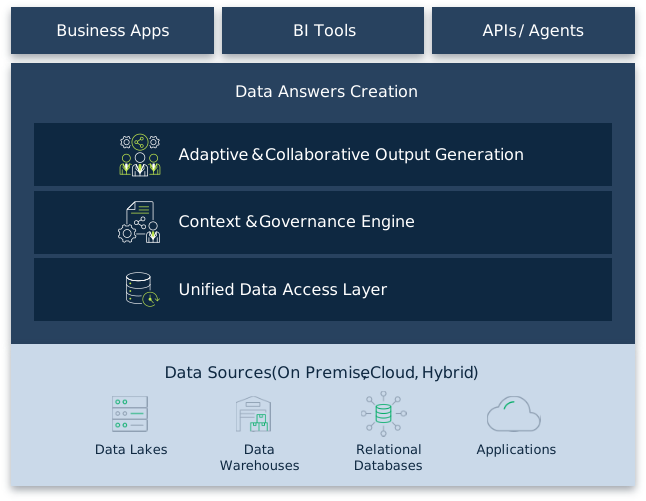

Unified Data Access Layer
Rather than requiring data movement or replication, data answers query live sources across cloud, hybrid, and on-premises environments. This eliminates data lag and ensures consistency while supporting real-time analysis across previously siloed systems.
Multi-Source Connectivity: Direct integration with data warehouses, operational databases, SaaS applications, and streaming sources without ETL overhead.
Query Optimization: Intelligent query planning that minimizes compute costs and maximizes performance across distributed data sources.
Live Data Access: Real-time execution against source systems maintains data freshness and eliminates synchronization issues.

Context and Governance Engine
Every data answer inherits organizational context automatically — business definitions, security policies, and quality standards are applied consistently without manual configuration.
Semantic Intelligence: Automatic mapping between business terminology and technical schemas enables intuitive access while maintaining precision.
Policy Enforcement: Role-based access controls, data classification, and compliance requirements are enforced at query time across all consumption patterns.
Quality Assurance: Automated validation ensures data answers meet organizational standards for accuracy, completeness, and reliability.

Adaptive & Collaborative Output Generation
Data answers are structured for immediate consumption while remaining flexible enough to evolve based on downstream requirements.
Multi-Format Support: Generate outputs optimized for human analysis, machine consumption, or integration with downstream systems.
Context Preservation: All technical components (SQL, lineage, metadata) travel with the answer, enabling validation and iteration.
Version Management: Automatic tracking of changes and refinements supports collaborative analysis and reproducible results.
This architecture enables organizations to generate trustworthy, reusable data insights at the speed of business while maintaining enterprise-grade governance and integration capabilities.
Data Answers vs Data Products vs Dashboards vs Datasets
Modern data organizations rely on multiple types of data assets, each serving different purposes and user needs. Understanding where data answers fit within this ecosystem — and how they complement rather than replace existing approaches — is critical for data leaders planning their architecture strategy.
The key insight is that data answers don’t eliminate the need for datasets, data products, or dashboards. Instead, they provide a new layer that bridges the gap between raw data access and finished analytics outputs, enabling faster iteration and validation before committing to more structured implementations.
Data answers occupy a unique position in the data asset spectrum: more structured and governed than raw datasets, more flexible and iterative than dashboards, and more immediate than traditional data products. This positioning makes them particularly valuable for exploration, hypothesis testing, and rapid response to business questions.
Understanding how data answers fit into the broader data architecture helps clarify when to use each approach:
Aspect | Raw Datasets | Dashboards | Data Products | Data Answers |
Purpose | Data storage | Ongoing reporting | Reusable business capability | Ad hoc analytics & exploration |
User Interface | Database queries | Fixed, pre-built visualizations | APIs, documentation, marketplace | Conversational, via third-party tools, marketplace |
Speed to Value | Slow (requires expertise) | Slow if build required, faster if readily available | Slow if setup required, faster if readily available | Instant |
Flexibility | High (raw access) | Low (fixed views) | Medium (defined structure) | High (adaptive outputs) |
Governance | Manual enforcement | Dashboard-level controls | Embedded standards | Automated, enforced at query level or through marketplace |
Reusability | Low (technical barrier) | Low (limited to pre-defined questions) | High (designed for reuse) | High (shareable, evolvable) |
Ideal Use Cases | Technical analysis | Regular monitoring | Production applications | Ad hoc questions, validation, hypothesis testing |
User Skills Required | SQL expertise | Navigation skills, business knowledge | SQL and API knowledge | Adaptive (business knowledge as baseline) |
The Evolution Pathway
Raw Datasets → Data Products → Data Answers
This represents the natural progression from technical data access to business-native interaction:
- Datasets: Foundational data storage and technical access
- Data Products: Structured, reusable business capabilities with defined interfaces
- Data Answers: Conversational, AI-native access that democratizes data interaction
Complementary, Not Competitive
These approaches work together rather than competing:
- Data products provide the structured foundation and governance framework
- Data answers enable rapid exploration and validation on top of that foundation
- Dashboards serve specific monitoring and reporting needs that benefit from static views
- Datasets remain essential for technical users and custom applications
Use Cases: When Data Answers Shine
Data answers excel in scenarios where traditional analytics approaches create friction or delay. Here are the primary use cases where conversational data access delivers the most value:

Ad Hoc Executive Questions
Scenario: A VP asks, “Why did our customer acquisition costs spike last month?”
Traditional Approach: Data team triages request, builds analysis, creates presentation — takes 1-2 weeks.
Data Answer Approach: VP asks question directly, receives immediate analysis with supporting context, can drill deeper with follow-up questions — takes 2-3 minutes.
Value: Time-sensitive decisions can be made with data rather than gut instinct.

Hypothesis Testing and Idea Validation
Scenario: Product team wonders, “Do customers who use our mobile app have higher retention rates?”
Traditional Approach: Request data analysis, wait for results, decide whether to invest in mobile optimization.
Data Answer Approach: Instant validation of hypothesis with supporting data, immediate follow-up questions to understand causation vs. correlation.
Value: Ideas can be validated or discarded quickly, accelerating innovation cycles.

Iterative Collaboration Between Teams
Scenario: Marketing and sales teams collaborating on lead quality analysis.
Traditional Approach: Multiple meetings, data requests, back-and-forth revisions, final dashboard.
Data Answer Approach: Real-time exploration during meetings, immediate what-if scenarios, shared understanding built through conversation.
Value: Faster alignment, better collaboration, decisions made with full team input.

Self-Service with Governance Guardrails
Scenario: Regional managers need periodic performance updates but don’t want to wait for IT support.
Traditional Approach: Request access to dashboards, submit tickets for modifications, wait for technical team availability.
Data Answer Approach: Enable data teams to quickly surface answers or ask questions directly to get governed results instantly, save and share useful queries with other managers.
Value: Democratized access without sacrificing control or overwhelming technical teams.

AI Agent Integration
Scenario: Planning systems need current data to generate forecasts and recommendations.
Traditional Approach: Build APIs, maintain data feeds, handle schema changes and updates manually.
Data Answer Approach: AI agents query for needed data through natural language interfaces, receive structured responses they can consume directly.
Value: Scalable AI-to-data integration without custom development overhead.
Benefits of Conversational Data Analytics
The shift from traditional analytics workflows to data answers creates measurable improvements across multiple organizational dimensions. While the technical architecture enables these benefits, the real value emerges in faster decision cycles, broader data access, and more agile business operations.
These improvements aren’t theoretical — early adopters consistently report dramatic reductions in time-to-insight, increased self-service adoption, and better alignment between data capabilities and business velocity. The benefits compound over time as teams learn to leverage instant, iterative analytics for everything from quick validations to strategic planning.
The core advantages of implementing data answers span operational efficiency, organizational agility, and strategic decision-making capabilities:
Organizations implementing data answers consistently report improvements across multiple dimensions:

Speed: Minutes Instead of Weeks
Traditional analytics projects measure delivery in weeks or months. Data answers deliver results in seconds or minutes, fundamentally changing the pace of data-driven decision making.
Quantified Impact:
- 95%+ reduction in time-to-insight for ad-hoc questions
- Real-time decision support during meetings and planning sessions
- Ability to validate ideas immediately rather than scheduling analysis

Accessibility: No Technical Skills Required
Natural language queries eliminate the barrier between business users and data insights. Users focus on asking the right questions rather than learning technical tools.
Organizational Benefits:
- Broader participation in data-driven decisions
- Reduced dependency on technical teams for simple questions
- More diverse perspectives included in analysis

Agility: Questions Evolve Naturally
Unlike fixed dashboards, data answers support the natural flow of business inquiry — where one answer leads to new questions and deeper exploration.
Operational Advantages:
- Follow-up questions build on previous context
- Analysis can pivot based on initial findings
- Exploration matches the pace of human thought

Trust: Explainable Results with Full Context
Every data answer includes the logic, sources, and methodology used to generate results. Users understand not just what the data shows, but how and why.
Trust-Building Elements:
- Query logic visible and explainable
- Data lineage and source attribution
- Quality indicators and freshness timestamps
- Natural language explanations of complex calculations

Scale: Handle More Questions Without Growing Teams
Data answers enable organizations to respond to significantly more data requests without proportionally increasing data team size.
Scaling Benefits:
- Self-service reduces technical team bottlenecks
- Reusable answers eliminate duplicate work
- Automated governance scales without manual oversight
- AI agents can handle routine queries independently
Implementation Considerations for Data Answers
Successfully implementing data answers requires attention to both technical and organizational factors:
Technical Requirements for Conversational Analytics
Data Infrastructure: Ability to query across multiple sources with consistent governance and security controls.
Semantic Layer: Business terminology mapping that connects conversational concepts to technical data structures.
Query Optimization: Performance capabilities that support real-time execution across large datasets.
Context Management: Systems that maintain conversation state and build on previous interactions.
Governance Integration: Automated enforcement of access controls, data quality rules, and compliance requirements.
Integration with Existing Data Stack
Data answers work best when they complement rather than replace existing infrastructure:
Data Sources: Connect to cloud data warehouses, on-premises databases, SaaS applications, and streaming sources without requiring data movement.
BI Tools: Feed results into existing Tableau, Power BI, or other visualization tools when dashboard views are needed.
Data Catalogs: Leverage existing metadata and governance frameworks to ensure consistency.
Security Systems: Integrate with identity providers and access control systems to maintain enterprise security standards.
Governance Framework
Maintaining control while enabling flexibility requires thoughtful governance design:
Access Controls: Role-based permissions that determine what data users can query and how results can be shared.
Quality Standards: Automated validation that ensures data answers meet organizational quality requirements.
Audit Trails: Complete logging of queries, results, and usage patterns for compliance and optimization.
Usage Monitoring: Analytics on data answer adoption and value to guide platform improvements.
Change Management
Shifting from dashboard-first to conversation-first analytics requires organizational adaptation:
User Training: Help teams learn to ask better questions and interpret conversational results effectively.
Process Updates: Modify workflows to take advantage of faster feedback cycles and real-time insights.
Success Metrics: Define new KPIs that measure speed, adoption, and business impact rather than just dashboard usage.
Cultural Shift: Encourage experimentation and iteration rather than perfect specifications up front.
Data Fabric as the Foundation
For many organizations looking to implement a data answer approach, data fabric architecture emerges as the optimal foundation. Data fabric provides the unified data access layer, automated governance, and semantic intelligence required to deliver instant, contextual responses across distributed data sources.
The combination of data fabric infrastructure with data answer capabilities creates a powerful platform for conversational analytics — enabling real-time queries across any data source while maintaining enterprise governance and security standards. This architectural approach eliminates the need for extensive data movement or custom integration work while supporting the flexibility and speed that data answers require.
Organizations evaluating data answer implementations should consider data fabric as both the technical enabler and strategic foundation for conversational analytics at enterprise scale.
The Future of Data Access
The evolution toward conversational data interfaces represents a fundamental shift in how organizations interact with information. As artificial intelligence becomes central to business operations, data access must match AI’s speed and flexibility requirements. This transformation goes beyond adding natural language capabilities to existing tools — it requires rethinking the entire relationship between business users and enterprise data.
AI-First Analytics
Artificial intelligence is fundamentally changing how organizations expect to interact with data. AI systems need instant access to contextual data to make recommendations and take actions, but they also require structured, governed responses that can be validated and traced. Data answers provide exactly this capability, offering real-time decision support that maintains enterprise standards while operating at machine speed.
The integration between human analysts and AI agents becomes seamless when both can access the same data answer infrastructure. Conversational interfaces enable natural collaboration between human analysts and AI systems, where insights generated by algorithms can be immediately validated, explored, and acted upon through the same conversational framework. This creates a new paradigm where human expertise and artificial intelligence complement each other rather than competing.
AI can also proactively surface relevant data answers based on patterns, anomalies, or changing business conditions. Rather than waiting for users to ask questions, intelligent systems can anticipate information needs and generate contextual insights that support faster decision-making and more proactive business management.
Evolution Beyond Traditional BI
Business intelligence is evolving from periodic reporting to continuous intelligence embedded directly in business processes. Traditional BI tools required users to navigate to separate applications and interpret static reports. The future model integrates data answers directly into workflow applications, CRM systems, planning tools, and operational dashboards where decisions are actually made.
This embedded approach means data insights become part of the natural flow of work rather than a separate activity. Users don’t have to context-switch between their primary applications and analytics tools — the intelligence comes to them when and where they need it. Data answers can integrate into email workflows, planning sessions, customer service interactions, and strategic discussions without requiring technical setup or custom development.
The shift also enables proactive insights that anticipate information needs rather than just responding to explicit requests. Systems can surface relevant data answers based on user behavior, business events, or changing conditions, creating a more intelligent and responsive data environment that supports continuous decision-making rather than periodic analysis.
Organizational Impact
Data answers fundamentally change how teams operate and make decisions across the organization. The traditional model created clear boundaries between technical data teams and business users, with formal processes for requesting and delivering analytics. Conversational data access flattens these hierarchies by enabling direct access to governed insights without technical intermediaries for routine questions.
This democratization leads to faster innovation cycles because ideas can be validated immediately rather than waiting for formal analysis. Teams can test hypotheses, explore market opportunities, and respond to competitive threats with data-driven insights available in real-time. The reduced friction between questions and answers encourages more experimentation and bolder strategic thinking.
Organizations also experience reduced technical debt as the pressure to build custom dashboards and reports for one-time questions diminishes. Data teams can focus on building robust data infrastructure and governance frameworks rather than responding to ad-hoc reporting requests. This shift allows data professionals to work on higher-value strategic initiatives while business teams gain the independence they need to move at market speed.
Getting Started with Data Answers
Organizations can implement data answers incrementally, building value while learning what works best for their specific context:

Assessment: Identifying High-Value Use Cases
Start by analyzing current data request patterns to identify opportunities where data answers would deliver the most value:
High-Volume, Low-Complexity Questions: Simple queries that currently require disproportionate effort to answer.
Time-Sensitive Decisions: Situations where delayed data access impacts business outcomes.
Repetitive Analysis: Similar questions asked by different users that could benefit from reusable answers.
Cross-Functional Collaboration: Projects requiring data input from multiple stakeholders who need shared understanding.

Pilot Approach: Starting Small and Scaling
Phase 1: Single Domain: Begin with one business area (sales, marketing, finance) where data is well-structured and questions are frequent.
Phase 2: Cross-Domain: Expand to queries that span multiple data sources and business functions.
Phase 3: Advanced Use Cases: Enable AI agent integration and automated insight generation.
Phase 4: Organization-Wide: Scale across all business functions with full governance and integration.

Success Metrics: Measuring Value and Adoption
Speed Metrics:
- Time from question to answer
- Reduction in data request backlog
- Faster decision-making cycles
Adoption Metrics:
- Number of active users
- Questions asked per user
- Retention and engagement rates
Business Impact Metrics:
- Decisions made with data vs. intuition
- Revenue or cost impact from faster insights
- Improvement in business outcome metrics
Efficiency Metrics:
- Reduction in dashboard development requests
- Data team capacity freed for strategic work
- Self-service success rates

Best Practices from Early Implementations
Start with Power Users: Begin with analytically sophisticated users who can provide detailed feedback and help refine the system.
Focus on Question Quality: Invest in training users to ask better questions rather than just providing technical access.
Build Feedback Loops: Create mechanisms to continuously improve natural language understanding and result quality.
Maintain Governance: Ensure data answers respect existing security and quality standards from day one.
Document Success Stories: Capture and share examples of how data answers drove business value to encourage broader adoption.
Data Answers FAQs
What's the difference between conversational queries and data answers?
Conversational queries refer to the interface — asking questions in business language rather than SQL. Data answers are the complete response that includes the query results plus context, explanations, and follow-up capabilities. Conversational queries are the input method; data answers are the comprehensive output.
Do data answers replace dashboards completely?
No. Data answers excel at exploration, iteration, and ad-hoc questions, while dashboards remain valuable for ongoing monitoring and standardized reporting. The goal is to use the right tool for each use case rather than defaulting to dashboards for every question.
How do you maintain data governance with conversational access?
Data answers enforce governance automatically through the underlying platform. Access controls, data quality rules, and compliance requirements are applied at query time, ensuring that conversational access doesn’t compromise security or accuracy.
What technical skills do users need to get value from data answers?
Users need business domain knowledge to ask good questions and interpret results, but no technical skills like SQL or data modeling. The system handles the technical complexity while users focus on business logic and decision-making. However, data answers adapt to the users technical skill level. SQL-savvy users are also able to directly iterate on the query rather than engaging conversationally.
How do data answers integrate with existing BI tools?
Data answers can feed results into existing BI platforms when dashboard views are needed. They complement rather than replace existing tools by handling the exploration and validation phases before formal reporting.
Can AI agents use data answers independently?
Depending on your setup, yes. Data answers are designed to support agent-to-agent communication, enabling AI systems to query for needed data and receive structured, contextual responses they can consume directly for decision-making or further analysis.
What happens to data answers over time?
Data answers can evolve based on their utility. Valuable answers can be saved, shared, and reused. Those that prove broadly useful can be promoted to formal data products or incorporated into dashboards. Others serve their purpose and naturally expire.
How do you ensure data answer quality?
Quality is maintained through automated validation, source attribution, and governance integration. Every answer includes metadata about data freshness, calculation methods, and quality indicators, enabling users to assess reliability independently.
What infrastructure is required to implement data answers?
Data answers require three core infrastructure components: unified data access across your existing sources, a semantic layer that maps business terminology to technical schemas, and governance integration with your current security and compliance frameworks. Most implementations leverage data fabric architecture to provide these capabilities without requiring data movement or platform replacement.
What's the ROI timeline for implementing data answers?
Organizations typically see immediate value from reduced analyst workload on ad-hoc requests, with quantifiable ROI emerging within 2-3 months through faster decision cycles and increased self-service adoption. Long-term ROI compounds through reduced dashboard development costs, fewer unused analytics assets, and improved business agility that enables faster response to market opportunities.
How are data answers different from ChatGPT or other AI tools for data?
While consumer AI tools can write SQL or explain data concepts, data answers provide enterprise-grade governance, real-time access to live business data, the necessary business and technical context to validate results, and complete audit trails. Data answers integrate with your existing security policies, respect access controls, and include full lineage tracking — capabilities that consumer AI tools cannot provide for enterprise data environments.
How do data answers compare to closed-loop systems like Snowflake, Databricks, or Microsoft Fabric?
While platform-specific solutions like Snowflake Copilot, Databricks AI/BI, or Microsoft Fabric lock you into their ecosystem, data answers provide an open, platform-agnostic approach that works across your entire data stack. Data answers can query live data from any combination of sources — whether it’s Snowflake, Databricks, Oracle, SAP, or cloud applications — without requiring data consolidation or vendor lock-in. This openness enables true enterprise flexibility while maintaining governance across all your data assets.
The Conversational Future of Enterprise Analytics
Data answers represent the natural evolution of enterprise analytics for the AI age. By shifting from dashboard-first to conversation-first data access, organizations can match the speed of modern business while maintaining the governance and quality standards that enterprise data requires.
The transformation from rigid reporting to flexible exploration doesn’t happen overnight, but the benefits — faster decisions, broader participation, and more agile business operations — justify the investment. Organizations that embrace conversational data access now will build competitive advantages that compound over time.
Ready to transform how your organization accesses data? Download our comprehensive whitepaper “Data Answers: A Faster, Smarter Way to Enterprise Analytics” to learn implementation strategies, technical requirements, and real-world success stories from early adopters.
The future of data access is conversational. The time to start is now.