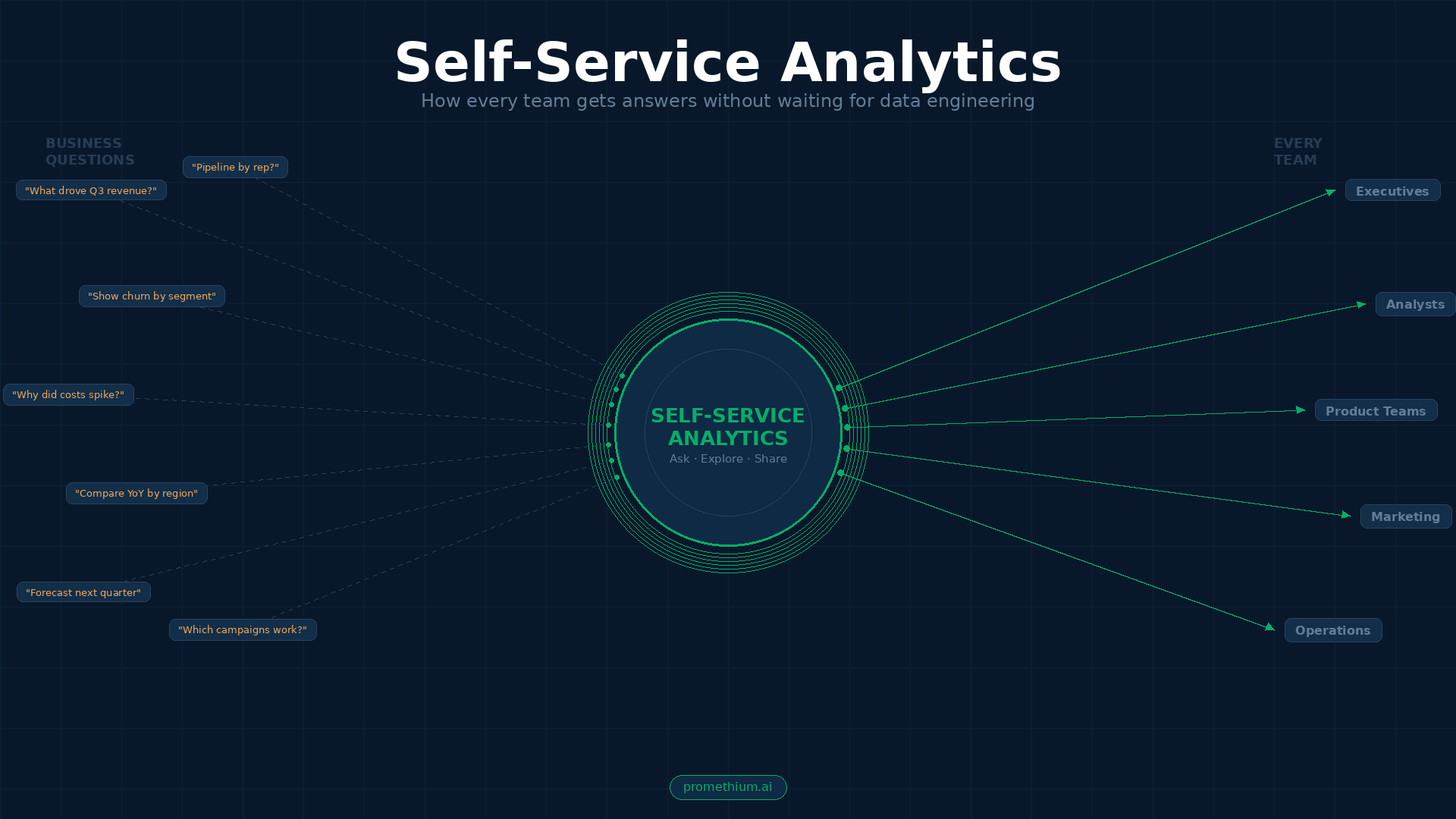
Top 10 Self-Service Analytics Tools in 2026: Empowering Every Data User
The self-service analytics market has reached $14.01 billion in 2026, representing 18.4% year-over-year growth as organizations fundamentally transform how they approach data-driven decision-making. This explosive expansion reflects more than adoption—it signals a paradigm shift where business users across departments independently explore data, ask questions in natural language, and generate actionable insights without technical intervention.
Modern self-service analytics platforms combine sophisticated natural language querying, AI-powered automated insights, embedded governance frameworks, and collaborative features that enable business users to extract value from enterprise data while maintaining security and consistency. The platforms evaluated here represent the leading solutions in 2026, each addressing distinct organizational needs while supporting the broader imperative to reduce IT bottlenecks and accelerate time-to-insight.
What Self-Service Analytics Really Means in 2026
Self-service analytics inverts the traditional business intelligence model. Instead of business users submitting formal requests to IT departments—creating approval workflows extending weeks or months—self-service BI tools empower non-technical stakeholders to independently connect to data sources, construct visualizations, perform exploratory analysis, and share findings without specialized technical expertise.
The value extends beyond simple democratization. Research shows 60% of organizations consider self-service analytics critical or very important to operational strategy, with this perception growing substantially among larger enterprises where scale and complexity make centralized reporting impractical. Furthermore, 89% rate collaborative business intelligence capabilities as important or critical, indicating organizations value not only independent exploration but team co-creation of insights.
Business impact is measurable: organizations implementing self-service platforms report 50% reductions in analysis time, higher employee engagement with data-driven workflows, and improved data literacy across the workforce. When paired with strong governance frameworks, organizations achieve democratized data with controlled chaos—business users gain genuine autonomy while administrators maintain visibility into data quality, access patterns, and metric definitions through automated governance layers.
Natural Language Querying: The Self-Service Breakthrough
Natural language querying (NLQ) represents the most significant technological advance enabling genuine self-service analytics in 2026. Rather than requiring users to navigate complex dashboard filters or write SQL queries, NLQ platforms allow users to ask questions using everyday language and receive accurate, visually formatted answers.
The fundamental challenge NLQ systems address is the gap between how business users naturally think about questions and how data systems expect those questions to be formulated. Business users think in terms like “Which regions had the lowest sales this quarter?” Traditional BI tools required users to mentally translate these questions into dashboard navigation or SQL syntax. NLQ systems eliminate this translation requirement through layers of natural language processing, machine learning, and semantic understanding.
ThoughtSpot has established itself as a leader in NLQ accuracy, earning a 4.6 out of 5 rating for natural language query precision, outpacing Power BI’s 4.1 and Tableau’s 4.0. ThoughtSpot’s advantage stems from its search-first architectural design and features like “Spotter Coach,” which uses a matching panel to map user queries to specific data fields, helping users refine questions when initial queries require clarification.
Most NLQ implementations follow a predictable workflow: they connect to databases through secure pipelines, standardize and model datasets so every team uses consistent information, present insights through interactive dashboards and natural language options, and refresh connected data frequently to maintain accuracy. Behind the scenes, when a user submits a question, NLP helps interpret user intent, identify relevant metrics and dimensions, resolve ambiguities using context, translate the question into executable format, and return results as clear summaries or visualizations.
Automated insights represent a related AI capability that complements NLQ by proactively surfacing patterns users might not think to ask about. Rather than waiting for users to pose specific questions, automated insight systems continuously analyze data in the background, detecting meaningful patterns, anomalies, trends, and correlations that warrant investigation.
The Top 10 Self-Service Analytics Platforms
1. ThoughtSpot: Search-First Analytics with Real-Time Querying
ThoughtSpot has positioned itself as an AI-native business intelligence platform built on a fundamentally different architectural premise than traditional BI tools. Rather than organizing around dashboards as the primary interface, ThoughtSpot organizes around search and live querying as core experiences.
Users type questions like they would in a search engine—”Which regions underperformed last quarter?” or “What’s driving customer churn?”—and receive immediate answers from live cloud data without requiring dashboard navigation or SQL knowledge. This search-first approach proves particularly effective for teams needing real-time data access, as ThoughtSpot connects directly to cloud data sources and performs live queries without relying on precomputed data extracts.
AI-generated explanations highlight trends, anomalies, and key drivers that influence business performance, automatically surfacing context that helps users understand not just what changed but why. ThoughtSpot’s pricing model reflects this accessibility focus, starting at $25 per user per month or $0.10 per query, providing flexibility for organizations with varying usage patterns.
Best For: Organizations prioritizing quick, live data access with minimal reliance on analysts, particularly in fintech and retail where real-time exploratory analysis on live data takes priority.
2. Tableau: Visual Analytics Excellence
Tableau maintains its reputation as the gold standard for advanced data visualizations, with capabilities helping teams identify patterns and trends through dynamic charts and dashboards that users consistently report feel intuitive and powerful. The platform connects to a wide range of data sources and uses drag-and-drop interfaces to enable building dashboards that are both powerful and visually compelling.
Tableau’s evolution reflects the broader shift toward AI-augmented analytics, with the platform’s Pulse feature focusing on predefined metrics, proving particularly useful for e-commerce teams tracking conversion rates or inventory levels. Tableau’s visualization capabilities earn a 4.7 out of 5 rating in 2026 comparisons, leading Power BI and ThoughtSpot.
However, organizations should acknowledge that Tableau pricing typically requires the Tableau+ Bundle ($75 per user per month standard pricing), and accessing enhanced Q&A features requires Salesforce integration. The platform’s full advanced functionality often demands more extensive training than simpler alternatives.
Best For: Teams prioritizing sophisticated data visualization, visual exploration, and presentation quality over rapid self-service query speed.
3. Power BI: Microsoft Ecosystem Integration
Microsoft Power BI has achieved dominant market position through aggressive pricing, tight integration with the Microsoft 365 ecosystem, and continuous feature development bringing advanced analytics capabilities to business users. At $14 per user per month for the Pro tier, Power BI offers clear value for organizations already invested in Microsoft infrastructure.
The platform fits neatly into environments where Excel, Teams, SharePoint, and Dynamics are already central to workflows, giving users a familiar experience and lowering entry costs. Power BI provides interactive dashboards, change analysis, and data modeling capabilities while Copilot and AI features help non-technical users easily prep data and create interactive visualizations.
Power BI’s AI capabilities have evolved from Q&A features toward Copilot-based natural language querying, though Copilot requires expensive Fabric or Premium licenses and works best with pre-aggregated data. Organizations deeply committed to Microsoft infrastructure find significant value in Power BI’s integrations and lower cost structure.
Best For: Microsoft-heavy organizations seeking cost-effective BI with familiar interfaces and tight ecosystem integration.
4. Looker: Semantic Modeling for Enterprise Consistency
Google Cloud’s Looker approaches self-service analytics through a model-based architecture that emphasizes consistency, governance, and scalability across organizations. Looker’s semantic modeling layer, implemented through LookML, defines business metrics and relationships once and reuses them consistently across all reports.
This “define once, use everywhere” approach means that when metric definitions change, the update happens in one place and automatically propagates across every dashboard and report consuming that metric. For organizations wrestling with metric inconsistency problems where different departments calculate “revenue” differently, Looker’s semantic layer provides the governance framework necessary to establish organizational alignment.
Looker connects to cloud warehouses using live queries that retrieve current information for every analysis rather than relying on data extracts. However, Looker’s complexity and learning curve—particularly LookML’s requirement to understand and write modeling code—create barriers for non-technical users trying to independently build content. Looker pricing ranges from $140 to $200 per user monthly, placing it in the premium tier.
Best For: Organizations with mature data teams, strong governance requirements, and commitment to the Google Cloud ecosystem.
5. Qlik Sense: Associative Exploration
Qlik Sense distinguishes itself through its associative engine, which enables exploratory analysis of complex datasets by revealing relationships dynamically rather than requiring users to specify query paths upfront. The associative data model differs fundamentally from traditional query-based approaches—users select data points and immediately see all related information that associates with that selection, even when relationships aren’t immediately obvious.
Qlik’s fast, in-memory processing improves responsiveness during exploration, supporting smooth interaction across demanding analyses. The platform suits organizations handling complex datasets that benefit from free-form exploratory analysis, teams needing responsive dashboards that visualize relationships across multiple systems, and companies prioritizing discovery-driven insights over predefined reporting structures.
However, professional user licensing ranges from $70 to $150 per month, capacity-based licensing starts around $2,500 to $5,000 monthly, and total year-one deployment costs for mid-sized teams typically run $125,000 to $215,000. Organizations must carefully assess whether Qlik’s associative capabilities justify the premium pricing.
Best For: Organizations needing sophisticated associative exploration of complex, interconnected datasets and willing to invest in premium capabilities.
6. Domo: Cloud-Native Unified Platform
Domo positions itself as a comprehensive cloud-native platform built specifically to help people interact with data in real time. The platform enables non-technical users to perform their own analysis, eliminating the need to wait for IT or data specialists. Users can connect to hundreds of data sources without code, visualize live data in customizable dashboards, and share what they learn directly in the tools they already use.
Domo’s no-code and low-code options support everything from quick chart building to app development, while AI-powered features like Domo AI help surface insights automatically based on patterns in data. Governance is built in, allowing admins to manage access and maintain data security without slowing down people who need answers.
Domo’s appeal extends to organizations seeking to consolidate multiple point solutions into a single integrated platform where data management, transformation, and self-service analytics operate within a unified environment. Organizations should note that Domo’s comprehensive platform approach requires more implementation effort than lightweight alternatives focusing solely on visualization.
Best For: Mid-to-large enterprises seeking an all-in-one platform consolidating data integration, transformation, governance, and analytics capabilities.
7. Promethium: AI Insights Fabric for Agentic Analytics
Promethium represents an emerging category of AI-focused analytics platforms addressing the fundamental barriers preventing enterprises from achieving instant, trusted answers from their data. Promethium’s AI Insights Fabric solves three challenges that must be addressed simultaneously for agentic data analytics to work: agent engineering, context engineering, and distributed data access.
Agent Engineering: Traditional BI tools require users to navigate complex interfaces or learn query languages. Promethium’s approach allows companies to talk to their data through Mantra, its conversational agent, or by plugging third-party tools like Claude directly into the fabric through the Model Context Protocol (MCP). This means users can ask questions in plain English using familiar AI interfaces and get accurate answers from enterprise data—no training required.
Context Engineering: Data without business context leads to wrong answers. Promethium automatically applies business logic, metric definitions, and data relationships so every answer—whether from Mantra or a third-party AI agent—understands what “revenue” means in your organization, which data sources are trusted, and how different systems connect. Context travels with the data, ensuring consistency across all analytical interactions.
Distributed Data Access: Enterprise data lives everywhere—cloud platforms, SaaS applications, on-premise databases. Promethium connects to all these sources with zero data movement or copying. The fabric federates queries across distributed systems in real time, eliminating the months-long pipeline projects that traditionally block self-service analytics.
By solving these three challenges simultaneously, Promethium creates an architecture where both humans and AI agents can interact with enterprise data conversationally. Business users ask questions through Mantra and receive curated, explainable answers. Developers integrate Claude or other AI tools via MCP, instantly giving those agents secure, contextualized access to enterprise data without building custom integrations.
This AI Insights Fabric approach acknowledges that true self-service analytics in 2026 requires more than better dashboards—it requires architectural changes that make data immediately accessible to both humans and intelligent agents, with trust and context built in from the start.
Best For: Forward-thinking enterprises prioritizing AI-native architecture, conversational analytics through familiar AI interfaces, and instant data access without copying or moving data.
8. Zoho Analytics: Accessible BI for Growing Teams
Zoho Analytics offers approachable BI tools for small and mid-sized teams, with emphasis on affordability and usability. Teams can create dashboards, automate recurring reports, and explore data using Zoho’s AI assistant, Zia. This tool connects with many popular apps, including CRM, finance, and e-commerce systems, and supports automated reporting tools for scheduled updates.
While it may not offer the advanced capabilities of enterprise BI platforms, Zoho Analytics fits well for growing teams wanting accessible analytics without added complexity. The platform proves especially useful for tracking KPIs, identifying performance trends, and building reports tailored for day-to-day decision-making.
Zoho’s 2026 enhancements include AI-powered innovations like Zia copilot for building data pipelines through natural language, MCP server integration enabling AI agent control, and significantly improved performance across data transformation operations.
Best For: Small-to-midsize organizations seeking cost-effective, easy-to-use analytics with strong integration to Zoho’s broader business application suite.
9. SAP Analytics Cloud: Planning Meets Analytics
SAP Analytics Cloud combines BI, planning, and predictive analytics in a single platform, often used by finance and operations teams needing to connect data with planning workflows. With self-service features like drag-and-drop dashboarding, natural language queries, and predictive forecasting, the platform supports both day-to-day reporting and long-term strategic planning.
The platform integrates well with other SAP systems and is designed for organizations already using SAP for ERP or supply chain operations. Built-in collaboration tools allow teams to share insights and align on plans in real time, helping make data-driven decision-making part of the workflow.
SAP Analytics Cloud’s 2026 releases introduce expanded chart types, story versioning enabling designers to create and manage up to 10 major story versions, comment management dashboards centralizing collaboration oversight, enhanced alerting capabilities for metric changes, and live Snowflake connectivity supporting real-time planning and analytics.
Best For: SAP-centric enterprises requiring integrated planning and analytics capabilities with strong ERP integration.
10. Sisense: Embedded Analytics for Product Teams
Sisense offers embedded and white-label analytics for product teams and developers wanting to bring BI directly into applications or customer-facing portals. It’s also used internally by teams needing tailored dashboards built around custom workflows or industry-specific requirements.
The platform supports a wide range of deployment options and includes tools for working with cloud data, complex joins, and advanced calculations. Sisense’s extensibility proves particularly valuable for those building data products or requiring detailed customization.
Sisense’s 2026 release introduces an MCP Server enabling external AI agents to interact with Sisense through natural language, email-based two-factor authentication strengthening security for non-SSO users, primary dashboard filters guiding users through relevant data in business context, expanded outer joins control for data modeling flexibility, and enhanced Compose SDK supporting calendar heatmaps and tabbed widgets.
Best For: Software vendors and enterprises building customer-facing analytics or requiring highly customized, embedded analytics within applications.
Platform Capabilities Comparison
| Platform | Natural Language Interface | No-SQL Data Exploration | Cross-Source Querying | Context-Aware Accuracy | Reusable Data Products | Governance & RBAC | Works With Existing Stack |
|---|---|---|---|---|---|---|---|
| ThoughtSpot | ✓ Search-first NLQ (4.6/5) | ✓ Live querying | ✓ Cloud data sources | ✓ AI-generated context | Limited | ✓ Enterprise controls | ✓ Cloud-native |
| Tableau | Partial (Q&A with Salesforce) | ✓ Drag-and-drop exploration | ✓ Wide connector support | Limited | ✓ Reusable dashboards | ✓ Row-level security | ✓ Broad compatibility |
| Power BI | ✓ Copilot (Premium) | ✓ Visual exploration | ✓ Microsoft ecosystem focus | Partial (pre-aggregated) | ✓ Shared datasets | ✓ Microsoft-integrated | ✓✓ Microsoft 365 |
| Looker | Limited | Requires LookML knowledge | ✓ Live warehouse queries | ✓✓ Semantic layer | ✓✓ LookML models | ✓✓ Enterprise-grade | ✓ Google Cloud focus |
| Qlik Sense | Limited | ✓✓ Associative engine | ✓ Multi-source associations | ✓ Dynamic relationships | ✓ Reusable apps | ✓ Enterprise controls | ✓ Flexible deployment |
| Domo | ✓ Domo AI | ✓ No-code exploration | ✓✓ 1000+ connectors | Partial | ✓ Shared datasets | ✓✓ Built-in governance | ✓ Platform approach |
| Promethium | ✓✓ Mantra + MCP integration | ✓✓ Conversational | ✓✓ Zero-copy federation | ✓✓ Context Fabric | ✓✓ Data Answer reuse | ✓✓ Automated compliance | ✓✓ Connects everywhere |
| Zoho Analytics | ✓ Zia assistant | ✓ Guided exploration | ✓ Zoho ecosystem + integrations | Partial | Limited | ✓ Basic controls | ✓ Zoho suite |
| SAP Analytics Cloud | ✓ Natural language | ✓ Drag-and-drop | ✓ SAP ecosystem focus | ✓ Planning integration | ✓ Story versioning | ✓✓ SAP-integrated | ✓ SAP environments |
| Sisense | ✓ MCP Server (2026) | ✓ Custom exploration | ✓ Complex joins | Partial | ✓✓ Embedded components | ✓ White-label controls | ✓ Embedded contexts |
Legend:
✓ = Supported
✓✓ = Advanced/Differentiated capability
Partial = Limited or requires add-ons
Limited = Basic functionality only
Critical Selection Criteria for Self-Service Analytics
Organizations evaluating self-service analytics platforms should approach selection systematically, recognizing that the best platform depends on distinct organizational context including current technology stack, user personas and skill levels, data governance maturity, and specific use case priorities.
Integration with Existing Data Infrastructure: Assess how well each platform integrates with your data infrastructure. If your organization has committed to Snowflake as a cloud data warehouse, platforms that connect directly to Snowflake without requiring data movement often offer better performance and simpler architecture. If you operate across multiple cloud providers, platforms with flexible, cloud-agnostic connectivity become essential.
Ease of Use for Primary User Personas: If your analytics use cases center on executives and managers consuming dashboards, ease of dashboard use and mobile accessibility should weigh heavily. If your primary use case involves analysts building content, drag-and-drop interfaces, data preparation tools, and calculated field capabilities matter more. If your use cases emphasize rapid exploratory analysis by business users asking ad-hoc questions, natural language querying accuracy becomes a differentiator.
Governance and Data Management Capabilities: Organizations with strict compliance requirements or complex data environments need platforms offering strong access controls, data quality monitoring, lineage tracking, and audit logging. Leading implementations recognize that self-service analytics success depends on having clean, well-documented data; clear metric definitions; and appropriate access controls.
Total Cost of Ownership: Calculate total cost including licensing, implementation services, training, and ongoing maintenance. Cheaper per-user fees can be attractive but may require substantial implementation investment and ongoing support to achieve business value. Platform-specific pricing models differ significantly—some charge per user, others based on data volume or query volume, and still others use capacity-based licensing.
User Involvement in Evaluation: Involve intended end-users in platform evaluations. Hands-on experience with candidate platforms on representative data often reveals usability issues that specification reviews miss. Leading implementations pair sophisticated technology platforms with strong governance frameworks, data quality discipline, and change management approaches that build user confidence and adoption.
The Future of Self-Service Analytics
The self-service analytics landscape in 2026 has fundamentally matured beyond its early iteration as a curiosity for tech-forward organizations. The market expansion to $14.01 billion, representing 18.4% year-over-year growth with projections reaching $24.4 billion by 2035, reflects industry-wide recognition that democratizing data access is essential for organizations seeking to operate with agility and make decisions based on evidence rather than intuition.
Several emerging trends indicate how the category will continue to evolve. Agentic analytics represents a significant paradigm shift where platforms move beyond enabling users to ask questions and toward systems that proactively suggest insights, monitor data continuously for anomalies, and recommend actions based on patterns. The rise of semantic layers reflects organizational recognition that true scale in self-service analytics requires consistent business logic and metric definitions across all analytical tools and users.
Real-time analytics and streaming data integration have moved from specialized use cases to mainstream expectations. Organizations increasingly expect self-service analytics platforms to query live data streams rather than relying on batch-updated data extracts. Embedded and white-label analytics are becoming central revenue drivers for SaaS platforms, with customers expecting analytics capabilities built directly into applications rather than requiring separate tools.
Successful self-service analytics implementation requires recognizing that platform capabilities alone don’t ensure success. Organizations that achieve the greatest business impact pair sophisticated technology platforms with strong governance frameworks, data quality discipline, and change management approaches that build user confidence and adoption. This transformation requires leadership alignment on vision, investment in data quality and governance infrastructure, training programs that build user confidence, and ongoing support that removes obstacles to adoption.
As competitive pressures intensify and data volume continues to accelerate, organizations without self-service analytics capabilities will find themselves increasingly disadvantaged relative to competitors who have distributed analytical capability throughout their organization and empowered business users to extract value from data independently.
Share This Article
SHARE THIS:



Share This Article
SHARE THIS: