
Multi-Agent AI Systems: Complete Platform and Tool Comparison 2026
Organizations deploying multi-agent AI systems face a fragmented infrastructure landscape where architectural choices directly impact production outcomes. Unlike single-agent deployments optimized for response latency and context efficiency, multi-agent systems demand orchestration overhead management, unified context sharing, inter-agent communication protocols, and distributed governance—capabilities that vary dramatically across platform categories.
This comparison examines vertically integrated data platforms, purpose-built agent frameworks, and emerging agentic data architectures, evaluating how each approach addresses federated data access, context unification, agent coordination, and production readiness for multi-agent deployments.
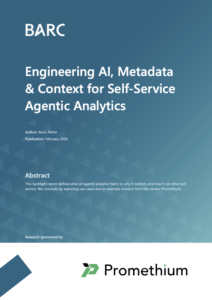
What does it take to build a production grade data analytics agent?
Read the BARC report about AI, metadata, and context written by Kevin Petrie.
From Single Agents to Multi-Agent Orchestration
The enterprise AI landscape in 2026 reflects a fundamental shift from isolated agent deployments to coordinated multi-agent architectures. Where 2025 focused on demonstrating that individual AI agents could automate specific tasks, 2026 demands systems where multiple specialized agents collaborate, coordinate work, and maintain governance across distributed infrastructure.
This evolution introduces distinct platform requirements. Single-agent systems optimize for immediate responsiveness with minimal architectural complexity—a customer service agent deployed as a serverless function operates with straightforward infrastructure. Multi-agent systems must solve coordination problems resembling microservices challenges: when multiple agents operate simultaneously with interdependencies, cascading failures, resource contention, and governance blind spots emerge that point-to-point connections cannot address.
Organizations eagerly building multi-agent systems struggle to scale them. The transition from pilot to production reveals architectural gaps: disconnected agents maintain separate contexts without synchronization, governance policies working for single agents fail when multiple agents access identical resources, cost analysis becomes opaque as orchestration overhead multiplies, and debugging grows exponentially harder as agent interactions increase.
These scaling challenges created demand for platforms designed around multi-agent orchestration rather than retrofitted single-agent frameworks. The market responded rapidly—established data platforms added agent orchestration capabilities, specialized frameworks matured toward production reliability, and purpose-built agentic platforms emerged to fill integration gaps.
Platform Architecture Categories
Multi-agent platform solutions divide into categories embodying different design philosophies about coordination location, data management approach, and governance responsibility allocation.
Vertically Integrated Data Platforms
Platforms like Snowflake, Databricks, and Microsoft Fabric embed agent orchestration within unified data warehouses or lakehouses. This architecture makes a deliberate choice: instead of agents reaching distributed data sources, data consolidates into a central platform where agents query, transform, and share results with uniform governance.
Snowflake Cortex AI Functions, generally available as of November 2025, enable agents to execute multimodal AI pipelines—processing text, images, audio, and video—entirely within the Snowflake SQL engine without external service calls or data movement. This delivers substantial advantages for organizations with established data consolidation strategies. Agents access governed, high-quality data without distributed query uncertainty. A single semantic layer defines business terms organization-wide, ensuring when one agent queries “customer revenue,” all agents reference identical logic.
However, consolidation requirements introduce significant tradeoffs. Organizations with distributed data architectures—where critical information resides in legacy systems, cloud platforms, and SaaS applications resistant to easy migration—face substantial data movement costs and implementation timelines extending months or years. Data centralization creates vendor lock-in risk. Once data resides within Snowflake’s ecosystem, switching platforms becomes enormously costly, requiring replication of consolidation work and rewriting agents built around platform-specific capabilities.
Databricks takes a different approach within this category. Rather than forcing complete consolidation, Databricks emphasizes lakehouse architecture where data engineers control organization. Databricks Agent Bricks, launched in 2025, provides governance, management, monitoring, and observability across enterprise AI agents. Fine-grained access control through Unity Catalog allows different agents to access only specific needed data, with clear ownership and end-to-end permissions across agents, models, and tools.
For multi-agent deployments, this flexibility matters. Teams can build some agents using Databricks’ no-code builders while developing specialized agents using open frameworks like LangChain or LangGraph, then deploying to Databricks compute for governance. However, Databricks’ complexity management strength also increases operational demands—organizations need data engineering expertise to properly structure lakehouses, optimize queries, and manage Apache Spark complexity.
Microsoft Fabric offers yet another perspective, combining lake-centric storage (OneLake) with data engineering, warehousing, data science, and Power BI within unified interfaces. Fabric’s Copilot capabilities provide natural language interfaces making agent coordination more accessible to business users. However, this integration comes with significant constraint: Fabric operates exclusively within Azure. Organizations with multi-cloud strategies or substantial AWS or Google Cloud investments face architectural friction.
Open-Source Agent Frameworks
Frameworks like LangChain, LangGraph, CrewAI, and AutoGen prioritize flexibility over simplified deployment. This approach avoids vendor lock-in and enables customization.
LangChain represents the most mature framework, providing modular components for LLM integration, memory management, tool connections, and basic orchestration. LangGraph, released as a purpose-built agent orchestration layer, addresses multi-agent challenges by treating workflows as traversable graphs rather than linear chains, enabling complex control flows including single-agent, multi-agent, and hierarchical architectures. LangGraph’s graph-based state management provides explicit visibility into agent interactions, enabling debugging and governance that chain-based approaches obscure.
CrewAI specializes in multi-agent collaboration from its foundation, providing native support for role-based agent delegation, inter-agent communication, and task orchestration. The framework includes a studio for building, deploying, and tracking agents, making it more accessible than bare LangChain code for organizations without extensive AI engineering expertise.
The fundamental strength of open-source frameworks is flexibility combined with cost control. Organizations retain complete implementation ownership, avoiding vendor lock-in. If requirements change or better frameworks emerge, switching costs represent primarily engineering effort rather than expensive contract terminations. For multi-agent systems where customization is almost always necessary, this flexibility proves valuable.
However, flexibility comes with substantial operational overhead. Open-source frameworks are development platforms, not production platforms. Organizations must invest in DevOps infrastructure, build observability and governance layers, manage model access and credentials, implement security controls, and maintain everything as requirements evolve. According to cost analysis, building a single-task agent using open-source frameworks typically requires $5,000–$10,000 in engineering effort, while complex multi-agent systems range from $20,000 to $80,000 or more, with ongoing costs of $100–$500 monthly for model access, vector database storage, and hosting.
For organizations with substantial AI engineering capabilities and long-term strategic commitments to AI agents, this investment can be justified. For organizations without deep expertise or seeking rapid multi-agent deployment, engineering burden often outweighs flexibility benefits.
Purpose-Built Agentic Data Platforms
Emerging from recognition that neither vertically integrated platforms nor bare frameworks fully address multi-agent requirements, purpose-built agentic data platforms have emerged. These platforms—including Promethium’s AI Insights Fabric and Databricks Agent Bricks—specifically target organizations deploying multi-agent systems across distributed enterprise data landscapes.
Promethium’s approach exemplifies this category’s core philosophy. Rather than forcing data consolidation like traditional warehouses, Promethium connects agents to data where it resides: in cloud platforms, on-premises systems, and SaaS applications. The platform’s 360° Context Engine aggregates technical and business metadata to generate relevant, contextual answers that agents can act upon. For multi-agent systems, this addresses a critical problem: agents need to operate across systems without human data engineering projects that consolidate everything.
Promethium’s Data Answer Agent (Mantra), released in private preview in July 2025, enables data teams to perform analytics with natural language on distributed data and receive instant, trusted responses. The platform was recognized by Gartner as a Cool Vendor in Data Management: GenAI Disrupts Traditional Technologies, validating its approach to enabling agentic data architectures.
Purpose-built platforms attempt to solve what existing solutions often don’t: how agents access trustworthy data without either centralizing everything or requiring agents to understand technical data models. This is particularly valuable for multi-agent systems where data governance becomes exponentially more complex. When a dozen specialized agents all access customer data, ensuring they use consistent definitions, respect access controls, and maintain audit trails becomes central to operational confidence.
However, purpose-built agentic data platforms are relatively new, and their market positioning is still stabilizing. Organizations considering these platforms need to carefully evaluate vendor viability, roadmap stability, and community maturity.
Data Virtualization Approaches
Traditional data virtualization platforms take a fundamentally different approach to the data access problem. Rather than consolidating data or building new platforms specifically for agents, virtualization creates a logical data layer that agents query as if accessing a single source, while the platform transparently handles federation across actual sources.
This approach offers particular value for multi-agent systems because it allows agents to query distributed data without understanding physical distribution. An agent requesting customer information doesn’t need to know whether customer master data resides in a CRM, transaction history in a data warehouse, and behavioral data in a data lake. The virtualization layer handles complexity transparently.
For organizations with complex data landscapes, this federated approach can be more pragmatic than wholesale consolidation. However, virtualization introduces performance tradeoffs. Queries must be orchestrated across multiple systems, introducing latency that agents may not tolerate. For multi-agent systems specifically, virtualization works best for simpler agent tasks where queries are relatively straightforward. For complex reasoning workflows where agents iteratively refine queries based on previous results, latency accumulation can become problematic.
Critical Evaluation Criteria for Multi-Agent Deployments
Generic platform evaluation frameworks often miss dimensions that specifically matter for multi-agent systems. The following criteria target unique multi-agent architecture demands.
Distributed Data Access and Context Sharing
Multi-agent systems fundamentally require agents to access data efficiently and share context seamlessly. A critical question: Can agents query data without moving it to the platform’s central location, or does the platform require data consolidation as a prerequisite? Platforms forcing consolidation create upfront implementation burden and long-term cost for data movement and storage. Platforms enabling distributed access allow faster deployment but may introduce latency if federation becomes complex.
Context sharing between agents determines whether orchestration remains efficient or degrades as agent count increases. Some frameworks achieve excellent single-agent performance but suffer severe latency and token degradation when agents transfer context. Google’s Agent Development Kit (ADK) addresses this explicitly by separating “Session” (persistent event history) from “Working Context” (specific information relevant to current operation). When an agent transfers control to a sub-agent, ADK allows explicit scoping of what context flows downstream, preventing context explosion.
Unified Governance Versus Distributed Policy Management
Single-agent governance is straightforward—establish policies for what that agent can access and do, apply them consistently, audit results. Multi-agent governance becomes exponentially more complex because policies must be consistent across multiple autonomous agents potentially built by different teams, using different frameworks, and accessing different data sources.
A critical criterion: Does the platform provide unified governance through a single control plane, or does governance require per-agent policy configuration? Databricks Unity Catalog, for example, enforces granular access control across all agents within a workspace, providing a single source of truth for permissions. This unified approach prevents the common failure pattern where agent sprawl creates governance chaos—each agent maintains local access policies with no visibility into collective behavior.
Conversely, organizations deploying agents across multiple platforms naturally cannot rely on unified governance. They must implement distributed policy management where each platform maintains its own governance layer, with orchestration ensuring policies remain synchronized. This distributed approach requires more engineering effort but enables platform flexibility that unified governance precludes.
Agent Orchestration Architecture and Coordination Patterns
How agents actually coordinate directly impacts multi-agent system reliability and cost. Some platforms support hierarchical coordination where a supervisor agent routes requests to specialized workers. Others support peer-to-peer collaboration where agents communicate directly. Still others implement consensus or debate patterns where multiple agents critique each other’s work before finalizing decisions.
The choice of orchestration pattern affects both reliability and cost. Hierarchical patterns provide predictable control flow but can create bottlenecks at the supervisor level. Peer-to-peer patterns enable parallelism but make debugging harder when interactions go wrong. Research benchmarking major frameworks revealed that CrewAI’s native multi-agent design handles role-based delegation efficiently, while LangChain’s chain-first architecture requires additional orchestration engineering for multi-agent scenarios.
Integration Breadth and Protocol Support
Multi-agent systems almost universally require integration with existing enterprise systems: CRMs, ERPs, data warehouses, document repositories, and specialized applications. A critical question: What integration effort is required, and does the platform provide standardized protocols that simplify agent connections across systems?
The Model Context Protocol (MCP) has emerged as the de facto standard for connecting agents to external tools and data sources. Platforms with native MCP support significantly reduce integration effort because developers implement tool connections once according to the standard, then agents can leverage those connections across frameworks.
The Agent2Agent Protocol (A2A) addresses a complementary problem: how agents built using different frameworks and hosted on different platforms can communicate with each other. Organizations deploying specialized agents from different vendors require A2A interoperability. Without it, they face the prospect of either consolidating onto a single platform or building custom integration layers between agent systems.
For multi-agent systems specifically, protocol support matters because it determines whether orchestration remains manageable as agent count grows. Without standard protocols, each new agent integration adds complexity. With protocols, new agents integrate according to established patterns.
Governance and Compliance Controls
Multi-agent systems operating in regulated environments face governance challenges that single agents don’t. When an agent makes a decision or takes an action, organizations need complete visibility into why that happened, what data informed the decision, and which human approved or reviewed it.
Critical evaluation criteria include: Does the platform provide immutable audit trails of all agent actions? Can it track which data each agent accessed and how it was used? Does it enforce role-based access controls and provide mechanisms for human review before autonomous actions execute?
SOC 2 compliance, increasingly required for enterprise agent deployments, demands specific controls. Organizations must maintain auditable access logs, enforce least-privilege access, separate privileged operations through approval workflows, and provide forensic investigation capabilities. Platforms supporting these controls simplify compliance. Platforms leaving governance as a post-deployment engineering effort create ongoing compliance risk and operational overhead.
Real-World Integration Challenges
Platform capabilities exist in theory; reality reveals unexpected constraints and integration patterns that complicate deployment.
Data Centralization Costs and Hidden Movement
Organizations view data consolidation as a necessary price for unified governance, yet hidden centralization costs often exceed initial expectations. A typical scenario: An organization with data spanning AWS S3, Azure Cosmos DB, an on-premises Oracle database, and Salesforce decides to consolidate into Snowflake for unified agent access. Initial migration projects consume six to eighteen months. Data replication creates infrastructure costs—running new systems during cutover while maintaining legacy systems. Ongoing synchronization requires either periodic batch updates (acceptable for static reference data but problematic for transactional systems requiring real-time consistency) or event-based replication that adds infrastructure complexity.
Organizations avoiding complete consolidation—using data virtualization or distributed query approaches—often achieve faster deployment timelines and lower upfront implementation costs. However, they trade query performance for flexibility. Queries spanning five systems execute slower than queries against consolidated data. For multi-agent systems where agents may execute dozens of queries as part of reasoning chains, cumulative latency becomes a real constraint.
Platform Lock-In Risk and Switching Costs
Vertically integrated platforms create genuine vendor lock-in, but mechanics are often misunderstood. While data lock-in matters, operational and architectural lock-in often prove more significant. Once organizations build multi-agent systems within a platform—creating agents that understand that platform’s specific governance model, data model, security model, and cost model—switching requires more than data export. It requires re-architecting the entire agent ecosystem.
For multi-agent systems specifically, lock-in risk is higher because coordination patterns and governance structures that work for one platform often require reimplementation for another. An agent swarm built using Databricks’ hierarchical patterns doesn’t simply “port” to Snowflake—the coordination logic, governance model, and data access patterns must be substantially reimplemented.
Context Window Management and Token Efficiency
One of the most underestimated challenges involves context window management. As agents run longer, accumulating reasoning history, tool outputs, and context from other agents, token consumption grows exponentially rather than linearly. An agent making five tool calls, processing responses, reasoning about next steps, and delegating to another agent easily consumes 50,000 to 100,000 tokens for what intuitively feels like a simple task.
Platforms handling context efficiently provide mechanisms to compress or filter context, preventing token explosion. Google’s ADK specifically addresses this through context compaction—using an LLM to summarize older events and replace raw history with summaries, dramatically reducing token consumption for long-running agents. Platforms lacking such mechanisms force developers to manually manage context truncation, which often breaks reasoning quality because essential context gets pruned.
For multi-agent systems, context management becomes critical because agents typically run longer (orchestrating across multiple specialized agents takes time) and process more information (collecting results from multiple agents). Platforms forcing manual context management create operational burden that accumulates with agent count.
Total Cost of Ownership Beyond License Fees
Platform license or subscription fees represent only a portion of total cost of ownership for multi-agent systems. Infrastructure, engineering, and operational costs often dwarf license expenses.
Compute and Storage Economics
Cloud data warehouses like Snowflake and BigQuery use consumption-based pricing, charging separately for compute and storage. This creates both advantages and risks. The advantage: organizations don’t prepay for unused capacity. The risk: organizations with poor cost discipline can accumulate substantial unexpected charges.
For multi-agent systems specifically, cost management becomes complex because agent orchestration creates compute patterns differing from traditional analytics workloads. Agents execute iteratively—attempting tasks, receiving failures, retrying with different approaches—creating multiple small compute operations rather than large batch operations. Research indicates that poorly optimized agents can cost 5-8 dollars per task because of inefficient loops and context management. Well-optimized agents using caching and dynamic turn limits cost under fifty cents per task for similar complexity.
Engineering and Integration Costs
Open-source frameworks require substantial engineering investment. Building production-grade multi-agent systems typically requires teams including LLM engineers, DevOps specialists, data engineers, security engineers, and governance specialists. Total engineering costs for production multi-agent systems typically range from $100,000 to $500,000 depending on complexity.
Vertically integrated platforms reduce engineering burden for organizations already standardized on them. If an organization uses Databricks for data engineering and has experienced Databricks teams, deploying multi-agent systems on Databricks requires less incremental engineering than adopting new platforms. However, if the organization uses different platforms for different functions, consolidating onto a single platform for multi-agent systems may require more total engineering than deploying open-source frameworks distributed across existing systems.
Successful Multi-Agent Deployment Patterns
Understanding how organizations successfully deploy multi-agent systems provides practical grounding for platform selection decisions.
Real-world deployments reveal patterns associated with successful outcomes. Gilead Sciences partnering with Cognizant reduced IT processes from weeks to days using multi-agent AI systems. AstraZeneca used agentic AI to parse over 400,000 clinical trial documents and achieved $10 million in productivity savings. Bradesco bank handles 283,000 monthly inquiries with Watson AI achieving 95% accuracy.
These deployments share common characteristics: clear process definition, centralized governance, extensive testing, and human-in-the-loop controls for high-stakes decisions. Less successful deployments typically share different characteristics: unclear process requirements, distributed governance creating confusion, inadequate testing revealing agent failures only in production, and insufficient human oversight allowing autonomous agents to take uncontrolled actions.
Organizations report that multi-agent systems fail in production most commonly through interaction effects between agents rather than individual agent failures. When one agent’s output becomes another agent’s context, errors propagate and compound. Orchestration failures create cascading problems that single-agent systems don’t exhibit.
Successful implementations invest heavily in orchestration infrastructure and governance frameworks that prevent these failure modes rather than reacting to them after failures occur. This typically means selecting platforms that provide orchestration primitives and governance controls rather than expecting custom implementations to handle these concerns.
Platform Selection Framework
Selecting platforms for multi-agent AI systems requires moving beyond product feature comparison to understanding fundamental architectural tradeoffs. Vertically integrated platforms like Snowflake, Databricks, and Microsoft Fabric offer governance and performance for organizations willing to consolidate data and accept some vendor lock-in. Open-source frameworks provide ultimate flexibility for organizations with engineering expertise but require substantial infrastructure investment. Purpose-built agentic platforms like Promethium bridge these approaches by enabling distributed data access with centralized governance—connecting to data where it resides through zero-copy federation while providing unified context across all agents through their AI Insights Fabric. These platforms support open architectures compatible with any agent framework and typically deliver production-ready deployments in weeks rather than months, though organizations should evaluate their relative maturity compared to established alternatives.
Organizations should begin platform evaluation by honestly assessing their current infrastructure, data distribution, governance maturity, available engineering resources, and long-term strategic direction. Organizations with consolidated data architectures, substantial AI engineering teams, and long-term platform commitment often maximize value from vertically integrated platforms. Organizations with distributed data, limited AI engineering resources, and multi-vendor strategies may find open-source frameworks plus managed observability platforms deliver better economics. Organizations seeking fastest time-to-value with multi-agent capabilities should evaluate emerging agentic platforms that explicitly target this market.
Regardless of platform choice, successful multi-agent deployments require equivalent investment in orchestration infrastructure, governance frameworks, observability systems, and human oversight mechanisms. No platform eliminates these requirements; platforms differ in how much they provide built-in versus requiring custom implementation. Organizations that understand these requirements and select platforms accordingly achieve multi-agent deployments that deliver promised value.
Share This Article
SHARE THIS:



Share This Article
SHARE THIS: