Agent-Ready Data Checklist: Is Your Enterprise Actually Prepared?
Most enterprises believe they’re closer to agent-ready than they actually are. Internal narratives focus on model capabilities, cloud infrastructure, and the presence of a data catalog — while ignoring the operational realities that determine whether AI agents succeed or fail in production.
The evidence is stark: models achieving 86% accuracy on academic benchmarks collapse to 6% accuracy on real enterprise databases. That gap isn’t a model problem. It’s a data architecture problem — and most enterprises are sitting squarely inside it.
This checklist covers the four dimensions that separate genuinely agent-ready data estates from those that only appear ready: federated access, context completeness, governance maturity, and trust infrastructure. Work through each section honestly. The gaps you find here are the gaps that will sink your production AI agents.
The Four Dimensions of Agent-Ready Data
Designing for agentic AI requires something fundamentally different from traditional AI-readiness. Agents don’t consume curated datasets — they plan multi-step workflows, query heterogeneous live data, write back state, and operate under delegated authority. The failure modes are consequential.
Four dimensions determine whether your data estate can support this:
- Federated, live data access — can agents reach all relevant data, fresh, across sources?
- Context completeness — can agents correctly interpret what that data means?
- Governance and security — are the right controls in place for autonomous agent behavior?
- Trust and validation — can you verify agent outputs and trace them back to sources?
These dimensions are interdependent. Strong access without context yields wrong answers. Rich context without governance amplifies risk. None of it matters without trust infrastructure to catch failures at scale.
Dimension 1: Federated Data Access (7 Checks)
Check 1: Real-time or near-real-time access to operational data
Are agents querying live sources, or reasoning on nightly batch snapshots? When source systems update continuously while AI operates on stale copies, you get inconsistent answers and potential compliance failures.
Check 2: Coverage across all relevant sources
Does your AI access layer reach cloud data warehouses, SaaS platforms, operational databases, and on-premises systems — or just the clean subset in your warehouse? Business-critical questions almost always require crossing source boundaries.
Check 3: Zero-copy or federated query execution
Are you querying data where it lives, or copying it into AI sandboxes? Copies introduce staleness, diverging security policies, and synchronization failures. Federation keeps access controls enforced at the source.
Check 4: Cross-source query execution in a single request
Can your system join data across Snowflake, Salesforce, and an on-premises Oracle instance in one query — without manual ETL? If not, agents will produce partial answers or fail on cross-domain questions.
Check 5: Sub-10-second end-to-end response for moderate queries
Latency thresholds matter for usability and cost efficiency. If query generation plus execution exceeds 10 seconds for routine questions, agent interactions become impractical at scale.
Check 6: Access controls enforced at the data layer, not the application layer
When data is copied into AI environments, source-level RBAC and row-level security often don’t follow. Do policy updates in source systems automatically propagate to what agents can see?
Check 7: Event streaming or near-real-time ingestion for high-velocity domains
For fraud detection, inventory management, or customer support, batch access isn’t sufficient. Stream-based architectures route high-value events to agents without flooding them with raw data.
Gap identified here maps to: Universal Query Engine — live, zero-copy federated access across 200+ sources without data movement.
Dimension 2: Context Completeness (5 Checks)
This is where most enterprises are least mature and most overconfident. Having data is not the same as having context.
When systems expose only raw schemas to AI — table names, column names, basic statistics — semantic accuracy stalls at 10%–31% regardless of which model you use. The same organizations, after implementing multi-layer context, achieve 90%–99% accuracy on real BI scenarios. The model didn’t change. The context did.
Check 8: Explicit relationship and join path mapping
Are primary/foreign key relationships, valid join chains, and cardinality rules documented and machine-readable? Without them, agents guess — and frequently guess wrong, producing queries that execute but return semantically invalid results.
Check 9: A maintained semantic layer with canonical metric definitions
Do you have a governed semantic layer that defines business metrics, hierarchies, and calculations? If “customer acquisition cost” or “net revenue” means different things in different tools, agents will produce inconsistent answers that contradict existing dashboards.
Check 10: Business rules and domain-specific logic encoded for agent consumption
Fiscal calendars, inclusion/exclusion criteria, regional policies, product hierarchies — are these formalized and accessible to AI systems, or buried in analyst notebooks and tribal knowledge?
Check 11: Integration between data catalogs, BI tools, and the semantic layer
A catalog that stores definitions but doesn’t feed a semantic layer that agents consume is incomplete. Are your existing metadata investments wired into the AI access layer, or operating in parallel?
Check 12: Knowledge graph or ontology for core business entities
Graph structures encode entities and relationships explicitly, enabling agents to traverse context with lineage-aware reasoning rather than inferring structure from table names. This matters especially for complex multi-hop questions.
Gap identified here maps to: Insights Context Graph — five levels of context unified across catalogs, BI tools, semantic layers, and tribal knowledge.
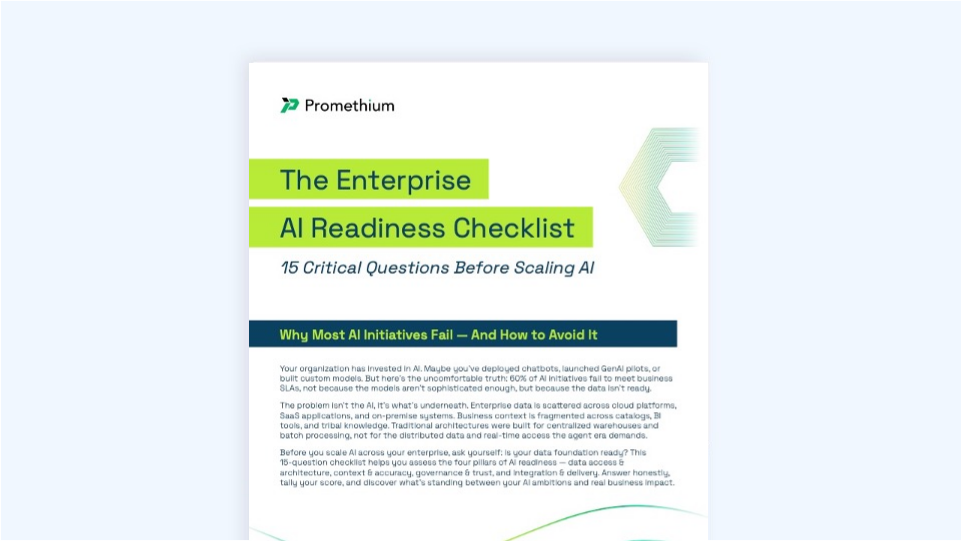
Want the full scorecard you can share with your team?
Get your Enterprise AI Readiness Checklist now.
Dimension 3: Governance and Security (4 Checks)
Gartner projects that approximately 60% of AI initiatives will miss value targets by 2027 — primarily due to fragmented, reactive governance. For agentic AI, the stakes are higher: agents act autonomously, at speed, at scale.
Check 13: Agent queries subject to the same RBAC and RLS as human queries
If a human analyst can’t access certain rows or columns, neither should an agent acting on their behalf. Are your access policies enforced dynamically at query execution — not just at login?
Check 14: PII and sensitive data protected in prompts, intermediate stores, and logs
When queries are constructed and sent to LLMs, does sensitive data appear in prompts? Are vector stores and caches applying the same classification and masking as source systems?
Check 15: Federated, domain-aligned governance with active metadata
Modern governance delegates control to business domains while providing enterprise-level oversight through active metadata and data catalogs. Is your governance operationally enforced, or documented but bypassed?
Check 16: Defined authority boundaries for agent actions
Agents that can draft emails, open tickets, or query financial data need explicit boundaries around what they’re authorized to do without human review. Are these boundaries defined, enforced, and auditable?
Gap identified here maps to: Trust Harness — automated governance policy enforcement, RBAC, and comprehensive audit trails across all queries and agent actions.
Dimension 4: Trust, Validation, and Explainability (4 Checks)
68% of data professionals have experienced AI model failures due to undetected data quality issues — failures that existing metadata described but didn’t actively monitor. Trust infrastructure is what prevents confident-but-wrong answers from reaching decision-makers.
Check 17: Automated data quality monitoring tied to AI pipelines
Are quality checks embedded in pipelines so anomalies are caught before propagating into agent outputs? Static profiling run quarterly doesn’t count — this requires active, continuous monitoring.
Check 18: End-to-end lineage for key domains
Can you trace any AI-generated answer back through the queries, transformations, and source systems that produced it? Without lineage, you cannot investigate failures, satisfy auditors, or build organizational trust.
Check 19: Defined trust metrics with monitored thresholds
Do you measure execution accuracy (target: >90% of generated queries run without error), semantic accuracy (results match ground truth), and hallucination rate (target: <5% references to non-existent tables/columns)? These aren’t abstract — they’re measurable, and organizations that don’t measure them are flying blind.
Check 20: Domain-specific evaluation datasets for ongoing validation
Enterprise-realistic benchmarks expose failure modes that synthetic demos hide. Do you have representative question-and-answer sets for your critical domains that you test against regularly, under realistic data freshness and access constraints?
Gap identified here maps to: Trust Harness — validation, accuracy scoring, lineage, and anti-hallucination safeguards at every step.
Scoring Your Results
Count your passing checks across each dimension:
| Dimension | Checks | Score |
|---|---|---|
| Federated Data Access | 1–7 | /7 |
| Context Completeness | 8–12 | /5 |
| Governance & Security | 13–16 | /4 |
| Trust & Validation | 17–20 | /4 |
Interpret by tier:
- 0–8 passing (Nascent): Expect 10%–20% semantic accuracy on real enterprise queries. Agents will fail in production. Focus on data access foundation and basic semantic layer before deploying agents beyond low-risk experiments.
- 9–14 passing (Emerging): Moderate accuracy possible in constrained domains with heavy human oversight. Prioritize semantic layer consolidation and federated governance for a single high-value domain before scaling.
- 15–18 passing (Operational): Production agents viable in specific domains. Extend patterns to additional domains and deepen trust instrumentation. Hallucination rates should be approaching manageable thresholds.
- 19–20 passing (Agent-Native): Your data estate can support multi-agent workflows and autonomous operation on critical business questions. Focus on expanding domain coverage and feedback loop instrumentation.
What to Prioritize First
The research is clear: most enterprises are Emerging at best, often Nascent, regardless of how modern their data platform is. The presence of a warehouse, a catalog, or a frontier model doesn’t change the underlying architecture gaps.
The fastest path to agent-ready isn’t a multi-year platform migration — it’s a domain-by-domain approach. Pick one high-value business domain. Wire it with federated access, a semantic layer for 10–20 key metrics, governance enforcement, and quality monitoring. Validate with a realistic question set. Then scale the pattern.
That scoped, evidence-driven approach is exactly what Promethium’s Discovery Workshop is designed to accelerate — mapping your data landscape, identifying where the gaps are, and defining the path from your current tier to production-ready agents in weeks, not years.
If the checklist revealed gaps you weren’t expecting, that’s the point. The organizations achieving 90%+ accuracy and 300%+ ROI in year one aren’t running better models — they built the right data foundation underneath them.
Schedule a Discovery Workshop to map your data landscape, identify high-value entry points, and define a realistic roadmap to agent-ready data — in 1–2 weeks.
Share This Article
SHARE THIS:



Share This Article
SHARE THIS: