
Multi-Agent AI Systems for Enterprise Data: 5 Real-World Use Cases
Multi-agent AI systems are transforming how enterprises handle distributed data challenges. Unlike single-agent approaches that struggle with scattered information across systems, coordinated agent architectures deliver answers impossible through traditional methods. This collection examines five production deployments where specialized agents working together achieve measurable results—with implementation patterns, ROI data, and lessons learned.
Why Multi-Agent Systems Excel at Enterprise Data
Enterprise data lives everywhere: Snowflake warehouses, Salesforce CRM, ServiceNow tickets, Oracle databases, marketing automation platforms. Traditional approaches force organizations to choose between expensive centralization projects or fragmented single-system solutions. Multi-agent architectures offer a third path—specialized agents that query data where it lives, coordinating results through an orchestrator.
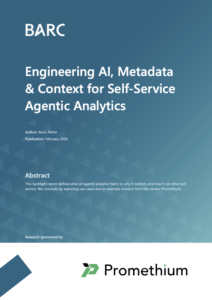
What does it take to build a production grade data analytics agent?
Read the BARC report about AI, metadata, and context written by Kevin Petrie.
The architecture delivers three critical advantages. First, parallel execution: while one agent queries credit bureau APIs, another analyzes transaction patterns, and a third checks regulatory watchlists—simultaneously. Second, specialized expertise: domain-specific agents encode business logic that general-purpose systems miss. Third, graceful degradation: if one data source times out, other agents still deliver partial answers rather than total failure.
Production deployments show consistent patterns: 4-6 specialized agents plus one orchestrator, 70-90% latency improvements, and 20-35% accuracy gains compared to single-agent systems. Here’s how five organizations deployed this architecture across different use cases.
Use Case 1: Financial Services Risk Analysis
A mid-size financial institution faced a critical challenge: risk scoring required real-time data from credit bureaus, internal transaction systems, market volatility feeds, and regulatory watchlists. Sequential API calls took 2.3 seconds—too slow for high-volume transaction processing. Worse, single-model approaches missed correlation signals across systems.
The Multi-Agent Architecture
The bank deployed five specialized agents:
- Credit Data Agent: Normalized Equifax and Experian data, handled rate limiting, cached results
- Transaction Pattern Agent: Analyzed 12-24 month velocity, frequency, and anomalies from core banking systems
- Regulatory Agent: Cross-referenced OFAC and AML databases in real-time
- Market Context Agent: Incorporated volatility indices and geographic exposure
- Orchestration Agent: Weighted signals, resolved conflicts, generated final scores
Each agent handled different data freshness requirements. Credit bureau APIs averaged 1.2 seconds latency; internal transaction databases returned in 0.3 seconds; regulatory lists took 0.8 seconds. Sequential processing meant waiting for the slowest call every time.
The multi-agent approach parallelized all queries. Total latency dropped to the longest individual call plus orchestration overhead—0.6 seconds total, 74% faster than sequential processing.
Measurable Results
Risk detection accuracy improved 23-27% compared to the previous scoring model, according to enterprise AI implementation studies. False positives decreased 34% through multi-signal correlation, reducing customer friction. For a bank processing 50,000 daily transactions, this eliminated approximately 7,500 false positive investigations weekly—saving roughly 2 FTE compliance positions.
Cost impact extended beyond personnel. Fraud losses decreased as high-risk transactions received more accurate pre-approval screening. The multi-agent system identified correlation patterns invisible to single-model approaches: a low credit score alone might not trigger alerts, but combined with unusual transaction velocity and exposure to volatile markets, the orchestrator elevated risk assessment appropriately.
The ‘Before’ vs ‘With Federation’ Reality
Before: Custom pipelines copied data from each source into a central risk database. ETL jobs ran hourly, meaning risk scores used stale data. Pipeline breaks caused incomplete risk views. Engineers spent 40% of time maintaining data movement infrastructure.
With federated access: Agents query sources directly without data duplication. Risk scores incorporate real-time data across all systems. Zero pipeline maintenance overhead. The platform—similar to Promethium’s federated query architecture—eliminates data copying while providing unified context across CRM, billing, and support systems.
Use Case 2: Healthcare Patient Journey Orchestration
A 300-bed hospital system struggled with fragmented patient data. EHR records lived in Epic, lab results in separate laboratory information systems, imaging in PACS archives, pharmacy data in drug interaction databases, and insurance eligibility in payer systems. Coordinating care required manual data gathering from multiple platforms.
The Specialized Agent Approach
The healthcare organization deployed five agents handling distinct domains:
- Clinical History Agent: Queried and synthesized EHR records, flagged key diagnoses
- Drug Interaction Agent: Cross-referenced medications against interaction databases and allergies
- Insurance Verification Agent: Checked coverage, pre-authorization requirements, out-of-pocket costs
- Specialist Coordination Agent: Identified appropriate specialists, checked availability, managed referrals
- Care Plan Synthesis Agent: Assembled treatment recommendations into executable plans
Each agent operated within HIPAA-compliant access controls, maintaining complete audit trails. The orchestrator coordinated timing: clinical history first (required for downstream decisions), then parallel queries to drug interaction and insurance systems, followed by specialist coordination based on clinical findings.
Production Results
Care coordination time dropped from 4.2 hours to 18 minutes for complex cases—a 93% reduction. The drug interaction agent identified 34% more potential conflicts versus pharmacist-only review by cross-checking all patient medications including over-the-counter supplements from patient reports.
Insurance pre-authorization changed dramatically. Previously, authorization questions delayed 23% of procedures by 2-3 days. The multi-agent system determined same-day authorization status by querying payer systems with complete clinical context. Patient appointment scheduling reduced from 2.1 touchpoints to 0.6 touchpoints per patient.
Clinical outcomes improved measurably. Pilot programs showed 8-12% reduction in 30-day readmissions, attributed to reduced gaps in medication handoffs and discharge instructions. For a 300-bed hospital, 8% readmission reduction equals roughly 240 fewer readmissions annually—at approximately $10,000 cost per readmission, this represents $2.4 million in savings.
Federated Healthcare Data Access
Before: Custom integration engines copied data from each healthcare system into a central patient database. Integration breaks meant incomplete patient records. HIPAA compliance required securing multiple data copies. IT teams maintained separate authentication for each source system.
With federated architecture: Agents access source systems directly with unified authentication and authorization. Patient data never leaves secure healthcare environments. Real-time access ensures care decisions use current information. Platforms providing federated healthcare access—including capabilities similar to Promethium’s zero-copy federation—enable coordinated multi-agent workflows while maintaining HIPAA compliance and data sovereignty.
Use Case 3: Retail Omnichannel Inventory Intelligence
A luxury retail brand maintained separate systems for online inventory, brick-and-mortar stores, distribution centers, and third-party fulfillment. Customer purchase history, preferences, and support interactions lived in different platforms. Stock-outs, fulfillment failures, and inconsistent personalization resulted from this fragmentation.
Multi-Agent Coordination
The retailer deployed five specialized agents:
- Inventory Search Agent: Queries warehouse, store, and 3P fulfillment systems; handles API rate limits
- Fulfillment Optimization Agent: Determines fastest/cheapest fulfillment path based on inventory location
- Customer Context Agent: Retrieves purchase history, preferences, loyalty status, return patterns
- Dynamic Pricing Agent: Adjusts recommendations based on inventory depth and customer segment
- Order Management Agent: Routes orders to fulfillment channels, coordinates delivery
Data freshness varied significantly: online inventory updated real-time, store inventory hourly, distribution center inventory every 15 minutes, third-party fulfillment daily batches. The multi-agent orchestrator handled mixed freshness appropriately rather than forcing all sources to real-time or batch processing.
Business Impact
Order fulfillment time decreased from 3.2 days to 1.1 days average. Same-day fulfillment increased from 8% to 27% of orders through better cross-location visibility. Customer-facing stock-outs decreased 31% through improved buy-online-pickup-in-store optimization.
Fulfillment costs dropped 18% per order through optimized routing. The system enabled more store-fulfillment versus expensive DC-to-home shipping. For a retailer with $500 million revenue and $150 average order value, 31% stock-out reduction on $15.5 million implied lost sales recovered approximately $4.8 million revenue. Cost reduction of 18% on fulfillment with 10,000 daily orders saved roughly $19,000 daily or $6.9 million annually.
Customer retention improved through better personalization. The context agent’s unified customer view enabled accurate product recommendations, increasing loyalty program engagement 22% and reducing returns 6%.
Cross-System Data Without Movement
Before: Nightly ETL jobs copied inventory data from stores and warehouses into a central database. Customer data replicated from Salesforce into separate analytics systems. Quality issue tracking required manual joining of returns data, inventory records, and customer feedback. Engineers spent significant time maintaining data pipelines.
With federated access: Agents query Snowflake product data, Salesforce quality issues, and MicroStrategy reports directly without copying. Real-time inventory visibility across all locations without data movement. Customer 360 analysis combines distributed data on-demand. Federated architectures—exemplified by Promethium’s approach to connecting returns, inventory, and feedback systems—eliminate pipeline maintenance while enabling cross-system analytics.
Use Case 4: Manufacturing Supply Chain Optimization
A mid-size manufacturer struggled with demand-supply mismatches. Demand signals scattered across retailer POS data, sales pipelines, market intelligence, and seasonal models. Supply planning occurred in separate systems with manual forecasting delays. The lag between demand signals and supply responses cost millions in excess inventory and stock-outs.
Agent Coordination Across Supply Chain
The manufacturer deployed six specialized agents:
- Demand Signal Agent: Aggregates POS data, pipeline forecasts, historical patterns; runs demand models
- Supply Capacity Agent: Queries supplier inventory, lead times, capacity constraints
- Production Planning Agent: Checks manufacturing capacity, raw material availability, equipment constraints
- Logistics Optimization Agent: Evaluates routing, carrier capacity, warehouse availability
- Scenario Planning Agent: Runs what-if analyses for disruptions and demand spikes
- Execution Agent: Coordinates purchase orders, production scheduling, shipment planning
Data distribution created coordination challenges. Retailer POS data arrived via EDI and APIs from multiple partners. Sales pipeline lived in Salesforce. Supplier capacity data existed in supplier portals and SRM systems. Production capacity tracked in MES and ERP platforms. Logistics data scattered across transportation management systems.
Quantified Improvements
Twelve-month demand forecast accuracy improved from 68% MAPE (Mean Absolute Percentage Error) to 82% MAPE through multi-signal fusion—a significant improvement in supply chain performance. Average inventory holdings decreased 12-16% while maintaining 96%+ service levels (previously 92-93%). Order-to-delivery cycle time reduced 19% through optimized routing and better supplier coordination.
Demand-supply mismatches dropped significantly: 41% fewer unplanned stock-outs and 28% reduction in excess inventory write-offs. Time to respond to supply disruptions decreased from 5-7 days (manual assessment and replanning) to 4-6 hours with automated multi-agent coordination.
Supplier collaboration improved dramatically. Sharing better demand signals with suppliers through the system resulted in 23% improvement in on-time delivery. For a manufacturer with $200 million inventory base, 13% inventory reduction freed up $26 million in working capital.
Eliminating Supply Chain Data Silos
Before: Custom integrations moved data from logistics systems, inventory databases, and supplier portals into a central data warehouse. Integration breaks meant incomplete supply visibility. Manual forecasting processes required days to incorporate new data. Engineers maintained dozens of brittle data pipelines.
With federated coordination: Agents query logistics, inventory, and supplier data directly across systems. Real-time federated queries provide current supply chain visibility. Scenario planning operates on live data without extraction delays. Architectures enabling coordinated agent access across distributed supply chain systems—similar to Promethium’s federated approach—deliver supply chain optimization without data consolidation projects.
Use Case 5: Financial AML Compliance Management
A major bank’s compliance team managed alerts from fragmented sources: transaction monitoring systems, sanctions list screening, behavioral anomaly detection, and regulatory filings. High false positive rates (18-22% of alerts required full investigation) overwhelmed analysts. Manual investigation pulling data from multiple systems averaged 45 minutes per alert.
Multi-Agent Investigation Architecture
The bank deployed six specialized compliance agents:
- Alert Triage Agent: Filters and prioritizes alerts, correlates with recent patterns
- Watchlist Correlation Agent: Cross-references customers against multiple sanctions lists (OFAC, EU, international)
- Transaction Context Agent: Analyzes characteristics (amount, frequency, geography) against customer risk profiles
- Historical Pattern Agent: Flags deviations from established behavior
- Case Assessment Agent: Synthesizes findings, assigns risk ratings, generates compliance narratives
- Regulatory Guidance Agent: Ensures recommendations align with regulatory requirements and internal policies
Alert storms from transaction monitoring systems created investigation backlogs. Analysts manually queried CRM for customer profiles, data warehouses for historical behavior, and multiple external databases for sanctions screening. Investigation consistency varied by analyst expertise.
Compliance Efficiency Gains
Average investigation time dropped from 45 minutes to 12 minutes per alert—a 73% reduction in analyst effort. False positive rates decreased significantly: only 5-8% of alerts required full investigation versus previous 18-22%. The same compliance team now handles 3.2x alert volume without additional headcount.
Detection accuracy improved alongside efficiency. False positive suspicious activity reports (SARs) filed decreased 41% through better correlation analysis. Customer risk scoring moved from quarterly batch updates to daily recalculation using real-time data. Regulatory inquiry response time reduced from 8-10 days to 3-4 days with readily available case structures.
For a bank with 500 AML analysts, 73% efficiency gain represents capacity to handle current workload with approximately 135 fewer FTE—roughly $13-15 million annual salary savings. False positive SAR reduction of 41% decreases regulatory risk and potential remediation costs.
Unified AML Data Without Centralization
Before: Transaction data, customer profiles, watchlist information, and historical patterns replicated into a central compliance database. Data freshness lagged hours behind source systems. Custom pipelines required constant maintenance. Regulatory lineage documentation required manual effort across multiple systems.
With federated compliance access: Agents query transaction monitoring systems, CRM, sanctions databases, and data warehouses directly with complete governance. Real-time access ensures compliance decisions use current information. Automated lineage tracking provides regulatory transparency. Federated architectures with built-in governance—exemplified by approaches like Promethium’s—enable financial risk analysis through real-time federated queries while maintaining compliance requirements.
Common Implementation Patterns Across Use Cases
Five successful deployments reveal consistent architectural patterns. Every implementation deployed 4-6 specialized agents plus one orchestrator—enough specialization to capture domain expertise without excessive coordination overhead.
Agent Topology
Financial risk used 5 agents (credit, transaction, regulatory, market, orchestrator). Healthcare deployed 5 agents (clinical, drug interaction, insurance, specialist, orchestrator). Retail implemented 5 agents (inventory, fulfillment, customer context, pricing, orchestrator). Manufacturing used 6 agents (demand, supply, production, logistics, scenario, orchestrator). AML deployed 6 agents (triage, watchlist, transaction, pattern, assessment, orchestrator).
Below 4 agents, too much logic forced into single agents loses specialization benefits. Above 6 agents, coordination complexity begins exceeding parallelism gains. The 4-6 range maps naturally to most enterprise use cases requiring cross-system coordination.
Coordination Patterns
Synchronous fan-out proved most common: orchestrator sends parallel queries to all agents, waits for responses with timeout management, then aggregates results. Financial risk and retail inventory used this pattern extensively—independent queries don’t block each other, minimizing latency.
Sequential with feedback loops appeared when early agent outputs inform later decisions. Healthcare used this pattern: clinical history agent results determined which specialists the coordination agent should contact. Manufacturing used it: demand forecast guided supply capacity queries.
Context Management
All implementations maintained shared context: customer/entity ID passed to all agents, previous decisions cached and visible to subsequent agents, typical context size 2KB-8KB per query. Healthcare and retail added vector stores for semantic search across customer embeddings—enabling faster pattern matching than re-analyzing raw data.
Conflict resolution registries tracked disagreements: when agents provided conflicting signals, orchestrators referenced historical resolution patterns. Manufacturing learned “when demand forecast conflicts with supplier capacity, supplier data proved correct 73% of the time”—weighting future decisions accordingly.
Context sharing overhead typically consumed 5-15% of total query latency. This cost remained acceptable because parallelism gains far exceeded context management overhead.
Critical Failure Modes and Mitigation
Production deployments revealed predictable failure patterns. Agent hallucination at scale occurred when agents expressed confidence in incorrect data. Healthcare caught a clinical history agent misreading patient allergies from OCR errors in scanned documents—nearly clearing a patient for contraindicated medication.
Mitigation requires human-in-the-loop validation for high-stakes decisions. Implementations added confidence scoring with automatic escalation for low-confidence results, audit trails showing which agent made which claim, and mandatory human override for certain thresholds. All systems ran 100-case validation sets before production deployment.
Cascading timeouts created latency explosions when one slow external API blocked entire queries. Financial risk experienced this when market data feeds occasionally spiked above 5 seconds latency. Setting orchestrator timeouts too low caused query failures; too high caused request pile-ups.
Solution: profile each agent independently for latency variance before integration. Set orchestrator timeouts at 95th percentile of agent latency, not average. Implement circuit breakers: if an agent fails three consecutive times, fail fast rather than retrying. Cache results from slow agents—use cached data on timeout with freshness warnings.
Agent coordination overhead exceeding benefit emerged when implementations attempted too many agents. Retail’s initial 8-agent architecture spent 30% of time managing context and conflict resolution. Reducing to 5 agents with merged logic improved overall performance.
Rule of thumb: if an agent processes independently less than 30% of total time, consider merging into adjacent agents. Measure agent contribution: “if we remove agent X, does latency or accuracy change?” If not, consolidation makes sense.
Data quality issues amplified by parallelism exposed inconsistencies hidden in sequential processing. Manufacturing faced conflicting inventory levels when the demand agent pulled 6-hour-old warehouse data while the supply agent queried real-time supplier APIs. Invalid purchase orders resulted.
Mitigation requires data validation before agent consumption and explicit conflict resolution rules: when agents see conflicting data, which version is authoritative? Usually: real-time over batch, internal over external, verified over unverified. Manufacturing added the rule “supplier data overrides warehouse data if recency difference exceeds 2 hours.”
ROI Metrics: Aggregated Impact
Time savings across five deployments show consistent patterns. Financial risk reduced latency 74% (2.3s to 0.6s). Healthcare decreased care coordination 93% (4.2 hours to 18 minutes). Manufacturing cut disruption response 96% (5-7 days to 4-6 hours). AML reduced investigation time 73% (45 minutes to 12 minutes).
These five deployments collectively eliminated approximately 25-30 FTE across analysis, investigation, and coordination roles—representing $3-4 million in annual labor costs.
Accuracy improvements compounded with scale. Financial risk improved detection 23-27% while reducing false positives 34%. Healthcare identified 34% more drug interactions and reduced readmissions 8-12%. Manufacturing improved forecast accuracy from 68% to 82% MAPE and cut stock-outs 41%. AML reduced false positive SARs 41%.
Cost reductions extended beyond labor. Retail saved $6.9 million annually in fulfillment costs through optimized routing. Manufacturing freed $26 million in working capital through 13% inventory reduction. Healthcare saved $2.4 million annually through readmission reduction.
Decision Framework: When Multi-Agent Systems Deliver Value
High-value indicators suggest multi-agent ROI potential:
- Data distributed across 3+ systems with different access patterns (example: Salesforce + Snowflake + ServiceNow)
- Decision-making involves 3+ independent expertise domains (example: clinical + insurance + logistics)
- Latency is critical constraint (example: risk scoring must complete under 1 second)
- Data freshness varies significantly across sources (example: real-time inventory + daily batch supply data)
- Current approach has high false positive/negative rates (example: 18% false alerts, 31% stock-outs)
- Manual coordination currently occurs across teams/systems (example: analysts checking 5 databases per alert)
Lower-value indicators suggest multi-agent complexity not justified:
- All data lives in single system (traditional ML likely sufficient)
- Decision is fundamentally simple binary classification
- Latency requirement very loose (hours or days acceptable)
- Current approach already achieves 95%+ accuracy
- No existing domain expertise to encode in specialized agents
Multi-agent systems solve a specific architectural problem: distributed data plus specialized decisions plus latency constraints. They’re not universally superior—they’re superior in scenarios matching these characteristics.
Conclusion: The Multi-Agent Data Architecture Pattern
Five production deployments across different industries reveal a consistent architectural pattern for enterprise data challenges. Specialized agents handling domain expertise, coordinated through an orchestrator, querying data sources directly without centralization—this approach delivers measurable improvements when data distribution, decision complexity, and latency requirements align.
The ROI proves real: 70-90% latency improvements, 20-35% accuracy gains, 25-30 FTE capacity freed. But implementation requires careful attention to failure modes: hallucination risk, coordination overhead, data quality issues, and appropriate human oversight.
Organizations facing distributed data challenges across multiple systems should evaluate whether their scenario matches the high-value indicators. When data spans systems, decisions require multiple domains of expertise, and speed matters—multi-agent architectures deliver results impossible through traditional approaches.
Share This Article
SHARE THIS:



Share This Article
SHARE THIS: